
Iran–US clash: Emirates, Qatar Airways, Etihad halt services, stranding thousands
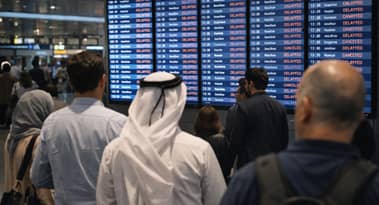

- Iran strikes on US bases trigger unprecedented Gulf-wide airspace shutdown.
- Emirates, Qatar Airways and Etihad halt services, stranding thousands.
- Disruptions to global “superconnector” hubs threaten wider travel, trade flows.
Civil air traffic over the Persian Gulf collapsed within hours on Saturday after Iran’s retaliatory strikes on US bases prompted an unprecedented shutdown of one of the world’s busiest aviation corridors.
What began as diversions and holding patterns quickly came to a full stop, as authorities closed airspace over key routes and regional carriers froze operations.
At Dubai International Airport, the world’s busiest international hub, departure boards that initially flashed rolling delays soon flipped to “cancelled” en masse as Emirates and other airlines suspended flights.
The carrier, which has built its brand on near‑clockwork reliability even through the pandemic and regional flare‑ups, said it would halt all services until 3 a.m. Sunday, calling the move the only viable response to the deteriorating security picture.
Qatar Airways followed suit in Doha, pausing operations until midnight, while Abu Dhabi‑based Etihad Airways extended its suspension into Sunday afternoon.
The decisions effectively shut down the Gulf’s “superconnector” model, which links cities across Europe, Asia, Africa and the Americas via giant long‑haul fleets funnelled through Dubai, Doha and Abu Dhabi.
Inside Dubai’s terminals, the impact was immediate.
Check‑in halls that usually process thousands of passengers in minutes using biometric gates and automated controls turned into holding pens for stranded travellers.
Smart e‑gates were shuttered, pushing crowds toward manual immigration desks as lines snaked through departure areas.
Some passengers rushed back toward the city in search of hotel vouchers, while others were told around 4 p.m. that all operations had stopped and they needed to leave the airport altogether.
The disruption was not confined to the Gulf’s main hubs. Kuwait’s civil aviation authority reported that a drone hit the country’s main airport, causing several light injuries and “limited” damage to a passenger facility, underscoring the physical risks that forced aviation authorities to act.
Lebanon’s decision to close its airspace led to similar scenes of confusion and fatigue in Beirut, where crowds built up at Rafik Hariri International Airport as cancellations mounted.
The shockwaves extended into the skies as well as on the ground.
Some travelers who believed they had escaped the shutdown saw their aircraft forced to turn back mid‑route when the airspace ahead was deemed too dangerous.
An Emirates Airbus A380 superjumbo bound for San Francisco diverted back to Dubai, leaving the airline with aircraft and crews out of position and compounding the operational complexity facing schedulers.
The Gulf region has grown used to tactical reroutings over the past two years, as conflicts and tensions imposed restrictions over swaths of the Middle East.
Airlines have already been forced to cancel profitable services, burn more jet fuel on longer routings and overfly countries they would typically avoid, including Afghanistan, to steer clear of higher‑risk skies.
But executives and analysts said Saturday’s sweeping, multi‑hub shutdown for many hours was without precedent, highlighting the stakes in the confrontation pitting Iran against Israel and the US.
Doha’s Hamad International Airport, which normally handles about 1,000 flights a day, saw scenes reminiscent of June last year, when earlier Iranian strikes on Qatar left some 20,000 passengers stranded.
With Emirates, Qatar Airways and Etihad commanding some of the largest wide‑body fleets in the world and serving more than a hundred airlines’ worth of connecting traffic through their hubs, the Gulf shutdown threatens ripple effects far beyond the region.
Extended closures or repeated disruptions could snarl cargo flows, upend schedules on distant continents and raise costs for airlines already navigating volatile fuel prices and capacity constraints.
For now, carriers and regulators are walking a tightrope between safety imperatives and the need to restore a critical artery of global connectivity.
How quickly they can reopen the skies — and whether further military action forces fresh closures — will help determine how long the world’s travelers and supply chains remain hostage to the latest Middle East flashpoint.

Here’s the top reasons why the Kospi Index is falling today

Lululemon stock forecast: why it may crash below $100 soon

Lloyds share price flashes diamond reversal, bearish divergence: what next?

The succession and strategy questions facing Tata Sons as N Chandrasekaran resigns

Nikkei 225 Index bullish flag forms as SoftBank, Kioxia, Nintendo stocks jump
No results found
Loading articles...
Failed to load articles. Please try again.