
Brent crude price analysis: Is the market being too complacent?

AI Sentiment: 62/100 Bullish
This score is generated through AI-driven analysis of the article's content.

powered by

Buy UKOIL (Brent futures/ETN) for a push through $90 toward $100. The article flags real supply-risk catalysts (Hormuz slowdown, Bab al-Mandab blockade risk, possible Fujairah port disruption) while inventories are already tight (US ~25 days; SPR at the lowest since the 1980s). Technicals also support continuation: above the 50-day MA, PPO > 0, bullish pennant/upper breakout setup.
Key Risk: A rapid de-escalation that restores shipping lanes and prevents port/strait disruptions, collapsing the risk premium.
Sell USOIL (WTI futures/ETN) versus Brent (i.e., short USOIL outright or express as a Brent-WTI long). The news is Middle East/Red Sea/Hormuz heavy, which tends to hit global seaborne flows and Brent more than WTI. With inventories tight, the market can still price a bigger premium for Brent if the bottlenecks persist, widening the Brent-WTI spread.
Key Risk: WTI catches up because US supply tightness or domestic demand shocks dominate the spread, erasing the relative advantage for Brent.
- Brent crude oil price has remained under pressure in the past few days.
- Tensions in the Middle East and in Russia have escalated.
- There are signs that market participants are getting complacent.
Brent crude oil price has struggled to break above the key resistance level at $90, even as geopolitical tensions in the Middle East continue to escalate. It was trading at $88.50 on Tuesday, a few dollars below its intraday high on Monday. This raises an important question: Is the oil market becoming too complacent about the growing geopolitical risks?
Crude oil price wavers as tensions rise
There are signs that the market is becoming complacent about the energy market as risks rise. The US launched the tenth wave of attacks against Iran overnight, with Iran retaliating by targeting US bases in Kuwait and Bahrain.
At the same time, shipping through the Strait of Hormuz has slowed as attacks on commercial vessels have intensified. Overnight, a tanker attempting to transit the strategic waterway was reportedly struck by an "unknown projectile."
The growing security risks could discourage shipping companies and their crews from using the narrow passage, through which roughly 20% of the world's oil supply flows.
Worse, there is a risk that diplomacy will not work out this time. Top negotiators are pushing for a new ten-day ceasefire even as President Donald Trump increases the number of F-16, F-35, and refueling planes in the region.
According to Axios, President Trump is weighing two options. The first is to give diplomacy another chance in an effort to de-escalate the conflict. The second is to launch a much larger military offensive alongside Israel to force Iran to capitulate.
The challenge, however, is that the initial wave of attacks appears to have hardened Iran's resolve rather than compelling it to back down.
Houthis have launched a Saudi Arabia blockade
Meanwhile, there are signs that the crisis is expanding in the region. Ansah Allah, commonly known as Houthi, has announced a blockade against Saudi Arabian ships crossing the Bab al-Mandab Strait. If this blockade is successful, it will affect millions of barrels of oil that pass through the strait.
At the same time, Professor John Mearsheimer, a top American political scientist, has warned that Iran may decide to destroy the Fujairah port. Such a move would affect over 1.7 million barrels of oil per day.
All this is happening at a time when the crisis between Ukraine and Russia is escalating. Ukraine has launched attacks against many Russian oil ships, refineries, and storage facilities. A recent report showed that over 135 million barrels of Russian oil was stranded at sea as strikes by Iran continue.
Meanwhile, the world’s oil inventories have dived in the past few months and have reached at alarmingly low levels. The current US inventories can last the country about 25 days, while Strategic Petroleum Reserves (SPR) have dwindled to the lowest level since the 1980s.
Brent crude oil price technical analysis
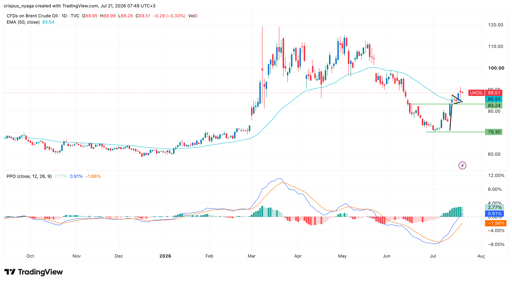
Crude oil price chart | Source: TradingView
The daily chart shows that Brent, the global benchmark, has jumped from this month’s low of $70.30 to a high of $91. This rebound has lost momentum, a sign that investors are either complacent or that it is hoping for a breakthrough.
On the positive side, the Percentage Price Oscillator (PPO) has moved above the zero line and is pointing upwards. Also, the price has moved above the 50-day moving average and the upper side of the bullish pennant pattern.
Therefore, the price will likely continue doing well in the coming weeks. If this happens, the next key target to watch will be the psychological level of $100.

Crude oil prices retreat: Brent, WTI slip even as rebound risks persist

Kospi Index at a crossroads as Samsung, SK Hynix leverage bets reverse

Is it a golden opportunity to buy ServiceNow stock as a rare pattern nears?

Adobe stock analysis: Golden cross pattern takes shape ahead of earnings

Rubrik stock drops as gross margin slips: Is the selloff a buying opportunity?
No results found
Loading articles...
Failed to load articles. Please try again.