
Movement (MOVE) files for Chapter 11 as $141.4M in funding fails to prevent collapse

AI Sentiment: 8/100 Bearish
This score is generated through AI-driven analysis of the article's content.

powered by

SELL MOVE. Chapter 11 at the core developer level plus near-zero on-chain fees/app revenue means the token has no near-term cash-flow support. With MOVE down ~99% and trading near all-time lows, any “restructuring hope” is already priced, while dilution/overhang risk remains. Key risk: Move Industries’ separate entity actually delivers real traction (sustained app revenue/fees) and the market re-rates MOVE sharply despite the bankruptcy.
Key Risk: Move Industries proves the ecosystem can generate real, sustained on-chain revenue, forcing a token re-rating.
SELL MOVE perpetuals (or short MOVE vs USDT). Use the bankruptcy headline as a catalyst for continued volatility and downside drift: weak usage metrics + legal/governance baggage typically keep liquidity thin and rallies sold. Perps also capture funding/volatility pressure as traders chase exits. Key risk: A credible restructuring plan or major exchange/market-maker support triggers a sharp squeeze higher that outpaces fundamentals.
Key Risk: A credible restructuring deal or liquidity support sparks a short squeeze that overwhelms the weak fundamentals.
- Movement Labs raised $141.4M despite weak network activity.
- Daily on-chain fees have dropped to just $1.
- MOVE token now trades just above its all-time low.
Movement MOVE is facing one of the biggest setbacks in its short history after Movement Labs, the company behind the blockchain project, filed for Chapter 11 bankruptcy in the United States.
The bankruptcy filing comes after months of declining network activity, governance issues, and a sharp drop in the token's value.
Despite raising more than USD 141 million (approx. $205.5 million) from investors, the project failed to build enough on-chain demand to support its long-term growth.
The bankruptcy filing has added to the pressure on MOVE token, which is now trading close to its all-time low after losing more than 99% of its value from the record high reached in December 2024.
Movement Labs enters Chapter 11 after months of financial strain
Movement Labs filed for Chapter 11 bankruptcy protection in the US Bankruptcy Court for the District of Delaware under Subchapter V, a restructuring process designed for qualifying small businesses.
Court documents show that the company listed assets between $100,001 and USD 1 million (approx. $1.5 million), while liabilities were estimated at between USD 1 million (approx. $1.5 million) and USD 10 million (approx. $14.6 million).
The filing also indicated that the company has between 200 and 999 creditors, highlighting the scale of its financial obligations.
The bankruptcy marks a significant turning point for a project that had attracted strong investor interest during its early stages.
Movement Labs raised a combined USD 141.4 million (approx. $206.1 million) in funding, but that financial backing did not translate into sustainable ecosystem growth.
Move Industries continues operations despite bankruptcy filing
The Chapter 11 filing applies to MVMT Labs, the original developer behind the Movement blockchain.
However, Move Industries has stated that it is a separate legal entity and is not included in the bankruptcy proceedings.
According to Torab Torabi, Chief Executive Officer of Move Industries, the company continues to operate independently and remains focused on developing the ecosystem.
You may have seen the news about the Chapter 11 filing by MVMT Labs, Inc. on July 15th.
— Torab (@torabyou) July 21, 2026
Two things worth saying clearly:
1 - MVMT Labs, Inc. is a separate legal entity, and Move Industries is not part of that filing.
2 - Move Industries is operating normally.
We continue to…
Move Industries has also shifted its strategic direction toward stablecoin payments and cross-border payment infrastructure, particularly for emerging markets.
The company has indicated that development work will continue despite the financial restructuring involving Movement Labs.
Weak network activity overshadowed significant fundraising
While Movement Labs secured more than USD 141.4 million (approx. $206.1 million) in funding, the blockchain struggled to generate meaningful economic activity.
Data from the network showed that daily application revenue remained below $800 since November.
At the same time, daily on-chain fees stayed in the single digits for months, with only $1 recorded over the most recent 24-hour period.
Those figures reflected limited user activity despite the project's substantial financial backing, and the Movement (MOVE) token's valuation has also fallen sharply.
MOVE currently has a fully diluted valuation (FDV) of approximately USD 106.3 million (approx. $154.9 million), compared with an all-time high token price of $1.45 reached on December 9, 2024.
Notably, the MOVE token launch was followed by controversy surrounding a market-making agreement, investigations into token sales, legal disputes involving former co-founder Rushi Manche, and actions taken by Binance against a related market-making account.
The token has since lost more than 99.3% of its value.
At the time of writing, MOVE is changing hands at around $0.01063, after falling 1.9% over the previous 24 hours.
During that period, the token traded between $0.01062 and $0.01094, remaining only slightly above its all-time low of $0.01043, which was recorded on July 20, 2026.
MOVE token under pressure after losing more than 99%
MOVE has fallen 94.1% over the past year, 10.1% over the last 30 days, and 6.3% during the past two weeks.
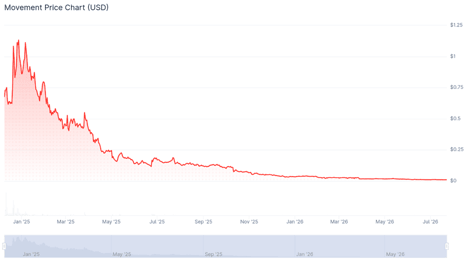
Over the previous seven days, the token declined 1.7%, while the latest 24-hour session recorded another 1.9% loss.
The combination of weak network usage, declining token value, governance challenges, and the Chapter 11 filing has placed the project under intense scrutiny.
Although Move Industries has confirmed that it will continue operating independently, the market is now closely watching whether the ecosystem can rebuild activity after one of the most significant corporate setbacks in the project's history.

Why is Bitcoin price struggling around $80,000?

Zcash price breaks above $1,000 as institutional and privacy demand rise

Is XRP quietly building toward $1.90 as macro pressure eases and demand holds?

Bitcoin price defends $80,000 as bulls prepare another run at $82,000

Strategy, Coinbase stocks rally as Bitcoin reclaims $80,000
No results found
Loading articles...
Failed to load articles. Please try again.