
Micron stock gains 8% as BofA reiterates Buy, says memory pricing power intact
AI Sentiment: 78/100 Bullish
This score is generated through AI-driven analysis of the article's content.

powered by

Buy MU. BofA’s case is that AI-driven demand is still rising (hyperscalers spending up, GPU rental rates near record highs, no signs memory availability is limiting deployments) and that the sell-off is positioning for a future supply/price normalization, not a demand break. Valuation also looks too low versus bear-case EPS, with long-term supply agreements expected to dampen price swings. Key risk: DRAM/NAND pricing collapses faster than expected (mid-2027/2028 supply hits early or demand slows), crushing earnings power even if AI capex stays strong.
Key Risk: DRAM/NAND prices fall sharply sooner than expected, wiping out Micron’s earnings even with AI demand intact.
Buy SMH. MU’s move is a signal that the market is re-rating the whole memory/AI infrastructure complex as “pricing power intact,” not “cycle top.” If hyperscaler AI spending keeps accelerating, investors will rotate into the highest-conviction beneficiaries across the memory supply chain, lifting the ETF even if MU-specific headlines cool. Key risk: A broad risk-off move hits semis (rates spike or AI capex expectations reset), pulling SMH down regardless of memory fundamentals.
Key Risk: A market-wide selloff in semiconductors (risk-off or AI capex expectations reset) overwhelms memory-specific positives.
- Micron shares climbed over 8% as BofA reiterated a Buy rating with a $1,550 PT.
- AI-driven demand and hyperscaler spending continue to support memory pricing.
- BofA said CXMT is still not a threat as it primarily serves commodity DRAM.
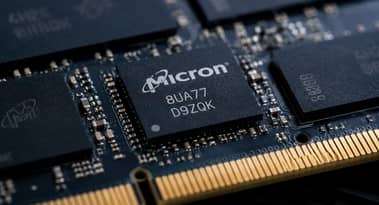
Micron Technology shares MU surged more than 8% on Tuesday after Bank of America reaffirmed its bullish stance on the memory-chip maker, arguing that the recent weakness in semiconductor stocks presents an "enhanced buying opportunity" rather than a deterioration in the company's long-term outlook.
The rally also reflected improving sentiment across Wall Street, with the S&P 500 climbing about 1.5% to a fresh record after upbeat earnings from companies including Palantir Technologies and Caterpillar, while easing oil prices further boosted investor appetite for risk assets.
The brokerage maintained its Buy rating on Micron and reiterated a price target of $1,550, implying more than 72% upside from current trading levels.
AI demand remains the key driver
In a note to clients, Bank of America analyst Vivek Arya said investors have become overly focused on the possibility of future pricing pressure in the memory market, even though current fundamentals continue to improve.
Arya acknowledged that memory prices and profit margins are likely to normalize eventually as additional supply enters the market between mid-2027 and 2028.
However, he argued that the recent sell-off reflects investor positioning ahead of a potential downturn rather than any meaningful deterioration in demand.
"Hyperscaler spending continues to rise despite higher component costs, suggesting semis/memory pricing power," Arya wrote.
According to the brokerage, the ongoing wave of artificial intelligence investments by major cloud providers continues to support demand for advanced memory products, particularly high-bandwidth memory used in AI servers.
Bank of America also noted that GPU rental rates remain close to record highs, while none of the major hyperscale cloud companies has indicated that memory availability is limiting AI deployments.
That, Arya said, suggests pricing power across the semiconductor memory industry remains intact.
Earnings outlook remains resilient
The brokerage's bullish thesis is underpinned by its earnings expectations.
Bank of America projects Micron could generate earnings per share of roughly $150 in fiscal 2028.
Even under a bearish scenario in which DRAM and NAND prices decline in line with previous industry downturns, the brokerage believes earnings could still remain near $100 per share.
That would be substantially higher than Micron's previous cycle peak of around $12 per share recorded in 2018.
According to the brokerage, the stock is currently valued at only about eight to nine times its projected bear-case earnings, suggesting investors are assigning little value to the company's AI-related businesses, including its high-bandwidth memory segment.
Bank of America also pointed to the increasing use of long-term supply agreements, which it expects could eventually account for between 50% and 70% of industry capacity.
While such agreements cannot eliminate cyclical downturns, they could reduce pricing volatility compared with previous memory cycles.
China concerns seen as overdone
Micron has faced significant volatility in recent weeks as investors questioned whether aggressive AI spending by hyperscale cloud companies would eventually slow and whether rising competition from China could erode the company's market position.
Concerns intensified after Chinese memory-chip maker ChangXin Memory Technologies, or CXMT, completed its initial public offering and reports emerged that the company was considering building a second DRAM fabrication facility in Beijing.
CXMT has rapidly expanded its presence in the global memory market.
According to Counterpoint Research, the company held an 8% share of the global DRAM market in the first quarter, compared with just 3% a year earlier.
BofA argued China's CXMT is still "not a threat in AI," as it primarily serves commodity DRAM rather than high-bandwidth memory.
Samsung Electronics, SK Hynix and Micron together still account for nearly 90% of the global DRAM market and continue to dominate the advanced high-bandwidth memory segment used in AI applications.
While investors remain wary of future industry supply increases, Bank of America believes the current pullback has created an attractive entry point for long-term investors betting on continued AI infrastructure spending and sustained demand for advanced memory chips.
Micron stock surged after Bank of America reaffirmed its Buy rating, citing strong AI demand, a resilient earnings outlook, and limited threat from China's CXMT.

HPE stock declines 8% on Monday: here's why

Netflix stock rises as Evercore raises price target to $110

Why Wedbush and BofA issued bullish notes on Roblox stock today

AI panic triggers a rally in CrowdStrike stock

Nvidia stock: Should investors buy the dip amid AI slowdown fears?
No results found
Loading articles...
Failed to load articles. Please try again.