
Zcash jumps 11% as Ironwood upgrade sparks powerful bullish wave

AI Sentiment: 82/100 Bullish
This score is generated through AI-driven analysis of the article's content.

powered by

Buy ZEC. Ironwood’s turnstile verification removes the “hidden inflation” discount by mathematically verifying circulating supply, while more coins migrating into long-term shielded wallets thins spot liquidity—so each incremental buy moves price more. Add the tailwinds from lower-cost mining (Fortitude’s ~60MW and cost drop) and growing demand from ZEC-collateral derivatives on Starknet (market makers must source spot). Technicals confirm: ZEC holds above key EMAs and is pushing toward $520/$537.
Key Risk: A reversal in sentiment where exchanges/market makers refuse to treat Ironwood verification as credible, causing the liquidity-thinning bid to disappear.
Buy exposure to SuperVega One-Touch Options on Starknet (or the closest liquid ZEC options product tied to that venue). Second-order effect: as open interest rises, market makers must buy and hold ZEC for collateral/hedging, creating persistent spot demand even if the initial ZEC pump cools. This turns “derivatives hype” into a mechanical spot-buy engine.
Key Risk: Options volume/open interest collapses (or collateral rules change) so market makers stop needing to source spot ZEC.
- ZEC has gained over 11% in a week and climbed above $510.
- Hype around the upcoming Ironwood upgrade is fuelling the rally.
- ZEC remains above key moving averages, positioning it for more gains.
Zcash ZEC has climbed more than 11% over the past week and reclaimed the $510 level as investors have responded to fresh catalysts.
The rally accelerated after ZEC crossed the $500 psychological level, with buyers maintaining control despite brief rounds of profit-taking.
CoinGecko data showed ZEC trading near $513 during Asian trading hours on Aug. 5 after climbing from roughly $460 over the past week.
The token has also gained more than 12% over the past month, extending its recovery from July lows.
Several developments have converged to support the latest advance.
According to the project updates surrounding the Ironwood network upgrade, the migration of more than 1 million ZEC into the new shielded pool, combined with changes in miner economics and expanding financial use cases, has changed how traders are evaluating the asset.
One of the biggest developments comes from the rollout of Ironwood's turnstile verification mechanism.
According to the project's documentation, the migration requires coins leaving the legacy Orchard pool to pass through mathematical verification before entering the new shielded pool.
The process is designed to verify the total circulating supply while sealing off the legacy pool.
Supporters of the upgrade argue that the mechanism removes one of the longstanding concerns surrounding privacy-focused cryptocurrencies: uncertainty over hidden inflation.
By introducing cryptographic verification of circulating supply, the upgrade gives exchanges, institutions, and market participants stronger assurances that every coin in circulation can be accounted for mathematically.
Market observers have argued that eliminating this uncertainty could reduce one of the valuation discounts historically applied to privacy coins.
According to the Ironwood rollout details, many users are transferring holdings directly into long-term shielded wallets rather than keeping coins on centralized exchanges.
As more ZEC leaves readily tradable order books, available spot liquidity declines.
When fresh buying enters a thinner market, price movements often become more pronounced because fewer sell orders are available to absorb demand.
At the same time, mining economics have provided another tailwind.
Digital Currency Group's mining subsidiary, Fortitude Mining, recently expanded its infrastructure after acquiring a 12.5-megawatt facility in Nebraska, lifting its owned mining capacity to more than 60 MW dedicated to ZEC.
According to the company, access to lower-cost electricity and vertically integrated operations could reduce mining costs from roughly $70 per coin to about $40.
Mining operators with lower operating expenses generally face less pressure to sell rewards immediately to cover electricity bills.
Instead, they have more flexibility to retain part of their production, reducing the amount of newly mined ZEC reaching spot markets each day.
The expansion also includes additional Antminer Z15 Pro hardware, which increases network hash rate.
While higher computational security does not directly raise token prices, it strengthens confidence in the Proof-of-Work network and demonstrates continued institutional investment in Zcash mining infrastructure.
Demand is also coming from new financial products built around the network.
According to ecosystem updates tied to the Ironwood release, ZEC-backed derivatives such as SuperVega One-Touch Options on Starknet require market makers to acquire spot ZEC for collateral and hedging activities.
As open interest grows, those hedging requirements can generate additional buying in the spot market.
Beyond derivatives, merchant adoption is expanding the asset's utility.
Privacy infrastructure provider Nym has integrated native Ironwood ZEC payments, allowing the token to be used directly within payment flows instead of serving only as a speculative investment.
Increased transactional use introduces another source of organic market demand alongside trading activity.
ZEC price analysis
Recent price action suggests buyers are still in control, with both the 4-hour and daily charts continuing to support the latest breakout above $500.
On the 4-hour chart, ZEC has maintained a pattern of higher highs and higher lows since rebounding from its late-July pullback.
See below:
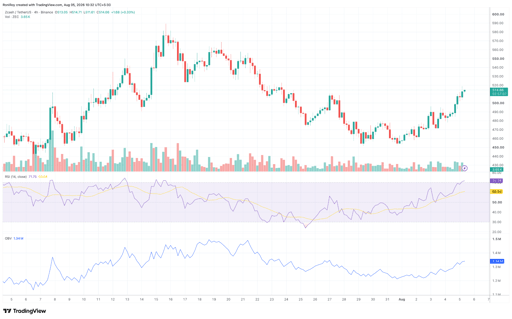
ZEC/USDT 4-hour price chart. Source: TradingView.
After reclaiming the $510-$515 area, the token has continued attracting buyers instead of giving back gains, indicating demand has remained intact following the breakout.
Momentum has strengthened alongside the move. The Relative Strength Index has climbed to around 71.8, placing it in overbought territory, while the On-Balance Volume (OBV) continues to trend higher.
Although an RSI above 70 can precede short-term consolidation, the rising OBV shows the rally is still being supported by sustained buying rather than fading participation.
The daily chart reinforces the same trend. ZEC remains above its 20-day, 50-day, 100-day, and 200-day exponential moving averages, with the short-term averages stacked above the longer-term ones.
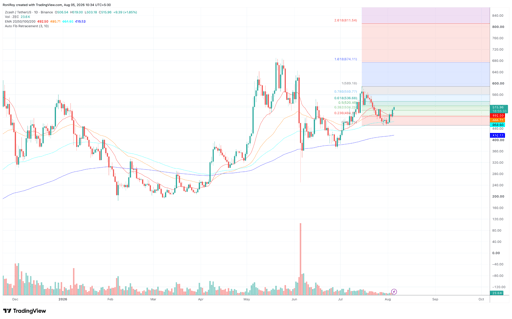
ZEC/USDT 1-day price chart. Source: TradingView.
This alignment points to bullish momentum across multiple timeframes instead of a rally driven only by short-term traders.
Price has also reclaimed the 0.382 Fibonacci retracement level near $504 and is now testing the 0.5 retracement around $520, an area that could determine whether the current advance extends further.
A move above that level would place the 0.618 Fibonacci retracement near $537 in focus, followed by the 0.786 level around $560.
If buying pressure remains intact beyond those resistance zones, the previous swing high near $598 would become the next technical hurdle.
On the downside, the moving averages continue to provide nearby support.
The 20-day EMA around $492 and the 50-day EMA near $487 are the first levels to watch if profit-taking increases, while the 100-day EMA around $465 sits close to the area where the current rally began gathering momentum.

Why is Injective price up 45% this week?

Polygon price erupts 50% as POL breakout sparks fresh $0.14 target

Ethereum price prediction: golden cross forms as ETF, staking inflows jump

Bitcoin rockets past $80K but one technical warning could spoil the breakout

XRP price prediction as Crypto Fear and Greed Index hits 83
No results found
Loading articles...
Failed to load articles. Please try again.