
Here’s why Kioxia stock is in a bear market despite the strong revenue, profit growth
AI Sentiment: 62/100 Bullish
This score is generated through AI-driven analysis of the article's content.

powered by

Buy Kioxia. The article shows NAND/SSD supply is sold out for this year and revenue/profit momentum is accelerating (big QoQ/YoY jumps). The stock is also already washed out near the 200-day moving average, with a clear upside path toward ¥75,000 if the dip-bounce plays out. Stock split (3-for-1) plus a buyback supports demand at lower prices.
Key Risk: Memory pricing turns down fast and the “sold out” supply turns into excess inventory, crushing margins and making the cycle fear come true.
Sell memory-exposed upside and rotate to cash/defensives: short or underweight Micron (MU) and other memory-heavy names (e.g., AMD’s memory exposure, and storage/servers like Super Micro Computer). The news is bullish, but the stock action across memory is still in a bear market—meaning the market is pricing the next downturn risk. If the cycle rolls over, these names typically fall harder than the broader market.
Key Risk: AI capex stays elevated longer than expected and memory pricing holds, letting the whole group re-rate upward despite cycle fears.
- Kioxia Holdings stock has dived into a bear market this year.
- The sell-off mirrors that of other memory companies.
- There are concerns about the cyclical nature of the memory industry.
Kioxia Holdings stock has suffered a big reversal this year, moving from a high of ¥112,750 in June to the current ¥49,280. This retreat happened despite its strong revenue and profit growth, and mirrors the performance of other memory companies. So, is it safe to buy the dip or sell the rip?
Kioxia Holdings’ business is thriving
Memory companies are all thriving this year as the artificial intelligence boom gained steam. Recent reports by top companies like Microsoft, Google, and Meta Platforms showed that their capital spending has more room for growth. It is estimated thar the top four big spenders will allocate over $750 billion in capital spending this year.
Kioxia, a top provider of NAND memory to companies like Apple, Dell, and Microsoft, is thriving, with its supply for this year being sold out. It also has a long-term relationship with SanDisk, which published strong financial results on Wednesday.
The most recent results showed that the company’s revenue growth was gaining momentum, even as its profit came short of expectation. Its revenue jumped by 78% QoQ and 415% YoY to ¥1.76 trillion.
The results also showed that its operating profit jumped by 121% from the previous quarter and by 2,833% from the same period last year. This figure came in at ¥1.32 trillion, while the non-GAAP net income soared by 4,692% to ¥887 billion.
Most of this revenue came from its SSD and storage solutions, followed by its smart devices business. Its data center revenue boomed, which helped to cushion the softness in the PC business.
Looking forward, the management expects that the momentum will continue. Precisely, it expects the revenues to come in at ¥2.39 trillion, with the profit before tax rising by 45.6% QoQ to ¥1.88 trillion.
Why Kioxia is falling
The company has also made some measures to boost the stock price. It will split its stock 3 to 1, a change that will happen on October 1. Also, the company launched its share buyback plan, that will see it reduce the outstanding shares by 30 million.
These numbers are strong turnaround for a company that was on the verge of collapse a few years ago. The Japanese government and Western Digital provided it with $1.64 billion in 2022 to keep its operations afloat.
One reason Kioxia and other memory stocks have slumped is growing concern that the industry could face a repeat of the downturn seen in 2022. The memory chip market is highly cyclical, with periods of strong demand and soaring prices often followed by sharp downturns.
During the last major bust, in 2023, most memory companies reported revenue declines of more than 50% as excess supply and weak demand weighed heavily on the industry.
Kioxia and other companies are using the long-term agreement (LTA) strategy to prevent this from happening. It has inked several LTAs that set a floor and ceiling for their memory prices.
Kioxia stock technical analysis
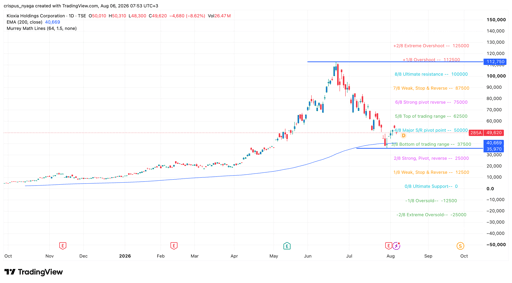
Kioxia stock chart | Source: TradingView
The daily chart shows that the Kioxis Holdings stock has dived in the past few months, moving from the year-to-date high of ¥112,750 to the current ¥49,660. The current price is along the Major S/R pivot point of the Murrey Math Lines.
It also bottomed at the 200-day moving average. Therefore, there is a likelihood that the stock will bounce back in the near term as investors buy the dip. If this happens, it will likely jump to the strong pivot reverse level of the Murrey Math Lines tool of ¥75,000. A drop below the support of ¥35,970 will invalidate the bullish outlook.

SpaceX stock is down around 1% today, but analysts remain strongly bullish

Why is Alphabet stock down today?
BofA warns of another 10% decline in chip stocks

Scotiabank stock has soared to a record high after earnings: more upside?
Oklo stock analysis: Is it a buy or sell as insiders continue selling?
No results found
Loading articles...
Failed to load articles. Please try again.