
Intel eyes a memory comeback: why the timing matters for Micron stock

AI Sentiment: 72/100 Bullish
This score is generated through AI-driven analysis of the article's content.

powered by

Buy MU. Persistent DRAM/NAND tightness through 2027 plus AI-driven bandwidth demand is already lifting pricing (HBM4/4E up sharply; DRAM/NAND sequential gains cited). Micron’s multiyear customer agreements (incl. Anthropic) make the boom more durable and reduce demand/price whiplash. Intel’s comments don’t change near-term competitive reality because a serious memory return needs time, capital, and scale.
Key Risk: Intel (or another new entrant) rapidly scales advanced memory/packaging and forces HBM/DRAM pricing down faster than 2027 expectations.
Buy NVDA. Second-order: if AI systems face a memory bottleneck, the winners are the platform builders that can sell more AI compute while customers scramble for memory capacity. Strong HBM pricing and tight supply typically increase the value of each shipped GPU/accelerator (more demand per unit of memory-constrained system). Intel’s packaging push reinforces that compute-memory integration is the direction, which keeps NVDA’s ecosystem demand strong.
Key Risk: AI customers slow GPU/accelerator purchases because memory supply constraints cap system builds, reducing NVDA unit demand despite strong pricing.
- Intel is exploring new memory architectures as AI reshapes chip economics.
- Micron still holds a strong lead in HBM, scale and customer relationships.
- Analysts see tight DRAM and NAND supply supporting prices well through 2027.
Intel is reconsidering a business it spent decades leaving as artificial intelligence transforms memory from a commodity into a crucial computing bottleneck.
CEO Lip-Bu Tan said on the TechSurge: Deep Tech podcast that Intel is exploring new memory architectures, including ways to bring memory and processors closer together.
Tan said he once viewed memory as a commodity business not worth investing in but believes the economics have changed.
Intel has not announced a new DRAM, NAND or HBM product. The comments matter for Micron stock investors because they arrive during shortages, rising prices and AI-driven demand.
Intel returns when memory economics have changed
Tan’s interest comes as memory profitability looks unusually strong.
KeyBanc analyst John Vinh said “memory shortages remain persistent,” after supply-chain checks in Asia.
The firm expects tight conditions through 2027, with DRAM prices rising another 15%-20% sequentially in the third quarter and 15% in the fourth. NAND prices could jump 30%-40% in the third quarter before another 15% increase.
That helps explain why Intel is looking again.
AI systems increasingly depend on moving huge quantities of data quickly between processors and memory.
That has made bandwidth, packaging and memory capacity strategic constraints for AI systems.
Intel also hired former SK Hynix chief executive Seok-Hee Lee in June to lead advanced packaging and system integration at Intel Foundry.
Lee will help tightly couple logic, memory, networking and other components in next-generation systems, the company said.
His appointment is not evidence of a new memory division, but it strengthens Intel’s expertise where compute and memory are converging.
Micron’s head start will be difficult to close
For Micron, the immediate competitive threat still looks limited.
Oppenheimer analysts, cited by Barron’s, said a serious Intel return to memory would require fresh capital, significant research and development and, crucially, time. That makes a major near-term challenge unlikely.
Meanwhile, Micron is benefiting from tightening high-bandwidth memory supply. UBS analyst Timothy Arcuri said HBM4 and HBM4E pricing was “even stronger than our prior expectations.” UBS expects HBM average selling prices to rise about 79% year on year.
Micron is also trying to make the current boom more durable. The company says multiyear strategic customer agreements should improve the predictability of its financial performance.
Its June agreement with Anthropic spans memory and storage architecture design, supply and AI infrastructure development.
Mizuho analyst Vijay Rakesh remains bullish too. Barron’s reported that Rakesh expects DRAM and NAND markets to stay tight through 2027 and believes Micron could sustain gross margins above 80%.
Intel can decide it wants exposure to memory, but recreating Micron’s manufacturing scale, HBM expertise and customer relationships is another matter.
The threat is longer-term, not immediate
That does not make Intel’s interest irrelevant.
High memory prices are attracting capital across the industry. Chinese producers are also expanding.
YMTC overtook Micron in NAND shipment volume during the second quarter, although Micron remained ahead by revenue because its product mix carries greater value.
Intel potentially represents a different competitive risk. Tan appears interested in architectures that integrate processing and memory more closely rather than simply returning to commodity NAND.
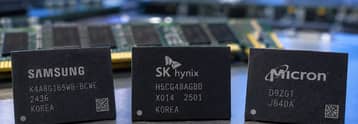
DRAM ETF gained 18% last month: can it continue its outperformance

UBS sees two Fed hikes in 2026: what should investors buy

Broadcom stock: Why the AI chipmaker’s growth story is gaining steam

Is Oracle stock a buy before earnings as analysts turn bullish?

Apple to release folded iPhone this week: what to expect
No results found
Loading articles...
Failed to load articles. Please try again.