
Celestica stock has dropped to a crucial support: what next for the shares?

AI Sentiment: 28/100 Bearish
This score is generated through AI-driven analysis of the article's content.

powered by

Sell CLS. The stock broke below $450 support and RSI is ~40 (not oversold), so the chart still allows another leg down toward $300. Fundamentals are improving (AI-driven revenue/margins), but the $3B common offering creates real dilution that can keep per-share momentum weak even if the business grows. Bears stay in control while price is under the 50-day EMA.
Key Risk: CLS reclaims $470 and holds it—signals the dilution scare is over and the downtrend is reversing.
Sell CLS on a valuation-compression thesis: forward P/E ~26 vs sector ~22 and 5-year ~18.3. Even with growth, the market is likely to keep rerating the stock lower until dilution is absorbed and the market stops demanding a premium for AI hardware/network exposure.
Key Risk: Management delivers a clear, dilution-neutral path (guidance/per-share metrics) that forces the market back to a premium multiple.
- Celestica stock has slumped into a bear market this month.
- The company recently announced a $3 billion cash raise.
- There are concerns about its elevated valuation.
Celestica stock has slumped and moved into a bear market this month as traders react to its earnings report and a major dilution event. CLS tumbled to C$407, down by nearly 40% from its highest point this year. This retreat may continue in the near term as focus remains on the ongoing AI growth.
Celestica stock technical analysis points to more downside
The daily chart shows that the CLS stock has been in a strong downward trend after peaking at $656 in June this year. It has recently dropped below the important support level of $450, while the Relative Strength Index (RSI) has dropped from 76 to the current 40, its lowest level since July 24. That is a sign that the stock is not yet oversold, suggesting more downside is possible.
Celestica has also dropped below the 50-day Exponential Moving Average (EMA), a sign that bears remain in control for now. Therefore, the stock will likely continue falling in the near term. If this happens, the next key level to watch will be at $300. A move above the key resistance level at $470 will invalidate the bearish outlook.
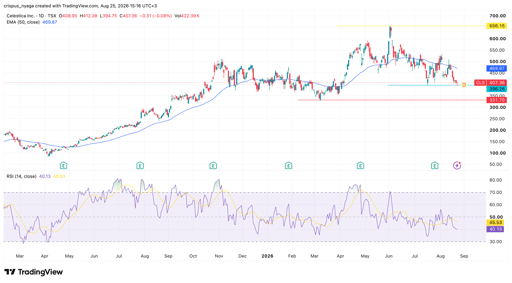
Celestica chart | Source: TradingView
Celestica is doing well, but dilution is a concern
The most recent numbers showed that Celestica’s revenue continued growing, helped by the ongoing AI boom. Its revenue jumped by 62% to $4.70 billion, much higher than the guidance of between $4.15 billion and $4.45 billion. This growth is also happening at a time when the adjusted operating margin is growing, reaching a high of 8.2%.
Most of the revenue came from its Connectivity and Cloud Solutions (CCS) segment, which designs and manufactures high-tech hardware, network infrastructure, and data center equipment. This segment made $3.8 billion in revenue, with its ATS business making $888 million.
Celestica’s business is expected to keep growing, with management boosting its forward estimate for the year from $19 billion to $20.5 billion. Analysts expect the company’s revenue to jump by 66% to $20.57 billion, followed by $35 billion next year.
The company’s profits are also continued to grow. Its EPS is expected to jump from $6.05 to $11.22 this year, followed by $19.48 per share.
This growth will likely continue in the coming months as its top clients like Alphabet, Microsoft, and Amazon have pledged to keep spending this year. Combined, these companies plan to spend over $750 billion in capital expenditure this year.
Still, there are concerns about the company’s valuation and its recent cash raise. The company raised $3 billion in a common stock offering, a move aimed at helping it fund its investments. Raising these funds led to more dilution among existing shareholders.
Celestica is also relatively expensive compared to its peers. It trades with a forward price-to-earnings ratio of 26, higher than the sector median of 22 and its five-year average of 18.30. Still, its strong revenue and earnings growth may help to justify its valuation.

SpaceX stock has stalled: here’s why it may rebound to a record high soon

Bloom Energy stock jumps after Nancy Pelosi reveals new position: is BE a buy?

Why are Micron and SanDisk bouncing back after Monday’s memory rout?

Nasdaq futures soar over 300 points: 5 things to know before Wall Street opens

Options traders brace for a $280B swing in Nvidia stock after earnings: what it means
No results found
Loading articles...
Failed to load articles. Please try again.