
US jobs rebound in August with 162,000 payrolls increase: is a Fed rate hike coming?

AI Sentiment: 25/100 Bearish
This score is generated through AI-driven analysis of the article's content.

powered by

Buy: go long 2Y Treasury futures (or buy TLT/IEF duration via futures/ETFs) because the jobs rebound raises the odds of a near-term hike, but the report also shows wage growth is the sore spot and consumption pressure is building—so the Fed likely hikes, then quickly hits the brakes as inflation fails to re-accelerate. This sets up a “hawkish now, dovish later” curve move.
Key Risk: CPI comes in hot and wages re-accelerate, forcing the Fed to stay restrictive longer and pushing 2Y yields higher.
Sell: short the S&P 500 via SPY (or short Nasdaq-100 via QQQ) because higher yields from stronger payrolls tighten financial conditions immediately, and the market is already pricing a ~60% hike. Even if the Fed eventually turns, equity multiples compress first on the hike probability shock.
Key Risk: Inflation cools fast in CPI and the Fed signals no hike, causing yields to fall and reversing the multiple compression.
- US nonfarm payrolls rose by 162,000 in August, well above the 53,000 forecast.
- July employment was revised from a 23,000 decline to a 21,000 increase.
- Stronger jobs data boosted Treasury yields and raised expectations for a potential Fed rate hike.
The US economy added a significant number of jobs in August, reversing a summer slowdown in hiring and reinforcing the likelihood of a rate hike from the Fed this month.
Nonfarm payrolls increased by a seasonally adjusted 162,000 last month, the Bureau of Labor Statistics said Friday, sharply exceeding the 53,000 gain economists surveyed by Dow Jones had expected.
The unemployment rate held steady at 4.1%, in line with expectations.
August marked the strongest monthly increase in employment since March and offered a more encouraging picture of the labor market after a period of weakening job growth.
The report could complicate expectations around the Federal Reserve’s policy path, particularly as inflation remains above the central bank’s 2% target.
People got too pessimistic after last month's report, and I guess we'll get excess optimism after today's
— Guy Berger (@EconBerger) September 4, 2026
The "totality of the evidence" is that the labor market has entered a slog/stall phase https://t.co/V4gslga3lN
"People got too pessimistic after last month's report, and I guess we'll get excess optimism after today's. The "totality of the evidence" is that the labor market has entered a slog/stall phase," said Guy Berger, US labour market expert and Director of Economic Research at the Burning Glass Institute.
Policymakers are now likely to turn their attention to next week’s Consumer Price Index report before making their final assessment ahead of the September 15-16 policy meeting.
US consumer inflation had risen modestly in July, matching economists' expectations, which had reduced the urgency for the Federal Reserve to raise interest rates this month.
July jobs figure revised sharply higher
One of the most significant developments in Friday’s report was a major revision to July employment.
The BLS said the US economy added 21,000 jobs in July, rather than shedding 23,000 jobs as previously reported.
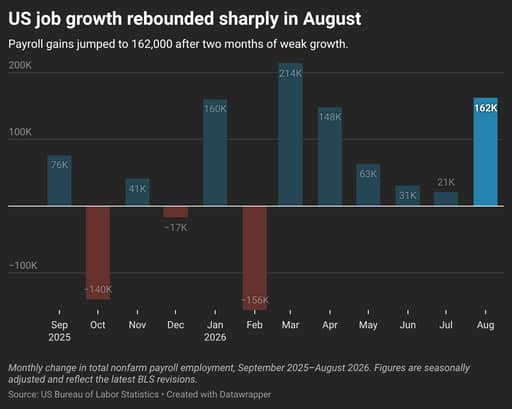
That represents an upward revision of 44,000 jobs and removes some of the concern surrounding what had initially appeared to be a contraction in employment.
Richard Carter, head of fixed interest research at Quilter Cheviot, said the August report helped ease concerns that the July decline could have marked the beginning of a more serious deterioration.
“Today’s US nonfarm payrolls report was an important test of whether July’s surprise decline in employment was the beginning of something more troubling, but with 162,000 jobs added in August, the unemployment rate holding steady at 4.1%, and July’s figure revised up to an increase of 21,000, it seems there was no need to worry."
He said the figures should provide some reassurance to Federal Reserve officials.
“The figures should offer some reassurance to Federal Reserve policymakers ahead of the meeting later this month, as a swift return to job growth supports the view that the labour market has managed to remain broadly stable despite the loss of momentum seen in recent months," he said.
Wage growth a sore spot
In August, average hourly earnings for all employees on private nonfarm payrolls rose by 10 cents, or 0.3%, to $37.75.
Over the year, average hourly earnings have increased by 3.1%
"One big sore spot in the August jobs report = wages. Wage growth is the lowest in 5 years," said Heather Long, chief economist at Navy Federal Credit Union.
She said with inflation likely to be around 3.5%, "Americans are being squeezed financially right now."
"Inflation has wiped out all wage gains since April (and March was close). Credit card debt is at a record high, savings is the lowest in years, and personal loan use is up. Consumption is almost certainly going to slow," she said.
Markets react as rate hike bets rise
Financial markets initially reacted negatively to the stronger-than-expected employment numbers, as investors reassessed the likelihood of higher interest rates.
Dow Jones opened 187 points lower, or by 0.3%, while the S&P 500 declined 0.2%. The Nasdaq Composite opened almost unchanged.
Treasury yields moved higher across the curve, with the two-year yield reaching its highest level since January 2025.
The move reflected growing expectations that the Federal Reserve could raise interest rates as soon as this month.
Traders were pricing in roughly a 60% probability of a rate hike, according to the CME FedWatch tool, following a relatively hawkish tone from Fed Chairman Warsh at the Jackson Hole Economic Symposium last month.
Still, the August jobs report alone may not determine the Fed’s September decision.
With inflation remaining the central bank’s primary concern, next week’s CPI data is likely to play a more decisive role.
Labor market remains broadly stable
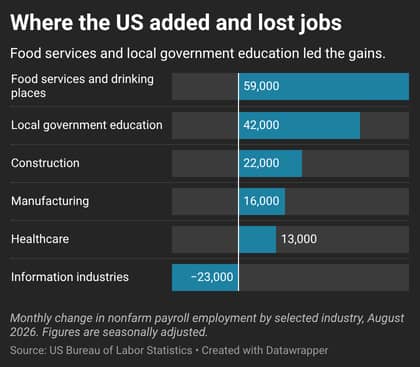
The BLS report showed employment gains in food services and drinking places and local government education, while the information sector lost jobs.
The number of unemployed people remained little changed at about 7 million, while long-term unemployment also held broadly steady at 1.9 million.
Long-term unemployed workers accounted for 27% of all unemployed people.
Despite August’s rebound, labor market momentum has slowed from its stronger pace earlier in the year.
Economists have pointed to several factors, including higher oil prices, supply-chain disruptions and the lingering effects of US trade tariffs imposed in 2025.
“Businesses felt some of the problems from 2025 were behind, then all of a sudden we get another black swan event that introduces a new set of uncertainties,” said Brian Bethune, an economics professor at Boston College, in a Reuters report published before the jobs data.
“We saw significant problems with supply chains, oil and fuel prices went up, and that situation has not changed. So that's why the job numbers have dropped from what we saw in the first few months.”
The latest figures suggest that while the US labor market has lost momentum, it has not yet shown signs of a sharp deterioration.
For the Fed, however, the next key question remains whether resilient employment is accompanied by sufficiently persistent inflation to keep interest rates higher for longer.

US jobless claims rise slightly as labor market remains in slow hire, slow fire phase

US layoffs jump 58% in August over July, but remain lowest for the month since 2022

US private payrolls rise just 38,000 in August as hiring momentum weakens: ADP

US job openings rise modestly in July but employers pull back on hiring

What the Iran war could mean for US midterm elections
No results found
Loading articles...
Failed to load articles. Please try again.