
US natural gas price analysis: The weather-driven market is coming full-circle


The US natural gas price dropped to its lowest level in two weeks, just a week after the winter storm bolstered it to a three-year high. Forecasts of milder temperatures later in February point to an ease in heating demand and supply disruptions. However, most parts of the country are still experiencing extremely cold weather. This aspect, coupled with the expected exports during Europe’s gas refill season, are set to offer some support to the asset.
Temperature forecasts erase natural gas price gains
Weather patterns have been a major driver of US natural gas prices in recent months. In mid-January, the benchmark Henry Hub futures dropped to a three-month low in response to the warmer-than-normal temperatures in most parts of the country. However, it soon rallied to a three-year high as an extreme winter storm heightened the warming demand.
Currently, extremely low temperatures in most parts of the US continue to bolster the heating demand. Besides, while production is in recovery following the winter storm-related disruptions, it is still falling short of demand. As of Friday last week, the production rate was 128.7 billion cu below the demand.
However, experts forecast milder weather later in February. In addition to lowering natural gas demand for heating, this outlook also means lesser supply disruptions.
Meanwhile, Europe is waiting for its natural gas inventory refill season. During the winter season, the amount in storage has been depleted at a faster rate than usual. According to the latest data, the amount of gas in storage in the EU was at 41.13%; significantly below its five-year average. Europe’s refilling season will likely offer some support to the US natural gas prices as it remains a key source of its LNG imports.
US natural gas price technical analysis
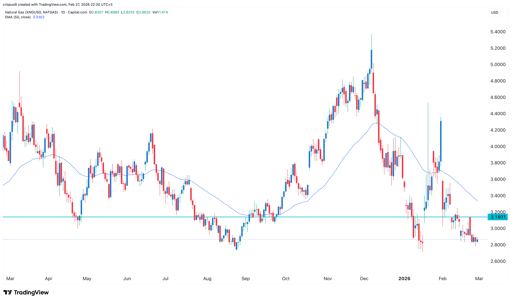
The US natural gas price has plummeted from the over three-year high reached a week ago. Earlier on Tuesday, it held close to the intraday low hit in the previous session when the prices plunged to the lowest level in over two weeks at $3.16 per million British thermal units (MMBtu). Notably, that was its highest daily decline, without considering the contract rollover days, since 1995. At the time of writing, it has rebounded slightly to $3.25.
Since hitting its three-year high at $7.44 per MMBtu, the Henry Hub natural gas futures have dropped by over 55%. While it has eased on the decline, it continues to trade below the 25 and 50-day EMAs as seen on its daily trading chart.
Notably, the two indicators seem likely to converge near the crucial zone of $4.00. That may result in the formation of the bearish death cross pattern where the short-term 25-day EMA crosses the medium-term 50-day EMA to the downside. Meanwhile, its RSI of 43 points to a slight rebound in the short term.
Based on these technical indicators, and the fundamentals, the selling pressure may curb natural gas price rebound at $4.00. In the immediate term, it may trade within a range of between the support level of $3.11 and the resistance level of $3.40.
With the entry of more dip buyers, the bulls may have an opportunity to bolster it further to $3.65. On the flip side, a further decline may activate the lower support zone of $2.95.

Crypto Market News This Week: Top Catalysts for BTC and Altcoins

Scottish Mortgage stock: SpaceX presents a risk, but Anthropic offers relief

Hormuz reopening lifts sentiment, but analysts see months before trade recovery

WTI crude oil price forecast after the US-Iran deal and the key risk

Silver price forecast: XAG/USD jumps 4% as oil slump revives bulls
No results found
Loading articles...
Failed to load articles. Please try again.