
LNG crisis in Middle East may boost Shell, Exxon energy profits
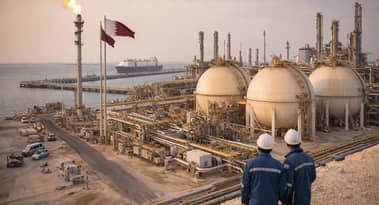

- QatarEnergy’s LNG halt and Strait of Hormuz suspension spike gas prices.
- US/European energy firms (Shell, Cheniere) are poised for huge profits.
- Rystad Energy sees limited long-term impact on global LNG markets.
Escalating Middle East conflicts, including QatarEnergy's halted LNG production and suspended Strait of Hormuz operations, have removed significant global natural gas supply, causing prices to jump over 40%.
However, even in the chaos of geopolitical tensions and soaring prices, western companies are likely to come off as the ultimate winners.
Major US and European energy companies, including Shell, TotalEnergies, ExxonMobil, and Cheniere, are poised to secure significant profits, even if Qatar quickly resumes gas shipments following the US and Israeli attacks on Iran that began on Saturday, according to a New York Times report.
Western energy giants poised for profit
These US and European firms are the most viable alternative suppliers for global customers—both countries and companies—that rely on Qatari gas for generating electricity or manufacturing industrial goods like chemicals and steel.
This advantage stems from a decade of investment.
Companies like Cheniere have developed eight US terminals to chill natural gas into a liquid for transport on ocean tankers.
Large oil and gas companies, such as Shell, Total, and Exxon, purchase much of this liquefied gas (LNG) under contract and subsequently sell it to customers worldwide.
The key Asian benchmark price for LNG has seen a sharp rise, increasing by approximately 91% since the close of last week, while the European benchmark price has climbed about 58%.

Short-term windfall and market volatility
Jason Feer, head of business intelligence at the global consulting and shipping brokerage firm Poten & Partners, described this as "a real windfall," noting that parties involved "get the benefit of this big jump."
Western energy companies are currently selling LNG to Europe at a price that is approximately double their cost to acquire and deliver the fuel, Feer was quoted as saying in the NYT report.
This represents a significant increase from just a week ago, when their revenue was only about 27%-28% higher than their costs.
Still, despite a more than 52% surge at Europe’s benchmark Title Transfer Facility (TTF) on March 2, Rystad Energy expects the current supply shock to have a limited long-term impact on global gas and liquefied natural gas markets.
Output decline scenarios
“In a scenario where there is limited or no damage and hostilities subside quickly, leading to a 15-day production halt, we estimate a 4.3% decline in 2026 output, equivalent to around 3.3 million tonnes,” Jan-Eric Fahnrich, senior analyst, gas & LNG research, Rystad Energy, said in an emailed commentary.
“A more prolonged disruption could result in 5.6 Mt of lost supply, while a full-scale interruption lasting four to five weeks before the Strait reopens to commercial traffic would translate into a loss of approximately 11.2 Mt for the full year 2026.”
Qatar's LNG exports are central to both its economy and global trade. Therefore, Rystad anticipates production restoration will take weeks, not months.
QatarEnergy indefinitely stopped all LNG production, affecting its current liquefaction capacity of 77 million tonnes per annum (Mtpa).
This halt followed a drone strike on its gas facilities in Ras Laffan on March 2, an incident that occurred while maritime traffic through the Strait of Hormuz was already stalled.

Since the war between Russia and Ukraine broke out in 2022, the former has cut off much of the gas it piped to Europe.
Additionally, all Russian gas transiting through Ukraine to the EU ended on January 1 of last year.
Supply dynamics and impact on countries
These developments have made LNG a critical resource for Europe.
Elevated LNG prices pose a risk to importers in Asia and Europe, particularly if these prices remain high or climb even further.
Europe's current low gas storage levels, resulting from high heating demand over the past winter, exacerbate this vulnerability.
The ongoing US-Israel campaign in the Middle East is set to tighten global gas supply in 2026.
The impact is likely to fall most heavily on price-sensitive South Asian buyers, including Bangladesh and Pakistan, rather than on premium markets willing to bid aggressively for cargoes, Rystad Energy said.
Meanwhile, the US has emerged as the world’s biggest LNG exporter, following a gas production boom much like the rapid acceleration in shale oil output in the 2010s.
Qatar and Australia occupy the second and third positions in the list of the biggest LNG exporters.
The suspension of sales, which typically see 82% of QatarEnergy's output going to Asian nations, also intensifies the strain on global energy markets, particularly in Europe.
According to the Energy Information Administration (EIA), US suppliers signed contracts last year to sell more LNG than in any year since 2022, which saw a demand surge following the attack on Ukraine.
The EIA forecasts that the capacity for US exports will almost double by 2031, compared to the level at the end of 2025.
Shell, as the world's largest LNG trader, is poised to be a major beneficiary if high prices persist for an extended duration, according to the NYT report.
Last year, TotalEnergies was the top seller of American LNG. Cheniere, meanwhile, was the largest producer of LNG in the US in 2025.

Shell share price jumps to record high as crude oil rallies with no end in sight
Brent is almost $100 and stocks are refusing to panic: what does the market know

Kalshi’s commodities bets outpace crypto as monthly volume tops $400M

Crude oil price forecast: why Goldman sees Brent at $85 despite Hormuz risk

Is gold ready to rally again, or will inflation hand control back to bears?
No results found
Loading articles...
Failed to load articles. Please try again.