
Here’s why the Hang Seng Index is falling after ceasefire extension

AI Sentiment: 35/100 Bearish
This score is generated through AI-driven analysis of the article's content.

powered by

Buy PetroChina (PTR) and add to China energy beta via Hang Seng Energy ETF exposure. Ceasefire extension keeps oil elevated longer, supporting upstream cash flows and dividends; China’s larger reserves reduce demand shock versus peers, so earnings risk is lower than the market implies. Key setup: HSI pullback looks like a pause, not a trend break, so rotate into defensives/energy while growth names bleed on geopolitics.
Key Risk: Oil mean-reverts fast if talks broaden or a renewed US-Iran de-escalation triggers a sharp crude selloff.
Sell Alibaba (BABA) and other geopolitics-sensitive China internet/growth (e.g., Netease). The ceasefire extension prolongs elevated energy costs and keeps risk premia high, pressuring discretionary ad/commerce demand and multiples; the article flags broad HSI weakness with internet names among the biggest laggards. Technical context: HSI is only slightly above key EMAs, so risk-off can extend before any clean rebound to 27,000.
Key Risk: A rapid risk-on reversal (HSI breaks above 27,000) driven by renewed trade/AI optimism that lifts China internet multiples despite energy staying high.
- The Hang Seng Index pulled back on Wednesday.
- President Donald Trump extended the ceasefire with Iran indefinitely.
- There are concerns about escalation of tensions between the US and Iran.
The Hang Seng Index sank by over 1.30% on Wednesday as concerns about the fragile ceasefire between the United States and Iran continued. It retreated to $26,137, erasing some of the gains made a day earlier.
Hang Seng Index slips after Trump ceasefire extension
President Donald Trump announced that he would extend the fragile ceasefire between his country and Iran after the latter remained non-committal on attending talks in Pakistan. Iran cited the ongoing blockade and argued that the talks would be meaningless.
In a statement, Trump cited the “fractured” Iranian government and plea from Pakistani officials on extending the ceasefire. In an earlier interview with CNBC, the president said that he would not extend the ceasefire.
Vice President JD Vance, Jared Kushner, a and Steve Witkoff were ready to travel to Pakistan for these talks and only canceled them as Iran remained muted on whether it would attend.
Iran believes that time is on its side as President Trump is already bored with the war and has midterm elections later this year. Chances are that the Republicans will lose the House of Representatives and the Senate, leading to his impeachment.
Iran also aims to prevent another attack by the US and Israel. As a result, while the war has caused thousands of deaths and destruction, the country believes that a prolonged war will prevent future attacks from happening.
Media reports have said that the only reason why Trump got into the war was that Benjamin Netanyahu and the head of Mossad convinced him of a short war that would lead to a regime change within hours.
The implication of the ceasefire extension is that crude oil prices will remain at an elevated level for longer. Also, there is a risk that the US and Iran will restart the war, a phase that will be risky as it will focus on energy and civilian infrastructure.
The ongoing crisis is risky for China, a country that imports most of its energy from other countries in the Middle East. China, however, unlike other countries like South Korea and Japan, has more oil reserves, which has helped to offset the situation.
Most companies in the Hang Seng Index were in the red on Wednesday. New Oriental Education stock dropped by 5.25%, while Contemporary Amperex, JD Health, Laopu Gold, and Orient Overseas dropped by over 3.8%. Other top laggards were firms like Netease and Alibaba.
On the other hand, some of the top laggards were companies like Lenovo Group, Geely Automobile, PetroChina, and China Resources Power.
HSI Index technical analysis
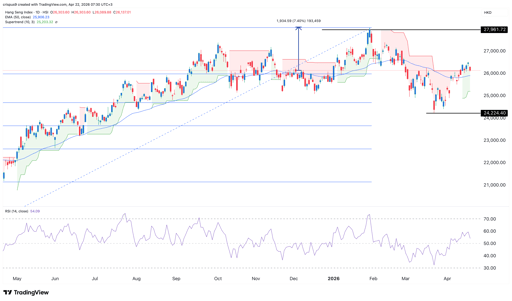
Hang Seng Index chart | Source: TradingView
The Hang Seng Index has rebounded in the past few weeks, moving from a low of $24,225 on March 24 to a high of H$26,480 on Tuesday.
It has now pulled back to $26,130, which is slightly above the 23.6% Fibonacci retracement level. It remains slightly above the 50-day and 100-day Exponential Moving Averages (EMA), while the Supertrend indicator has turned green.
Therefore, the most likely scenario is where the index resumes the uptrend and possibly retests the important resistance level at $27,000. A move above that price will point to more gains towards the year-to-date high of $27,960.

Reddit stock rises 6% as August user growth hits 2026 high
iPhone Duo: analyst explains how big of a revenue opportunity it really is

Why Wall Street is split on Meta’s Muse AI agent and stock outlook
Why a 'beat and raise' isn't driving Macy's stock higher?

Pinterest stock crashes below key price: Is it a bargain or a value trap?
No results found
Loading articles...
Failed to load articles. Please try again.