
Nvidia stock: Jensen Huang’s China remarks matter for investors
AI Sentiment: 35/100 Bearish
This score is generated through AI-driven analysis of the article's content.

powered by

Buy NVDA. The stock is strong on AI demand, and Huang’s Beijing diplomacy signals Nvidia is actively working to reduce policy surprise risk. Even without new export-control changes, “more predictable” ties improve planning for supply, customer relationships, and longer-cycle product roadmaps—supporting premium valuation. Key risk: a new or tightened US export-control action that blocks Nvidia’s latest chips (like H200) from China, forcing revenue and margin disappointment despite AI strength elsewhere.
Key Risk: New US export restrictions block Nvidia’s latest chips into China, cutting revenue and margins.
Sell ASML (NASDAQ: ASML). If China remains politically segmented, advanced lithography demand tied to China ramps slows, and ASML’s China-related uncertainty can re-rate the whole semiconductor capex cycle. Nvidia can still sell into other regions; ASML’s exposure is more directly linked to global equipment buildouts and China policy risk. Key risk: a clear easing of China-related semiconductor equipment access that restores confidence in long-term capex growth.
Key Risk: China equipment access improves, reversing the capex slowdown thesis.
- Jensen Huang joined Trump’s Beijing trip after a last-minute White House invite.
- Huang called for better US-China ties as Nvidia faces ongoing China restrictions.
- Investors are watching whether diplomacy can ease Nvidia’s long-term China risk.
Nvidia stock NASDAQ:NVDA has remained a market favourite after hitting another all-time high this week, extending the chipmaker’s golden run on Wall Street.
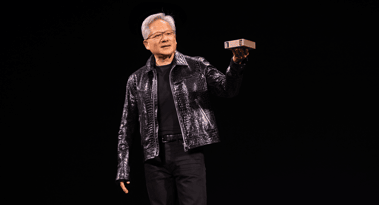
Yet Jensen Huang’s appearance in Beijing alongside US President Donald Trump’s state visit is a reminder that, for all the enthusiasm around artificial intelligence, one of Nvidia’s most important strategic problems has not gone away: China.
Huang said he hoped Trump and Chinese President Xi Jinping would “build on their good relationship” to improve two-way ties, according to CCTV.
The comment was diplomatic, but the subtext was commercial.
Nvidia needs a more predictable relationship between Washington and Beijing because the current one leaves the company squeezed between booming global AI demand and a market it still cannot fully serve.
Huang joined Trump’s visit at short notice, underlining how important the Beijing talks are for the company.
Nvidia has struggled to maintain its footing in China and, according to Reuters, remains unable to deliver its latest H200 chips to clients there.
Nvidia stock: Why investors should care
For investors, the significance of Huang’s remarks is less about optics and more about what they reveal.
Nvidia’s stock may be trading near record territory, but China remains one of the clearest examples of the gap between the company’s technological leadership and its ability to monetise that leadership everywhere.
That matters because China is too large a market to ignore.
Even when the company continues to benefit from surging AI infrastructure spending elsewhere, restrictions on what it can sell into China limit revenue opportunities, complicate customer relationships and create room for local rivals to strengthen their position.
In other words, Nvidia’s stock momentum and China reality are moving on different tracks.
The share price reflects investor confidence in AI demand, margins and product leadership.
Huang’s Beijing comments reflect the harder truth that geopolitics still shapes where and how that growth can be captured.
What Beijing could change
So far, Huang’s comments do not point to any policy shift. No change to export controls or market access was announced.
Still, his intervention matters because it shows what the company would most like to see: a more stable operating backdrop, fewer surprises in policy and a diplomatic tone that lowers the risk of further disruption.
If Trump and Xi manage to steady relations, even without a major breakthrough, that could help companies such as Nvidia plan supply chains, customer engagement and longer-term product strategies with greater confidence.
Stability alone would be valuable.
But if tensions remain elevated, or if new restrictions emerge, Nvidia’s China problem could deepen.
That would not necessarily derail the broader AI trade, but it would reinforce the view that a portion of global semiconductor demand will stay politically segmented.
The bigger implication for Nvidia stock
The bigger implication is that Nvidia’s valuation is being supported by extraordinary optimism at a time when one of its major overseas markets remains constrained.
That does not make the rally wrong, but it does mean investors should distinguish between near-term stock strength and longer-term addressable market potential.
China is no longer just a growth market for Nvidia.
It is also a policy variable. Huang’s decision to join the Beijing visit at the last minute suggests the company understands that clearly.
The message from Beijing was cautious rather than dramatic: better ties would help, access still matters and diplomacy remains relevant to the investment case.
What to watch next
The next thing to watch is not just the tone of the Trump-Xi meeting, but whether that tone leads to anything practical for the semiconductor sector.
Investors will also be watching for any signal on how Nvidia might serve Chinese customers if current restrictions remain in place.
For now, Nvidia stock may be near fresh highs, but Huang’s comments highlight a key tension beneath the rally: the company is winning the AI race globally while still trying to navigate one of the world’s most important markets with both hands tied.

SCHD ETF rally has stalled as a major risk emerges despite soaring inflows

Bloom Energy stock surges 8% as S&P 500 inclusion boosts investor interest

ALLW: Is this Ray Dalio’s All Weather fund a good ETF to buy today?
SpaceX stock could see massive buying on Nasdaq 100 rebalance: will SPCX rally?
Micron stock: a coiled spring ready to pounce ahead of earnings?
No results found
Loading articles...
Failed to load articles. Please try again.