
Warsh’s stance on Fed powers sparks concerns over market stability
AI Sentiment: 18/100 Bearish
This score is generated through AI-driven analysis of the article's content.

powered by

Buy gold (GLD). If investors expect less reliable Fed backstops for global dollar funding, they rotate away from cash-like assets and toward hard hedges. Gold benefits from both weaker USD expectations and higher tail-risk premia tied to market stability.
Key Risk: A clear commitment to Fed independence and rapid risk-on sentiment crushes tail-risk demand for gold.
Sell USD via long JPY (buy USD/JPY puts or short USD/JPY). Warsh’s comments raise the odds that dollar liquidity support becomes politically conditional in a crisis, which typically widens funding stress and pushes investors into funding-safe currencies. The market will price a higher “crisis discount” to dollar liquidity even before any policy change.
Key Risk: Fed clarifies that international dollar liquidity tools remain fully independent and automatic, removing the crisis-liquidity fear.
- Central bankers fear reduced Fed support could destabilise global markets.
- Warsh comments raise doubts over Fed’s future crisis response independence.
- Policymakers expect no immediate shift in Fed liquidity operations.
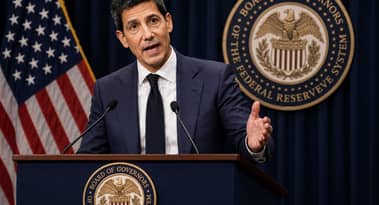
Incoming Federal Reserve Chair Kevin Warsh has sparked concern among global central bankers after suggesting the US Federal Reserve’s independence may not fully extend to its international crisis-response operations
These remarks have raised fears that political influence over dollar liquidity support could unsettle financial markets during periods of stress.
Over the years, the central bank has expanded its emergency tools to ensure funding markets continue functioning during times of stress.
Warsh's comments raise concerns
Warsh, US President Donald Trump’s pick to lead the Federal Reserve, raised eyebrows during his confirmation hearing after suggesting that, outside of monetary policy, the Fed should work closely with the presidential administration and Congress.
His comments implied that the Fed’s independence in setting interest rates may not fully apply to areas such as international financial operations.
That prompted some policymakers and economists to question whether the Fed would remain capable of acting quickly and independently during the next global financial crisis.
Warsh is expected to be sworn in soon, although no official date has been announced.
The Fed board said on Friday it had appointed Jerome Powell as chair pro tempore.
According to on- and off-the-record comments from more than half a dozen policymakers, central banks are closely monitoring Warsh’s remarks and waiting for further clarification.
However, most do not expect any immediate shift in policy, largely because the Fed’s liquidity facilities are viewed as critical to protecting the US economy as well as global markets.
Concerns over dollar liquidity access
Several policymakers warned that a less dependable Federal Reserve could accelerate the long-term decline in the dollar’s share of global markets.
They added that even suggestions that dollar liquidity lines may not be readily available during times of crisis could trigger financial turbulence.
The Federal Reserve currently provides dollars on demand to the European Central Bank and the central banks of Canada, Japan, Britain and Switzerland through standing liquidity tools backed by collateral.
Other central banks can also access dollars through a separate and more demanding facility.
These arrangements are designed to prevent global financial stress from spilling into the United States.
Overseas commercial banks hold trillions of dollars in US Treasury securities, and periods of stress could force rapid selling if institutions struggle to access dollar funding.
Political influence and market risks
Political involvement in dollar liquidity support is not entirely new.
The Trump administration reportedly extended a $20 billion liquidity line to Argentina ahead of elections last year.
Gulf and Asian nations have also recently requested liquidity lines to help offset energy shocks and the fallout from the Iran conflict.
South Korean President Lee Jae Myung reportedly discussed the issue with US Treasury Secretary Scott Bessent earlier this month.
Takahide Kiuchi, a former Bank of Japan board member, warned that Warsh’s policy approach could have broader consequences for global markets.
“Warsh could attempt a tightrope of conducting dovish interest rate policy that aligns with Trump’s hopes, while guiding a hawkish balance sheet policy,” Kiuchi said, as cited in a Reuters report.
Hike or hold? Fed policy meet next week to test Kevin Warsh's credibility
Trump’s $5,000 dividend plan raises debt, inflation and funding concerns

US producer prices rise 0.4% in August as energy costs rebound
US 10-year Treasury yield jumps as Trump floats $5,000 dividend checks

US jobs rebound in August with 162,000 payrolls increase: is a Fed rate hike coming?
No results found
Loading articles...
Failed to load articles. Please try again.