
Samsung labour dispute sparks fears over chip supply disruptions
AI Sentiment: 18/100 Bearish
This score is generated through AI-driven analysis of the article's content.

powered by

Buy Samsung Electronics. The market is pricing a worst-case supply shock, but the government is signaling “room for dialogue” and emergency arbitration is only used rarely (4 times in modern history). Even if a strike starts, the 30-day arbitration window and legal pressure on noncompliance make a full 18-day production hit less likely. Upside: memory supply fears fade quickly, and AI-driven memory demand keeps end-market support strong.
Key Risk: A real, sustained 18-day strike that materially cuts Samsung memory output and forces customers to lock in longer-term alternative suppliers.
Sell SK Hynix. If Samsung is disrupted, investors may rotate to the next-largest memory supplier, but that’s a trap: any disruption in Korea’s memory complex raises uncertainty across the whole supply chain (equipment, logistics, customer qualification timing). SK Hynix also faces second-order demand destruction if OEMs delay shipments due to broader memory availability risk.
Key Risk: Samsung disruption is short and contained, and SK Hynix captures clean incremental orders with no demand pullback.
- Samsung union plans 18-day strike after bonus talks collapse.
- South Korea may consider rare emergency arbitration intervention measures.
- Strike could hurt chip supply and pressure South Korean economy.
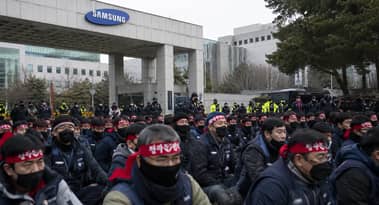
Samsung Electronics is facing the threat of a large-scale labour strike after bonus payment talks between management and the company’s union collapsed.
The strike, scheduled to begin on Thursday, could have major implications for South Korea’s economy and the global supply of memory chips.
Around 48,000 workers are expected to participate in the planned 18-day walkout.
The scale of the strike has prompted discussions over whether the South Korean government could issue an emergency arbitration order to halt the industrial action temporarily.
Government says talks can continue
A South Korean government official said on Wednesday that discussions around an emergency arbitration order were premature.
The official added that there was still room for dialogue between Samsung Electronics and the labour union.
The government is generally viewed as labour-friendly under President Lee Jae Myung, who previously worked as a youth labourer and suffered injuries while on the job.
However, Lee criticised what he described as excessive demands from a union during a cabinet meeting on Wednesday.
He said a certain union was crossing the line by demanding a share of a company’s operating profit before income tax payments were made.
“There is a role for the government when anyone crosses the line to make sure they conduct themselves responsibly for the good of the larger community,” Lee said during the meeting.
What does an emergency arbitration order mean
South Korea has used an emergency arbitration order only four times in modern history.
Such a measure would suspend the strike for 30 days while both sides continue negotiations under mediation from the National Labor Relations Commission.
The government can invoke the order if authorities determine that a strike could cause “significant injury to the national economy”.
If mediation efforts fail, the dispute would move to a separate arbitration panel.
The panel would hear arguments from both sides before issuing a legally binding decision.
Under South Korean law, individuals who refuse to comply with the order could face up to two years in prison or fines of up to 20 million won, equivalent to around $13,300.
The last time the measure was used was in 2005 during a strike by Korean Air pilots.
The dispute ended after four days when both sides agreed on a compromise wage increase.
Economic concerns grow over Samsung disruption
The potential strike has raised concerns because Samsung Electronics plays a central role in South Korea’s economy.
The company accounts for nearly a quarter of the country’s exports and is also the world’s largest memory chip manufacturer.
Any major disruption to production could affect global semiconductor supply chains, particularly at a time when demand linked to artificial intelligence has already caused chip shortages.
An unnamed official from South Korea’s central bank warned that, in a worst-case scenario, the strike could reduce the country’s projected economic growth for the year by 0.5 percentage points.
The current growth forecast stands at 2.0%.
South Korean officials have also estimated that severe production disruptions at Samsung Electronics could result in daily losses of up to 1 trillion won, or around $665 million, for the company.
Political risks ahead of local elections
The labour dispute could also carry political implications ahead of South Korea’s local elections on June 3, when voters will elect mayors and governors nationwide.
President Lee’s liberal bloc is currently expected to perform strongly in the elections.
However, the ongoing strike threat could influence swing districts and affect labour support, which has traditionally backed liberal candidates.
Lee is also seeking support in Gyeonggi province, an economically important region where thousands of workers are employed at Samsung facilities.
Samsung’s labour union was established only two years ago and is not affiliated with any of South Korea’s major labour federations.
Despite that, several established and more militant unions have pledged solidarity support for Samsung workers during the dispute.

TxFlow L1 strengthens its infrastructure with OpenZeppelin audit

Robinhood stock jumps 11% as BTC rally fuels crypto shares: Can HOOD hold the gains?
30-year Treasury yields: why they're set to soar despite Bessent's intervention

Dow falls as AI optimism lifts tech stocks, oil prices climb

SCHD ETF just hit a record high: Here’s why DIVB is a better buy
No results found
Loading articles...
Failed to load articles. Please try again.