
JEPQ ETF stock just hit a record high and yields 10%: Is it a good buy?

AI Sentiment: 35/100 Bearish
This score is generated through AI-driven analysis of the article's content.

powered by

The news highlights the core driver: Nasdaq 100 strength. QQQM delivered materially higher total returns than JEPQ in both YTD and 12 months. Buy QQQM to capture full upside without the covered-call cap, while still benefiting from tech earnings momentum.
Key Risk: Nasdaq reverses hard (rates spike or earnings disappoint), and QQQM drops more than JEPQ because JEPQ’s call premiums cushion declines.
JEPQ’s ~11% yield is largely call-premium, but the trade caps upside in bull runs. The article shows JEPQ total return ~9.7% YTD vs QQQM >20%, and 12-month 29% vs 42%. If Nasdaq keeps grinding higher, you’re paying for income while giving up the best part of the move. Sell JEPQ and rotate into QQQM for cleaner exposure to Nasdaq 100 upside.
Key Risk: Nasdaq goes sideways or down modestly and covered calls keep paying, so JEPQ’s capped upside doesn’t matter and the income outperforms QQQM.
- The JEPQ ETF stock has jumped to a record high this year.
- The fund has had over $5 billion in inflows this year.
- However, the fund’s total returns continue to lag behind its peers.
The JPMorgan Nasdaq Equity Premium Income ETF (JEPQ) surged to a record high in May as technology stocks soared, and has climbed over 14% from its lowest point this year. The rally has coincided with steady inflows as investors chase its high yield. So is it a good ETF to buy today?
JEPQ ETF inflows are soaring as investors chase growth and yield
The JPMorgan Nasdaq Equity Premium Income ETF has done well in the past few months. Data shows that the fund has had a net inflow of over $5 billion this year, higher than JEPI’s $4 billion.
This surge is mostly because JEPQ promises growth and income. Data shows that it has a dividend yield of 11%, higher than most funds, like the popular Schwab US Dividend Equity (SCHD) ETF, which pays a 3.25% yield.
The iShares Core Dividend Growth ETF (DGRO) yields 2%, while the Vanguard High Dividend Yield ETF (VYM) yields less than 3%. This yield is also much higher than what the short-term government bonds are paying.
At the same time, the fund gives investors access to the fastest-growing companies in the United States. That’s because its equity portfolio is made up of firms in the Nasdaq 100 Index.
The fund generates its dividend return through a covered call strategy. This is an approach that invests in companies in the index, including popular names like Nvidia, Microsoft, Google, and Netflix. It then writes calls on the Nasdaq 100 Index and takes a premium, which it distributes to its investors as a dividend.
Is the 11% dividend yield worth it?
The question, therefore, is whether the 11% dividend yield that the fund pays to its investors is worth it. The best way to assess this is to compare its performance in terms of total returns with a similar ETF that tracks the Nasdaq 100 Index.
In this case, data shows that the JEPQ ETF has had a total return of 9.7% this year, while the Invesco QQQ ETF (QQQM) has jumped by over 20%. The same trend is seen in the last 12 months, as its total return was 29% compared to QQQM’s 42%.
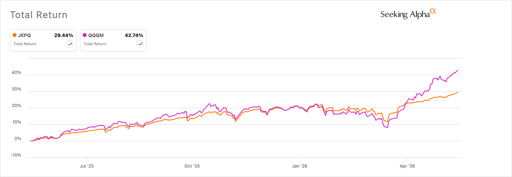
QQQM vs JEPQ ETF stock chart | Source: SeekingAlpha
JEPQ ETF underperforms the broader market because of how it is structured. Its mechanics means that it underperforms the underlying asset during a bull market. For example, in this case, with the Nasdaq 100 Index trading at $30,000, its call option may have a strike price of $30,500. If the index jumps to $31,200, it means that the options trade is capped.
This situation explains why other popular covered call ETFs, including the popular JPMorgan Equity Premium Income ETF (NYSE: JEPI), continue to underperform the S&P 500 Index.
Even in bear markets, these covered call ETFs don’t have a major edge against their peers. For example, the CONY ETF has had a total return of minus 15% compared to the Coinbase stock’s performance of minus 16%.

iPhone Duo: analyst explains how big of a revenue opportunity it really is

Why Wall Street is split on Meta’s Muse AI agent and stock outlook

Why a 'beat and raise' isn't driving Macy's stock higher?

Pinterest stock crashes below key price: Is it a bargain or a value trap?

Why Nvidia stock is down over 2% on Thursday
No results found
Loading articles...
Failed to load articles. Please try again.