
AMD stock surge brings $1 trillion status within reach, but key risks remain

AI Sentiment: 68/100 Bullish
This score is generated through AI-driven analysis of the article's content.

powered by

Buy AMD (AMD). The stock has already broken out of a long $194–$265 range, is holding above the 50/100-day EMAs, and has not hit an “overbought” signal. A clean move above $546 (this year’s high) would confirm the next leg toward the $613 $1T threshold, while fundamentals keep improving (revenue +38%, data center leading).
Key Risk: AMD fails to clear $546 and the breakout reverses, showing the rally was just hype and not sustained demand.
Sell AMD (or short AMD) versus buying Nvidia (NVDA). The article flags Nvidia encroaching on AMD’s CPU turf with Windows chips; that’s the direct threat to AMD’s growth narrative and margins. With AMD’s forward P/E ~94 versus Nvidia ~22, the market is paying a premium for execution that Nvidia may steal.
Key Risk: AMD proves Nvidia’s CPU push isn’t taking share (or AMD defends with faster product wins), and the valuation premium is justified by accelerating margins.
- AMD stock has soared and is nearing its all-time high.
- The stock needs to jump by 20% to hit the $1 trillion market cap.
- Valuation and competition risks from Nvidia are a major concern.
Advanced Micro Devices AMD stock price has soared this year, making it one of the top gainers on Wall Street.
It jumped by 133% this year, bringing its market capitalization to over $834 billion.
This article explores why it may be the next big name to hit a $1 trillion market cap.
AMD stock surge puts the $1 trillion valuation milestone within reach
The ongoing artificial intelligence boom has pushed several companies to the exclusive $1 trillion club.
Some of the most notable of them are SK Hynix, Samsung, Broadcom, and Micron.
AMD, which is run by Jensen Huang’s cousin, could be the next big entrant to this club.
With its valuation at $834 billion, the company needs to jump to at least $613 to get to that milestone.
The stock peaked at $546 earlier this month.
There are signs that the stock will jump to that milestone.
One of the most notable ones is its technicals, which indicate that the stock has the momentum to achieve that.
The daily chart shows that the AMD stock price made a strong bullish breakout in April this year.
Before that, it had remained inside a narrow range of between $194 and $265 for months.
That is a sign that it has now moved to the markup phase of the Wyckoff Theory, which is characterized by more demand.
AMD stock has remained above the 50-day and 100-day Exponential Moving Averages (EMA), which have provided it with substantial support over time.
It has also crossed the important ultimate resistance level of the Murrey Math Lines tool.
That is a sign that it is not yet in the overbought zone.
Therefore, more gains towards the key point of $613 will be confirmed if it jumps above the key resistance level of $546, its highest point this year.
A move above that level will invalidate the forming double-top point and signal more gains ahead.
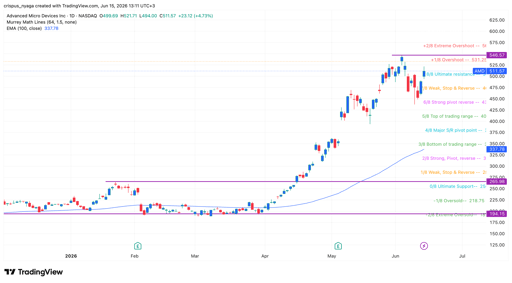
AMD stock chart | Source: TradingView
READ MORE: Nvidia, AMD, Arm stocks rally as BofA sees $170B agentic AI opportunity
AMD’s business is growing despite risks
Fundamentally, AMD’s business is doing well, with demand for its products continuing to grow.
The most recent results show that its revenue growth continued, reaching $10.3 billion, up by 38% from the same period last year.
This growth was mostly driven by its data center business, which made over $5.7 billion in revenue.
The client & gaming business made $3.6 billion, while its embedded segment rose by just 6%.
Wall Street analysts are optimistic that AMD’s revenue and margin growth will accelerate in the coming years. The average estimate is that its revenue will jump by 42% to $50 billion, followed by $76 billion next year.
Still, the company faces some major headwinds. The biggest one is that Nvidia is encroaching on its CPU territory. It recently launched Windows chips that it hopes will gain market share in the future.
Nvidia’s entry means that there are now three major players in the CPU industry: AMD, Nvidia, and Intel.
There is a possibility that Nvidia will take some share of its business soon.
The other risk is its valuation, which is quite rich compared to its peers.
It has a forward price-to-earnings ratio of 94, much higher than the sector median of 32. Its multiple is also higher than Nvidia’s 22.
This likely explains why analysts from companies like Citigroup, Barclays, Wolfe Research, and Zacks downgraded their outlooks.

Software stocks are back from the dead as AI fuels growth: can the rally continue?

GoPro stock soars 200% after Markiplier stake, $285M Starman deal

SpaceX stock rally meets another lockup expiry test on September 9: what to expect

Dow closes 270 pts lower as strong jobs report lifts September Fed rate-hike bets

Evening digest: Trump pressures Fed as US jobs rise, gold falls
No results found
Loading articles...
Failed to load articles. Please try again.