
Stellar price surges 14% as XLM rally gains steam on PayFi buzz

AI Sentiment: 78/100 Bullish
This score is generated through AI-driven analysis of the article's content.

powered by

Buy XLM. The news is translating into real usage: network volume jumped from ~$153M to ~$880M, plus PayFi/payment rails (Zebec payroll) and bank-style tokenized deposits (VersaBank Digital Meteor) that validate Stellar as regulated infrastructure. Chart confirms buyers defending the $0.20–$0.21 high-volume node and RSI ~59 (room before overbought). Thesis: sustained inflows keep pushing XLM toward the $0.26 resistance and beyond if volume stays high.
Key Risk: A volume fade—if transaction activity drops and XLM loses the $0.20–$0.21 support, the breakout thesis collapses.
Buy a PayFi/altcoin beta proxy: e.g., buy an altcoin ETF/ETN exposure where available, or directly buy a diversified PayFi-linked basket (XLM + other PayFi names). Rationale: the article ties Stellar’s surge to a sector rotation into PayFi, and that sector is outperforming the broader alt market. Second-order effect is that capital chasing “winners” spreads to correlated PayFi infrastructure tokens as traders front-run more announcements.
Key Risk: Sector rotation reverses—if PayFi stops outperforming and the broader alt market sells off, the basket trade fails.
- XLM emerged as the leading gainer for the day among top 100 tokens.
- Project-specific developments have helped support the latest rally.
- XLM continues to hold above a key breakout zone.
Stellar has climbed more than 14% over the past 24 hours, making XLM the best-performing asset among the top 100 cryptocurrencies by market capitalization as fresh ecosystem developments have drawn renewed buying interest.
According to CoinGecko data, XLM traded near $0.22 on June 16 after surging from levels below $0.19 earlier in the week.
The rally transpired alongside a sharp rise in trading activity, with Stellar network volume reportedly jumping to nearly $880 million from about $153 million over the weekend.
Strong buying interest has emerged as payment-focused decentralized finance projects, commonly known as PayFi, continue to attract capital.
Market participants have linked part of Stellar's advance to the sector's recent outperformance, which has exceeded gains across much of the altcoin market.
Institutional adoption has also added support. Spiko Finance recently announced that it had tokenized $1 billion in assets on the Stellar network, a milestone that strengthens Stellar's standing in the real-world asset tokenization sector.
The development has increased attention on the network's role as infrastructure for regulated financial products and on-chain asset issuance.
Enterprise payment activity expanded further after Zebec launched its payroll platform on Stellar.
The service allows employees and contractors to receive salary payments directly into digital wallets, while Mastercard-backed debit cards and local currency conversion tools provide additional spending options.
The rollout adds another real-world use case to Stellar's payment network and could contribute to sustained transaction activity.
Simultaneously, in a recent SEC filing, London-headquartered VersaBank outlined its Digital Meteor initiative, which introduces Real Bank Tokenized Deposits on Ethereum, Algorand, and Stellar.
According to the filing, these tokenized deposits represent bank-issued demand deposit liabilities rather than privately issued stablecoins.
The initiative positions Stellar within a banking-focused framework that includes corporate treasury operations, digital asset custody, and programmable escrow services.
VersaBank's decision to include Stellar alongside larger blockchain networks has been viewed by market participants as validation of the network's payment and settlement infrastructure.
Outside the Stellar ecosystem, improving macroeconomic conditions have supported risk assets.
Investor sentiment strengthened after reports of a ceasefire framework between the United States and Iran reduced concerns surrounding disruptions to the Strait of Hormuz.
The easing of geopolitical tensions coincided with a decline in the U.S. Dollar Index below 100 and renewed inflows into both equities and cryptocurrencies.
Can XLM hold its breakout?
Price action suggests that traders are now testing whether the latest advance can develop into a sustained trend.
Daily chart data shows XLM rebounding from a recent pullback and reclaiming the $0.20 to $0.21 region, an area that aligns with the highest concentration of trading activity on the visible range volume profile.
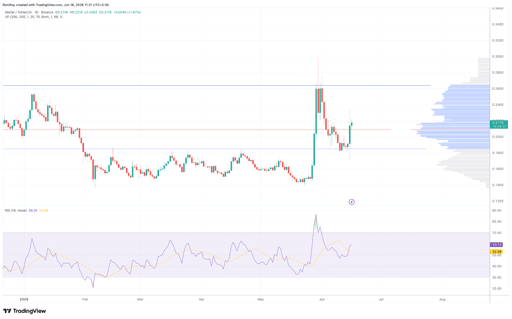
XLM/USDT 1-Day price chart. Source: TradingView.
The return above this high-volume node indicates that buyers have so far defended the zone that attracted the largest amount of recent market participation.
Momentum indicators also remain constructive. The daily Relative Strength Index has recovered to roughly 59, moving back above its signal average while remaining below overbought territory. Such positioning leaves room for additional upside if buying pressure persists.
Resistance remains near the $0.26 area, where XLM was rejected during the initial breakout attempt earlier this month.
A move above that level could expose higher targets, although continued strength would likely require volume to remain elevated after the recent surge.
For now, XLM continues to hold above the $0.20 area that previously acted as resistance, while the RSI remains above the neutral 50 level.
As long as both conditions persist, the chart continues to support a consolidation phase within a broader uptrend rather than a full reversal of the recent rally.

Crypto price predictions: Dogecoin, XRP, Venice Token (VVV)

Zcash price prediction: Here’s why ZEC token has gone parabolic

ARB price prediction: How Robinhood Chain growth is boosting Arbitrum

Why is Bitcoin price struggling around $80,000?

Zcash price breaks above $1,000 as institutional and privacy demand rise
No results found
Loading articles...
Failed to load articles. Please try again.