
What's next for the Nikkei 225 Index after the BoJ rate hike today? (June 16)

AI Sentiment: 78/100 Bullish
This score is generated through AI-driven analysis of the article's content.

powered by

Buy Nikkei 225 exposure via iShares MSCI Japan ETF (EWJ) or Nikkei 225 futures. BoJ hiked to 1% (in line with expectations) and the index is breaking out above ¥69,238 with the 100-day EMA support; upside target is ¥70,000. Lower oil from the US-Iran MoU is a near-term earnings tailwind for Japan’s import-heavy economy.
Key Risk: BoJ turns hawkish faster than expected and the yen strengthens sharply, crushing exporters’ earnings and reversing the rally.
Buy Japanese bank stocks via TOPIX/financial exposure (e.g., iShares MSCI Japan ETF (EWJ) tilt toward financials, or a Japan bank like MUFG). Higher rates improve net interest margins and help banks as the BoJ moves off ultra-low rates; the market is already pricing a continued normalization path.
Key Risk: A growth scare forces the BoJ to pause or reverse, and credit losses rise, wiping out the margin benefit.
- The Nikkei 225 Index held steady at its all-time high on Tuesday.
- The Bank of Japan decided to hike interest rates by 0.25%.
- It hiked to contain inflation and the ongoing Japanese yen sell-off.
The Nikkei 225 Index continued its strong rally this week, even after the Bank of Japan (BoJ) hiked interest rates to the highest point since 1995. It soared to ¥69,245, up by 80% in the last 12 months and by 35% this year.
Japan stocks jump after US-Iran deal
The Nikkei 225 Index has been in a strong bull run in the past few months, mirroring the performance of other global stocks. It has even outperformed American equities like the Nasdaq 100 and S&P 500 indices.
The rally continued this week after the US and Iran reached a memorandum of understanding (MoU) on ending the war that has been going on since February 28.
This deal pushed crude oil prices lower, with Brent falling to $83 and the West Texas Intermediate slipping to $80. Natural gas and shipping prices have continued moving downwards this week.
Still, there are risks to the deal, with the biggest one being Israel, which vehemently opposes it. In separate statements, top Israeli officials, including Prime Minister Benjamin Netanyahu, warned that they will continue battling regional foes, including Hezbollah and Hamas.
Continued attacks and counterstrikes may push Iran to respond by striking Israel, which may draw the US back to the war.
Bank of Japan interest rate hike
The Nikkei 225 Index also jumped after the BoJ continued its hiking trend. In a statement today, June 16, the bank hiked rates by 25 basis points to 1%, the highest point since 1995. It was the first time that the bank hiked rates since December last year.
The bank decided to hike rates to contain the elevated inflation, which has continued rising in the past few months because of the war and rising wages. A report coming out on Friday is expected to show that the headline CPI jumped from 1.4% in April to 1.6% in May this year. Core inflation is also expected to have a similar increase.
The BoJ is also hiking rates to curb the Japanese yen sell-off. Data shows that the USD/JPY exchange rate is stuck at the critical zone of 160, a few pips below its all-time high of 160.70. By hiking rates, the bank hopes to make the currency more attractive to investors.
Therefore, Japanese stocks jumped after the BoJ rate hike for two main reasons: it was in line with expectations, and the Iran deal provided a bigger catalyst.
The next key catalyst for the Nikkei 225 Index is the upcoming Federal Reserve interest rate decision on Wednesday. Economists believe that the bank will leave rates unchanged between 3.5% and 3.75%.
Nikkei 225 Index technical analysis
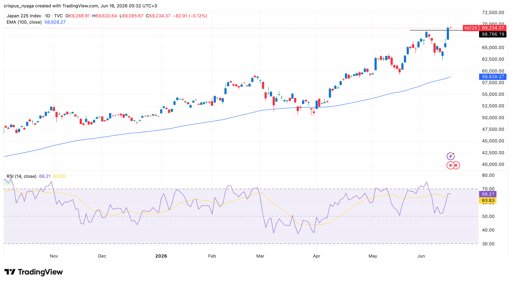
Nikkei 225 Index chart | Source: TradingView
The daily chart shows that the Nikkei Index has been in a strong bull run this year. It crossed the important resistance level of $69,238 on Monday, invalidating the forming double-top pattern.
Its rally has been supported by the 100-day Exponential Moving Average (EMA), a sign that bulls are in control. Also, the Relative Strength Index (RSI) has continued rising and is nearing the overbought level of 70.
Therefore, the path of the least resistance for the Nikkei 225 Index is in the upside, with the next key level to watch being at ¥70,000. A drop below the key support at ¥68,000 will invalidate the bullish outlook.

Nikkei 225 retreats as Asian markets weigh BOJ, Fed and US-Iran deal

Hang Seng index flashes risky patterns as China economic growth falters

Analyst says buy these two space stocks amid SpaceX-driven sell-off

Dow hits record high as Iran deal hopes, SpaceX rally lift stocks

Why a SpaceX merger may not prove bullish for Tesla stock
No results found
Loading articles...
Failed to load articles. Please try again.