
FTSE 100 Index forecast ahead of the BoE interest rate decision

AI Sentiment: 72/100 Bullish
This score is generated through AI-driven analysis of the article's content.

powered by

Buy FTSE 100 exposure (e.g., iShares FTSE 100 ETF, ticker: ISF.L). Inflation is coming in below expectations for a second month, oil is falling, and the market is leaning toward a BoE hold at 3.75%. That combination supports a “rates stay higher for longer” pause rather than a near-term hike, which is bullish for UK large-cap earnings and risk appetite. Technicals also point up: inverted head-and-shoulders and RSI > 50, with upside toward 10,945.
Key Risk: BoE turns hawkish and signals a hike soon despite the softer inflation prints, pushing gilt yields and the FTSE down.
Sell UK rate risk via short positions in 5-year UK gilts (e.g., iShares Core UK Gilts 0-5yr ETF, ticker: IGOV.L, or a 5-year gilt futures short). The article shows yields already pulled back (5-year ~4.285%, 2-year ~4.145%), but traders are split on later-year hikes. If the BoE holds at 3.75% while inflation stays above target, the “dovish” bond pricing can unwind quickly, lifting yields and hurting gilt prices.
Key Risk: BoE stays clearly dovish and inflation continues undershooting, keeping yields capped and making the short lose money.
- The FTSE 100 Index has remained in a narrow range this week.
- The UK published an encouraging consumer inflation report.
- The Bank of England will deliver its interest rate decision today, June 18.
The FTSE 100 Index remained in a narrow range this week as focus shifted to the key UK macro data and actions from the Federal Reserve and the Bank of England (BoE). It was trading at 10,440 points on Wednesday, up from this month’s low of 10,122.
Bank of England interest rate decision
The FTSE 100 Index moved sideways after the UK published the encouraging consumer inflation report. According to the Office of National Statistics, the headline consumer inflation rose 2.8% in May, lower than the median estimate of 3.0%. It rose 0.2% on a MoM, also lower than the expected 0.4%.
This was the second consecutive month in which UK inflation came short of expectations. With crude oil prices falling, there is a likelihood that inflation will continue moving towards the Bank of England’s target of 2.0% in the coming months.
The UK will publish the latest jobs numbers on Thursday morning. Economists predict the data to show that the unemployment rate remained unchanged at 5.0%, while the claimant change slowed to 25.8k.
The most important catalyst for the FTSE 100 index is the BoE interest rate decision. Like the Federal Reserve, economists expect the bank to leave interest rate decision unchanged at 3.75%. A Polymarket poll gives this view a 100% chance.
Traders are then mixed on what the bank will do after that. A poll shows that 59% of traders expect the bank to hike interest rates later this year to combat inflation that has remained above the BoE target of 2.0% for years.
The bond market, however, expects the bank to maintain a dovish view. For example, the rate-sensitive five year yield has pulled back to 4.285%, its lowest level since April 17, and much lower than the year-to-date high of 4.718%.
Similarly, the two-year yield retreated to 4.145% from the year-to-date high of 4.70%. Longer-term bond yield have also retreated, while the sterling has dropped to 1.3300 as the US dollar jumped.
The BoE decision comes after the Federal Reserve left interest rates unchanged between 3.5% and 3.75%. Nine officials said that they will support hiking interest rates later this year if inflation remained stubbornly high. This was an important decision because it was the first one under Kevin Warsh.
FTSE 100 Index technical analysis
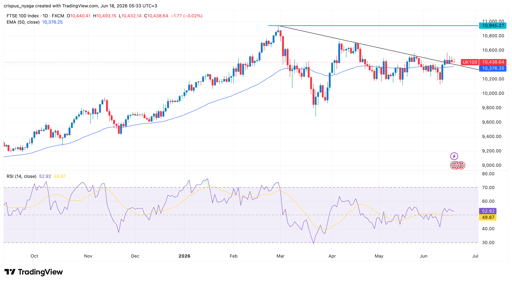
Footsie Index chart | Source: TradingView
The Footsie has remained in a narrow range in the past few days. It was trading at 10,440, a few points above the 50-day moving average and the descending trendline that links the highest points since February this year.
The index has formed a small inverted head-and-shoulders pattern, a common bullish reversal sign in technical analysis. Also, the Relative Strength Index (RSI) has moved above the neutral point of 50.
Therefore, the Footsie will likely continue rising, with the next key resistance level to watch being at 10,945, the highest point this year.

Wall Street is about to lose a $1.1 trillion buyer: why stocks could get bumpier

Lloyds share price forms a risky pattern as insiders sell, risky pattern forms

Vodafone share price: Technicals point to a jump to 135p as turnaround continues

US CPI data this week could influence Fed rate decision: What investors must know

Jensen Huang sees AGI arriving with OpenAI's Astra: 3 stocks investors should watch
No results found
Loading articles...
Failed to load articles. Please try again.