
Nio, XPeng, Li Auto, BYD, Polestar: Why are China EV stocks tumbling?
AI Sentiment: 18/100 Bearish
This score is generated through AI-driven analysis of the article's content.

powered by

Buy BYD. The selloff is driven by discounting and subsidy cuts, but BYD’s scale (1M+ Q1 deliveries, +59% YoY) lets it absorb margin pressure better than smaller peers. If China demand normalizes after the subsidy step-down, BYD’s production momentum and cost advantage should translate into faster margin recovery than Nio/Xpeng/Li Auto.
Key Risk: China demand stays weak and BYD is forced into deeper, longer price cuts that permanently compress margins.
Sell Nio, Xpeng, and Li Auto. The article points to “thousands of cars” being built while investors fear growth is being bought with discounts. With subsidies ending and competition intensifying, these firms face the worst mix: lower pricing, higher cash burn, and weaker bargaining power versus BYD.
Key Risk: They secure a durable cost advantage or a clear path to profitability that offsets discount-driven margin damage.
- Top China EV stocks have tumbled by double digits this year.
- Nio stock has slumped by 30% from its highest point in May this year.
- China’s competition has pushed companies to slash vehicle prices.
China EV stocks are in a strong freefall this year as investors remain pessimistic about their growth prospects. Nio stock slipped to $5 on Friday, down nearly 30% from its May high, and is hovering at its lowest level since March 9.
Xpeng stock has tumbled to $13.21 in New York, down 53% from its November 2025 high. This retreat has wiped out billions of dollars in its value as its market capitalization has slumped to $12.55 billion.
Li Auto stock has slumped to $13.2, marking a major downfall for one of the most popular Chinese EV companies. Its valuation has slumped to $13.3 billion from $34 billion at its peak last year.
Polestar stock has dropped to $20, down by 52% from its 2025 highest point in 2025, while BYD has lost 50% of its value in the past few months. In total, all these Chinese EV companies have shaved over $100 billion in value from their all-time highs.
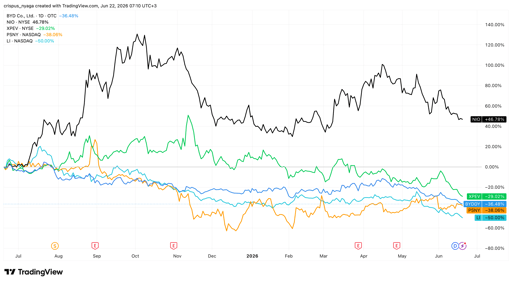
Nio, Xpeng, BYD, Li Auto, and Polestar stocks | Source: TradingView
China EV stocks have tumbled amid competition and incentives concerns
China’s top EV companies like Nio, XPeng, Li Auto, and BYD have slumped because of the ongoing competition in the country that has pushed them to issue robust discounts.
A closer look at their quarterly numbers show that these firms are building thousands of cars and are seeking to boost production. For example, data shows that BYD delivered over 1 million vehicles globally in the first quarter, up by 59% YoY. XPeng sold 94,000 units, while Li Auto, Nio, and Polestar sold 94,000, 92,864, and 12,300 units in the same period.
These deliveries are on top of those made by other EV and traditional companies like Mercedes-Benz, Toyota, Geely, Tesla, and Xiaomi. As a result, these companies are working to boost their sales by offering discounts, which will affect their margins in the long term.
READ MORE: NIO stock has 22% upside, so why are investors still staying away?
China government is ending EV subsidies
China EV stocks have also plunged because of a major policy shift in the country. Beijing started ending its subsidies, which is affecting the growth momentum. New energy vehicles transitioned from full purchase tax exemption to 50% exepemption, with the maximum tax deduction falling from 30,000 yuan to 15,000 yuan.
As a result, Chinese residents boosted their purchases in the December quarter as they took advantage of the new shift. Most companies launched their “tax-difference guarantee” for customers who ordered in November and received deliveries in 2026.
The policy shift mirrors what happened in the United States when President Donald Trump ended the EV tax credit, a move meant to boost sales of Internal Combustion Engine (ICE) vehicles.
Many Chinese EV companies are now working to diversify their revenue sources by expanding their businesses beyond the country. Europe has become one of their favorite destinations, with firms like BYD, Saic, Jaecoo, and XPeng spending aggressively in the region.
Chinese companies are also aiming to capitalize on a major tariff cut in Canada to boost their growth there. Canada reduced the tariff of China EVs from 100% to 6% for the first 50,000 vehicles.

Dow closes 500 pts higher as Wall Street rebounds from Treasury yield-driven sell-off

Evening digest: Samsung buybacks rise as Bitcoin, oil rally

Nvidia stock dubbed 'top pick' ahead of Q2 earnings

SpaceX stock rises as Starlink nears 11,000 satellites in orbit

Here’s why the Bloom Energy stock is losing momentum despite its growth
No results found
Loading articles...
Failed to load articles. Please try again.