
Why are Micron, Sandisk, and SK Hynix stocks falling today?
AI Sentiment: 18/100 Bearish
This score is generated through AI-driven analysis of the article's content.

powered by

Buy ASML. Even if China accelerates DUV/EUV progress, the near-term reality is still dependence on ASML’s proven lithography for leading-edge DRAM. The news is a negative headline for China, but it reinforces that the bottleneck remains equipment capability—supporting ASML’s long-cycle demand and pricing power.
Key Risk: China’s domestic lithography scales faster than expected and meaningfully displaces ASML orders within the next 2–3 years.
Sell MU. CXMT’s STAR Market debut and rapid DRAM capacity ramp (to ~18% share by 2028) plus Apple testing CXMT DRAM raise the odds of faster share loss in commodity DRAM, pressuring Micron’s pricing and margins. MU also faces a sentiment hit as investors re-rate “China risk” across memory.
Key Risk: Micron successfully defends commodity DRAM with faster cost/technology improvements and demand stays strong enough that pricing doesn’t break.
- Memory stocks declined after CXMT surged 466% in its Shanghai STAR Market debut.
- Investors fear China's expanding DRAM capacity could pressure Micron's commodity memory business.
- A report on China's domestic DUV lithography machines added to concerns over semiconductor self-sufficiency.
Memory and storage stocks came under heavy selling pressure on Monday after Chinese memory chipmaker ChangXin Technology Group (CXMT) made a blockbuster stock market debut, and reports emerged that China has begun manufacturing domestically developed deep ultraviolet (DUV) lithography machines.
The twin developments heightened investor concerns that China's semiconductor industry is rapidly closing the technology gap with global leaders, putting pressure on established memory manufacturers.
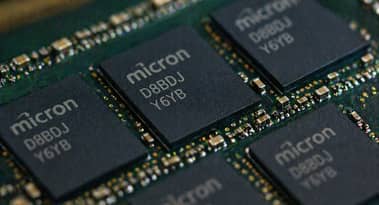
Micron Technology MU shares fell about 6%, while SanDisk dropped more than 12%. US-listed shares of South Korea's SK Hynix also declined nearly 9%.
CXMT's market debut fuels competitive concerns
CXMT's shares surged nearly 466% on their first day of trading on Shanghai's technology-focused STAR Market, making the company the most valuable China-listed chipmaker.
The listing comes as CXMT continues to expand rapidly in the global memory market.
According to Counterpoint Research, the company's share of the global DRAM market nearly tripled over the past year to approximately 8% during the first quarter.
While that remains well below Micron's estimated 22% market share, the pace of growth has raised concerns among investors.
Analysts expect the fresh capital raised through the listing to accelerate CXMT's manufacturing expansion, particularly in commodity DRAM products used in smartphones, personal computers, and servers.
Nomura estimates CXMT could increase its global DRAM market share from roughly 10% today to about 18% by the end of 2028.
That growth would be supported by significant production expansion.
Monthly capacity is projected to rise from 280,000 12-inch wafers at facilities in Hefei and Beijing by the end of 2025 to 350,000 by the end of 2026 and approximately 550,000 by the end of 2028 through additional production lines in Shanghai.
Investor concerns have intensified in recent days following reports that Apple is testing DRAM chips supplied by CXMT.
The possibility that one of the world's largest electronics manufacturers could eventually source memory from a Chinese supplier has increased expectations that CXMT could win higher-profile customers more quickly than previously anticipated.
However, some analysts believe the competitive threat to Micron remains limited.
Milk Road AI analyst Melvin said CXMT is likely to compete most aggressively in commodity DRAM used in smartphones and PCs, but remains well behind in premium memory technologies.
He noted that Micron has increasingly shifted its focus toward high-bandwidth memory (HBM), which is used in artificial intelligence servers and data centres.
According to Melvin, CXMT remains at least two generations behind in HBM technology and therefore does not currently pose a significant threat in the rapidly growing AI memory segment.
China's semiconductor progress deepens concerns
The selloff gathered further momentum after The Information reported that China has started manufacturing domestically developed immersion DUV lithography machines, while also developing domestic EUV machines, even though they are still at a prototype stage.
Lithography equipment is regarded as the most technologically challenging part of semiconductor manufacturing because it prints microscopic circuit patterns onto silicon wafers.
Until now, Dutch company ASML has dominated the global market for advanced lithography equipment.
Chinese chipmakers have relied heavily on ASML's immersion DUV systems after US-led export restrictions blocked access to the company's more advanced extreme ultraviolet (EUV) machines beginning in 2019.
Samsung Electronics, SK Hynix, and Micron all manufacture advanced DRAM using ASML's EUV lithography systems, allowing them to produce smaller, faster, and more power-efficient chips.
Because the more advanced EUV systems are out of their reach, Chinese producers remain several years behind in advanced AI memory products.
However, the report said China is also developing a domestic EUV lithography machine, although that technology remains at the prototype stage.
ASML stock also plunged 6% on the report.

More details of the mega Anthropic IPO are coming out: here’s what we know

Software stocks are back from the dead as AI fuels growth: can the rally continue?

GoPro stock soars 200% after Markiplier stake, $285M Starman deal

SpaceX stock rally meets another lockup expiry test on September 9: what to expect

Dow closes 270 pts lower as strong jobs report lifts September Fed rate-hike bets
No results found
Loading articles...
Failed to load articles. Please try again.