
Xiaomi share price analysis as smartphone sales severely lag Samsung, Apple

AI Sentiment: 18/100 Bearish
This score is generated through AI-driven analysis of the article's content.

powered by

Buy TSMC. If Samsung’s semiconductor price hike spreads to other foundry supply chains, customers may front-load orders and lock in capacity, supporting utilization and pricing power. Even if smartphone volumes are weak, AI-driven demand and higher wafer pricing can offset handset softness. TSMC is the cleanest way to own the “higher chip prices” effect without betting on Xiaomi’s execution.
Key Risk: AI/semiconductor demand cools or customers successfully renegotiate lower wafer pricing, crushing pricing power and utilization.
Sell Xiaomi. Q2 shows shipments -26.3% YoY, revenue -6.1% YoY, and gross margin 19.8% vs 22.5%—clear demand weakness plus cost pressure. The article flags chip/memory price hikes as a continuing headwind, so the “turnaround” is likely slower than the market is pricing. Technicals back it: below 50/100-week EMAs and a rebound that looks like a dead-cat bounce; next downside magnet is HKD 21.44.
Key Risk: Chip prices fall fast and Xiaomi regains shipment growth and margins in the next 1–2 quarters, forcing a re-rating.
- Xiaomi stock has bounced back in the past few days.
- The company published weak earnings as its smartphone sales dropped.
- It is severely underperforming companies like Samsung and Apple.
Xiaomi share price has crawled back this week, moving from a low of HKD 25.32 on August 18 to the current HKD 28.45. This rebound happened after the company published its financial results, which demonstrated the lingering weakness in its business.
Xiaomi’s revenue and profits dropped in Q2
China’s Xiaomi has become a major player in the smartphone and electric vehicle markets. It is the third-biggest smartphone company in the world after Apple and Samsung, while its EV brand is growing substantially in China.
The challenge, however, is that the company relies on memory and chips from other companies. These products have seen their prices surge in the past few months as the artificial intelligence boom has intensified.
This, in turn, has pushed it to hike prices, which is affecting its growth. The most recent results showed that its smartphone shipments stood at 31.2 million units in the second quarter, down by 26.3% from a year earlier. In contrast, Apple’s shipments rose by 5.3% to 60.5 million, while Samsung’s rose by 23% to 55.1 million. Its weakness was worse than other brands like OPPO and Vivo.
The results showed that its revenue dropped to 108.9 billion yuan in Q2 from 116 billion in the same period last year. Its smartphone and IoT segment made 84 billion yuan, down from 94 billion a year earlier. This slowdown was offset by a slight increase in its electric vehicle revenue, which rose to 24.9 billion yuan.
Xiaomi’s margins also continued falling, with the gross figure dropping to 19.8% from the previous 22.5%. The net profit fell to 6.2 billion yuan from 10.8 billion yuan in the same period last year.
The unfortunate aspect is that Xiaomi’s business will remain under pressure in the foreseeable future as chip prices continue rising. In a statement, Samsung said that it would hike the price of semiconductor manufacturing. While Samsung does not make Xiaomi’s chips, the announcement means that other firms like TSMC and MediaTek may decide to do the same.
Therefore, Xiaomi’s investors will likely have to accept the ongoing challenges and the fact that its turnaround will take longer than expected. This explains why its valuation multiples have improved, with the price-to-earnings ratio falling to 16, much lower than Apple’s 35.
Xiaomi stock price forecast
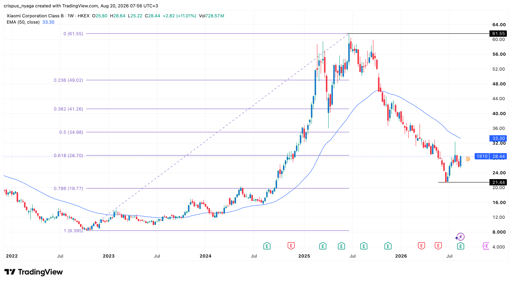
Xiaomi chart | Source: TradingView
The weekly chart shows that the Xiaomi share price has been in a steep decline in the past few years, moving from the year-to-date high of HKD 61.5 to the current HKD 28.45. It has dropped below the 61.8% Fibonacci Retracement level.
The stock has remained below the 50-week and 100-week Exponential Moving Averages (EMA), a sign that bears remain in control. Therefore, for now, there are signs that the ongoing rebound is a dead-cat bounce, which is a brief rebound that is followed by a retreat.
If this happens, the next key level to watch will be the year-to-date low of HKD 21.44. A drop below that level will point to more downside over time.

Dow opens 280 pts lower as oil tops $100, fueling Fed rate hike concerns

Rocket Lab stock is down 56% from its yearly high: Is this a buying opportunity?

Chime Financial stock jumps after Stride Bank deal; upside of up to 40% seen

Plug Power stock forms a risky pattern as short-seller pressure builds

Dow futures tumble over 300 points: 5 things to know before Wall Street opens
No results found
Loading articles...
Failed to load articles. Please try again.