
Here’s why the Alibaba stock is crashing in Hong Kong today

AI Sentiment: 18/100 Bearish
This score is generated through AI-driven analysis of the article's content.

powered by

Buy Trustar Capital Group (the buyer of Lingxi Games) as a second-order beneficiary of Alibaba’s asset sale. If Alibaba is exiting/downsizing gaming to fund AI, the gaming unit’s sale can be a near-term catalyst for the buyer’s portfolio and deal momentum, while Alibaba’s gaming cash becomes “clean” funding for AI. This can re-rate the buyer as a consolidator in China gaming assets.
Key Risk: The Lingxi deal fails to translate into profitable growth (weak monetization/regulatory or competitive pressure), so the buyer’s upside never materializes.
Sell Alibaba (BABA) / short HK: 9988.HK. Earnings show AI revenue growth (cloud/compute +45%) but profits are collapsing (operating income -57%, net income -75%) while capex spikes (RMB 67B). The $10B share dilution at a discount adds immediate supply and signals investors will keep funding losses. Technicals confirm momentum: below the 50-day MA, RSI <50, double-top breakdown—likely drift toward ~HK$100.
Key Risk: AI spending turns into sustained margin expansion fast enough to reverse the profit collapse and dilution overhang.
- Alibaba shares are falling sharply in Hong Kong today.
- The company’s costs have jumped amid the AI boom.
- It announced a $10 billion share offering, diluting its shareholders.
Alibaba stock price dropped sharply in Hong Kong, reaching its lowest level since July 30th, as traders reacted to its earnings report and its plan to dilute shareholders. It plunged to H$111, down substantially from this month’s high of H$130.1. It has slumped by over 40% from its highest level last year.
Alibaba stock dropped as AI costs surge
BABA stock dropped even after the e-commerce and cloud company, published strong financial results. These numbers demonstrated that its business was seeing strong demand across most of its business.
Alibaba’s revenue rose by 9% in the second quarter to over 268 billion RMB. Its e-commerce revenue rose by 4%, while its AI cloud and compute services rose by 45%. Most notably, its AI labs and applications revenue rose by 16% during the quarter.
However, the main challenge is that the company’s revenue came at a cost. Its income from operations dropped by 57% to over 15.1 billion RMB, while its net income tumbled by 75% to 10.4 billion RMB. These costs may continue rising as the company invests huge sums of money on its AI business. Its capital expenditure soared to over 67 billion RMB during the quarter.
Alibaba stock dropped after the management announced that it raised $10 billion by selling new shares in Hong Kong. It sold 710 million shares at HK 112.7 each, a discount from where it closed on Friday.
In addition to this, the company announced that it sold Lingxi Games, its gaming studio as it seeks to pump more money to its AI business. It sold the business to Trustar Capital Group.
AI business is starting to pay off
On the positive side, there are signs that Alibaba’s AI investments are starting to pay off. For example, a recent report showed that its models had achieved about 3 billion downloads, more than other companies like Meta Platforms and Google.
Alibaba has also inked a major partnership with Apple, which is now using its models in China. And its recent models have become so successful that they are at par with Fable, Anthropic’s new model.
The challenge, however, is that competition is at an elevated level in China. This competition is coming from companies like Moonshot, DeepSeek, and MiniMax. As a result, as we have seen in the electric vehicle industry, this competition may lead to price wars, which will affect its margins.
Alibaba share price technical analysis
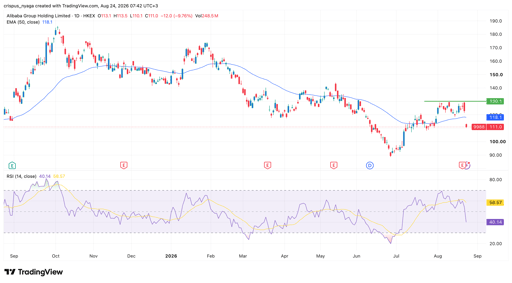
BABA stock chart | Source: TradingView
The daily chart shows that Alibaba shares have plunged in the past few days. It dropped to 111 HKD in Hong Kong, its lowest level since July 30. This retreat happened after it formed a double-top pattern, a common bearish reversal sign in technical analysis.
The stock has slumped below the 50-day moving average, while the Relative Strength Index (RSI) has moved below the neutral level of 50. Therefore, the stock will likely continue falling, potentially to the psychological level of 100 HKD. The bearish outlook will be invalidated if it moves above the key resistance at 130 HKD.

How will private credit and equity stocks react to Fed rate hikes?

WTI crude oil price forecast as Middle East risks remain elevated: can it hit $120?

Top crypto price predictions today: Pi Network, Pepe Coin, Zcash

Why SpaceX stock is up around 1% on Friday

Should you buy the dip in OKLO stock today?
No results found
Loading articles...
Failed to load articles. Please try again.