
SpaceX stock gains as Bernstein maintains bullish outlook
AI Sentiment: 72/100 Bullish
This score is generated through AI-driven analysis of the article's content.

powered by

Buy SPCX. Bernstein reiterates Outperform and a $248 target, with strong fundamentals in launch services, orbital data centers, and Starlink. The stock move is justified by the 52% gross margin and $23B trailing revenue, while the only major overhang flagged is direct-to-device mobile execution—so you’re paying for the diversified core, not betting on the hardest segment first.
Key Risk: Direct-to-device mobile proves uneconomic or fails to scale, forcing costly delays and capital burn that overwhelms the profitable core.
Buy telecom infrastructure/tower exposure tied to satellite-to-device buildout (e.g., American Tower AMT or Crown Castle CCI). Bernstein explicitly flags implications for telecom and tower operators from SpaceX’s direct-to-device plans. If SpaceX needs more ground infrastructure, backhaul, and site capacity, these names get second-order demand even if the mobile service ramps slower than hoped.
Key Risk: SpaceX’s direct-to-device rollout uses minimal third-party tower/ground infrastructure, so tower demand doesn’t materialize.
- Bernstein maintains an Outperform rating on SpaceX with a $248 price target.
- Bernstein sees Starlink's direct-to-device business as a key challenge.
- SpaceX targets mid-2027 for Starship launches of Mobile V2 satellites.
SpaceX stock SPCX gained on Monday after Bernstein SocGen Group reiterated its Outperform rating and $248 price target, while highlighting uncertainty around the company's direct-to-device mobile business.
Bernstein remains positive on SpaceX's broader opportunities, including launch services, orbital data centers and Starlink broadband for consumer, enterprise and government customers.
The firm said these businesses support its positive outlook for the company's stock.
"We continue to be optimistic about the overall SpaceX opportunity," Bernstein said, while identifying the direct-to-device mobile business as the segment it considers most difficult.
SpaceX generated $23 billion in revenue over the last 12 months with a gross profit margin of 52%, according to Bernstein. The company remains unprofitable.
Direct-to-device business remains a challenge
Bernstein's main concern centers on SpaceX's plans to expand Starlink into direct-to-device mobile connectivity.
The company plans to begin Starship launches of its Mobile V2 satellite constellation in mid-2027.
Bernstein previously examined the prospects for SpaceX's mobile business in a report titled "SpaceX: The Telecom Play - Can Direct-to-Device Work?"
Its latest analysis focuses on the requirements and costs associated with SpaceX's planned buildout, as well as potential implications for companies operating in the telecom and tower industries.
The work was led by Bernstein's US Communications Infrastructure and Telecom teams.
The firm's assessment suggests that while SpaceX has multiple businesses supporting its long-term opportunity, the direct-to-device segment presents greater challenges than its other activities.
Bernstein's positive stance therefore remains focused on the broader SpaceX opportunity rather than a full endorsement of its mobile ambitions.
SpaceX faces Dragon launch delay
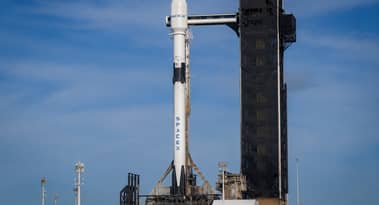
Separately, SpaceX and NASA are delaying the planned Crew-13 mission to the International Space Station after identifying an oxidizer leak in the Dragon spacecraft's propulsion system.
NASA and SpaceX are conducting additional testing and have not announced a new target launch date. The mission is expected to carry American, Canadian, and Russian astronauts.
Dragon is SpaceX's primary spacecraft for transporting astronauts and cargo to orbit and is the only US alternative for transporting crew to the International Space Station.
The launch delay comes after a busy period for SpaceX.
The company launched a $4.3 billion NASA telescope designed to study dark matter and dark energy on Sunday. Following the launch, President Donald Trump praised the mission during a post-launch press conference.
The broader US space sector is also receiving attention from the administration. Trump began the process Friday of creating a "US space academy" intended to serve the US Space Force and support civilian spaceflight through NASA.
For investors, Bernstein's reiterated rating underscores its continued confidence in SpaceX's diversified business prospects.
At the same time, the firm's assessment highlights the direct-to-device mobile operation as an area where execution, costs and competitive dynamics could remain important considerations as the company works toward its planned 2027 satellite launches.

Apple stock falls as Tim Cook signs off, Ternus faces AI and post-iPhone tests

Strategy (MSTR) stock gains after resuming Bitcoin purchases after 10 weeks

Dell stock flags bearish divergence pattern as earnings loom: will it rise or fall?

Nvidia stock rises as company announces $3.5B investment in MediaTek

Credo Technology stock: Insider selling meets options market jitters before earnings
No results found
Loading articles...
Failed to load articles. Please try again.