For educational purposes only. Invezz is not registered with CIRO. Consult a qualified financial adviser before investing.
Capital at risk:
Your investments can go up and down, including cryptoassets which are highly volatile, unregulated, and not protected by CIPF. You may get back less than you invest. Past performance is not a reliable indicator of future results.
CFD warning:
68–72% of retail accounts lose money trading CFDs due to leverage.
Affiliate disclosure:
We may earn a commission from partner links. This never influences our editorial opinions or evaluations.
Forex is the world's largest financial market with turnover reaching US$9.6 trillion per day in 2025, up 28% in three years, with the US dollar on one side of 89% of all trades.
Canadians can access it through CIRO-regulated brokers offering major and CAD currency pairs, flexible leverage, and around-the-clock market hours, but risk management matters more than any other skill.
Whether you are still working out how to start trading or already active in other markets, this guide explains how to trade forex in Canada: choosing a regulated broker, opening and funding an account, sizing positions, and placing your first currency trade.
Quick answer: How to trade forex in Canada?
To trade forex in Canada, open an account with a suitable broker such as AvaTrade, OANDA, Plus500, FOREX.com, or CMC Markets, complete identity checks, and fund it using an available Canadian payment method. Start with a demo account, then trade a currency pair such as USD/CAD using a defined position size, stop-loss, and take-profit order while keeping risk per trade to around 1% to 2% of your balance.
How to trade forex in Canada: A step-by-step guide
Trading forex in Canada involves choosing how you want market exposure, opening an account with a suitable broker, funding it, and placing trades using clear risk controls. Beginners should start with a demo account and avoid using the maximum leverage available until they understand how position size, spreads, and price movements affect losses.
Step 1: Decide how you want exposure to forex
All retail forex trading in Canada runs through a broker, but "trading forex" covers five different activities, and the right platform depends on how you want to trade.
Route
How it works
Worth knowing
Broker fit
Trading currency pairs directly
Speculate on one currency rising or falling against another, in pairs such as USD/CAD, EUR/USD, and GBP/CAD, through a broker's own platform, MT4, MT5, or TradingView
Costs come almost entirely from the spread, so this route rewards comparing pricing closely, which Step 2 covers
OANDA allows very small position sizes for learning with tiny stakes; CMC Markets carries over 300 pairs for traders who want minors and exotics
Leveraged CFDs
Most retail forex in Canada is technically traded as a leveraged contract, which magnifies gains and losses alike. Margin on major pairs works out to roughly 30:1 leverage at most CIRO dealers
Treat leverage as a separate decision from trading itself. Once it is involved, position sizing matters more than pair selection. Full rules in the leverage section below
Available at all the CIRO dealers compared in this guide
Copy trading
Your account automatically mirrors the trades of another trader
Removes the execution burden but none of the risk, and adds one, since past performance of the trader you copy is all you can evaluate, and it does not predict their future results
AvaTrade supports copy trading for Canadian clients
Automated strategies
MetaTrader's expert advisors run rule-based strategies without manual input
Suits traders who already have a tested strategy, and suits nobody as a first step. An automated bad strategy just loses money faster
Any MT4/MT5 broker, including AvaTrade and FOREX.com
Forex options
Contracts giving the right to exchange at a set rate
The one leveraged structure where maximum loss is known in advance, capped at the premium paid, which you pay whether or not the move happens
Available through AvaTrade
What leverage is allowed for forex trading in Canada?
There is no single leverage cap in Canada.
CIRO sets minimum margin rates rather than a headline leverage number, so the leverage available on any trade depends on the currencies involved, the account's base currency, and the dealer's own margin treatment, which can be stricter than the regulatory minimum.
The structure is worth understanding because it explains the numbers brokers quote.
What CIRO publishes
What it means for your trade
Spot FX risk margin rates
The minimum percentage of a position's value that must be held as margin, published for Canadian and US base-currency accounts and updated through the year
Four currency groups
Each currency is assigned to a group that determines its margin requirement, with major, liquid currencies attracting lower margin than volatile or thinly traded ones
Sections 5461 to 5469 of the IDPC Rules
The rulebook dealers must follow when margining unhedged FX positions
In practice, the published rates work out to roughly 30:1 maximum leverage on major pairs at most CIRO dealers, with lower leverage on minors and exotics as the margin rates step up by group. Your broker's platform shows the exact margin requirement per pair before you place the trade.
How margin translates to leverage
Margin is the capital your account sets aside to hold a position, and leverage is just its reciprocal.
Exposure
Margin required
Effective leverage
$10,000
$333 (3.3%)
30:1
$10,000
$1,000 (10%)
10:1
$10,000
$2,000 (20%)
5:1
The same arithmetic runs in reverse, and that is the part to internalise before trading. At 30:1, a move of about 3.3% against the position wipes out the margin behind it entirely. Major currency pairs move that much in volatile weeks, not volatile years.
Before using leverage
Confirm the firm is registered in your province and is a CIRO member, since forex in Canada is regulated as trading in a security or derivative and unregistered offshore leverage offers are a standing source of investor alerts.
Check the broker's current margin schedule for the pairs you trade, not the advertised headline.
And know which currency group your pairs fall into, because a strategy built on majors and one built on exotics face different margin maths.
The CSA's own description of retail forex is blunt, calling it very complicated, high risk, and typically not for the average investor. Leverage is the reason. It is also optional, and nothing requires a funded forex account to use the maximum available.
Step 2: Choose a regulated platform or provider
Compare each broker’s Canadian legal entity, regulatory status, trading costs, available currency pairs, platform tools, and deposit requirements. Regulation is especially important because the protections attached to an account depend on the entity that holds the client’s money, not simply the broker’s global brand.
Where is the best place to trade forex in Canada?
There is no single best broker for every Canadian trader. AvaTrade is well suited to beginners and copy trading, OANDA stands out for flexible trade sizing, FOREX.com offers strong education and more than 80 currency pairs, and CMC Markets provides one of the widest forex selections, while Plus500 may appeal to traders who prefer a simplified proprietary platform.
Broker
Best suited to
Forex offering
Minimum deposit
Main platforms
Key consideration
Best suited to
Beginners and copy traders
Forex offering
50+ currency pairs
Minimum deposit
$100
Main platforms
MT4, MT5, WebTrader, AvaTrade App, AvaOptions
Key consideration
Fixed or spread-based pricing can be easier to understand, but retail spreads may be higher than some competitors
Opening a forex account involves more questions than opening a bank account, and the questions are not padding. A CIRO dealer must assess whether a leveraged trading account is appropriate for you before activating it, so the application is partly an eligibility check. Understanding what each part is for makes the process faster and the answers easier to give.
What you will be asked for, and why
What the forex broker requests
Why it is asked
Identity basics such as full name, residential address, date of birth, and contact details
Canadian identity and anti-money-laundering rules require verified identity before the account can trade
Social Insurance Number
Normal and legitimate here, unlike on many crypto platforms. CIRO dealers are investment dealers that issue tax slips, and the SIN is required for that reporting
Government photo ID and proof of address
A passport or driver's licence plus a recent bank statement or utility bill. The ID must be current, and the address must match the application
Employment, income, and net worth
Part of the dealer's appropriateness assessment. These answers help determine whether a margin account should be opened at all
Trading experience questions
The part beginners try to game, and should not. Overstating experience can unlock leverage you are not equipped to manage, and it removes a protection that exists for you, not the broker. Answer honestly and let the account grow with you
The two checks worth doing before you sign
Confirm the legal entity. The brand on the website and the regulated firm holding your account can differ.
Canadians trading with AvaTrade actually hold accounts with Friedberg Direct, a division of Friedberg Mercantile Group, and FOREX.com's Canadian accounts sit with GAIN Capital - FOREX.com Canada Ltd.
The entity named in your account agreement is the one whose CIRO membership, CIPF coverage, and complaint process apply to you, so that is the name to verify on the regulators' registers, not the brand.
Choose your account currency deliberately. A CAD-denominated account converts profits and losses on non-CAD trades at the broker's conversion rate, while a USD account avoids that on USD-quoted pairs but adds conversion when you fund from a Canadian bank.
Neither is wrong, but the choice compounds over hundreds of trades, and it is easier to set correctly now than to change later.
While you are in the agreement, find two documents. The margin agreement sets out when the broker can close your positions, and the risk disclosure states whether negative balance protection applies, which varies by broker and is not universal in Canada.
How long verification takes
The application itself takes around 5 to 10 minutes.
Automated identity checks often clear the same day, and manual reviews stretch to a few business days. The common delays are avoidable, expired ID, an address that does not match the application, unclear document photos, and source-of-funds checks on larger planned deposits, which are routine rather than a problem.
One practical use for the waiting period. Nearly every forex broker offers a demo account instantly, with no verification needed, and the days while your documents clear are exactly the time to learn the platform's order tickets and test its spreads with zero at stake.
Step 4: Deposit funds
After verification, fund the account through a method the broker's Canadian entity accepts. Two decisions at this stage matter more than the payment method, how much to start with, and which currency the money lands in.
Deposit methods compared
Method
Typical speed
Worth knowing
Electronic funds transfer / online bank transfer
Same day to 2 business days
Usually free and the standard route for CAD funding
Debit or credit card
Near-instant
Fastest, but funding a leveraged account with borrowed money stacks leverage on leverage, and some card issuers treat broker deposits as cash-like transactions with extra fees
Bank wire
1 to several business days
Suits larger amounts. The sending bank often charges, and international wires can add conversion along the way
Digital payment services
Near-instant where offered
Availability varies by broker. Check the fee before assuming it is free
Whatever the method, the account you fund from must be in your own name. Third-party payments are an anti-money-laundering red flag that can freeze a new account before it ever trades.
Minimums, and viable starting amounts
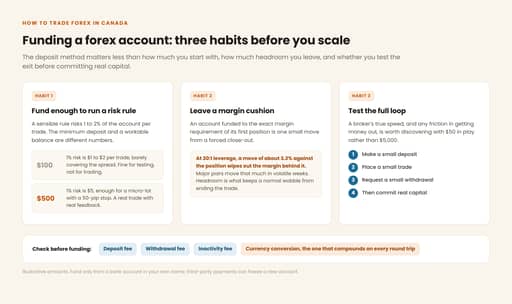
AvaTrade and FOREX.com require a minimum deposit of CAD $100, while OANDA and CMC Markets have no minimum. But the minimum and a workable starting balance are different numbers, and conflating them is a common early mistake for new forex traders.
The arithmetic behind this is simple.
A sensible risk rule is 1 to 2% of the account per trade. On a $100 account that is $1 to $2 of risk, which barely covers the spread. On $500, risking 1% supports a micro-lot position with a 50-pip stop, which is a real trade with real feedback.
Fund enough to run your risk rule properly, and not a dollar you cannot afford to lose beyond that.
There is also a margin cushion to think about. An account funded to the exact margin requirement of its first position gets closed out by the first small move against it. Leave headroom, or the broker's platform will manage your risk for you, at the worst possible moments.
Checking costs before you fund
Deposit fees are only one cost. Check four numbers:
The card or wire fee on the way in
The withdrawal fee on the way out
Any inactivity fee if you plan to trade occasionally
The currency conversion
Funding a USD-denominated account from a Canadian bank converts your deposit at the broker's rate, typically with a markup, and this is where the account-currency decision from Step 3 either pays off or quietly costs you on every round trip.
Start small even above the minimum, then test the full loop. Make the deposit, place a small trade, and request a small withdrawal before committing serious capital. A broker's true processing speed, and any friction in getting money out, is worth discovering with $50 in play rather than $5,000.
Step 5: Start trading forex
A forex trade has four decisions, the pair, the direction, the size, and the exit. Beginners tend to spend all their attention on the first two, and the last two are where accounts are won or lost.
Read the pair correctly before picking a direction
Every pair quotes the base currency against the quote currency, and the price is what one unit of the base costs in the quote. Buying USD/CAD means buying US dollars and selling Canadian dollars, so you profit if the US dollar strengthens against the loonie.
Misreading this sounds trivial and catches beginners constantly, especially on CAD pairs, where "I think the Canadian dollar will rise" means selling USD/CAD, not buying it.
Stick to major pairs at the start, EUR/USD, USD/CAD, GBP/USD, because their spreads are a fraction of what minors and exotics cost, and spread is a fee you pay on every single trade.
Size the position from your risk, not your conviction
Work backwards from the loss you can accept, never forwards from the profit you want.
Step
Example
1. Set your risk per trade
1% of a $500 account is $5
2. Choose your stop distance
Your analysis says the trade is wrong if price moves 50 pips against you
3. Divide risk by stop
$5 across 50 pips is $0.10 per pip, which is one micro lot on USD-quoted pairs
That is the entire calculation, and it means position size falls out of the maths rather than the mood. A trader who always risks 1% can be wrong five times in a row and lose 5% of the account. A trader sizing on conviction can be wrong once and lose half of it.
Place the trade with the exit attached
Select Buy for a long position or Sell for a short one, and attach the stop-loss and take-profit to the order at entry, as one bracket, rather than planning to add them later. Later is exactly when a losing position starts negotiating with you.
Order type
What it does
The catch
Market order
Opens now at the best available price
The fill can differ slightly from the quote in fast markets
Limit order
Opens or closes only at your price or better
May never fill
Stop order
Activates once price reaches your level
Becomes a market order when triggered
Stop-loss / take-profit
Close the position automatically to cap the loss or bank the gain
A standard stop-loss is not guaranteed. In gaps and fast markets the fill can be worse than the level. Some brokers offer guaranteed stops for a premium
When to trade, and when to leave it alone
The forex market runs around the clock from Sunday evening to Friday afternoon ET, but liquidity is not flat.
The busiest window for Canadian traders is the London and New York overlap, roughly 8:00 a.m. to noon ET, when spreads on EUR/USD, GBP/USD, and USD/CAD are usually at their tightest.
Two Canadian timing specifics sit inside that window.
Most Canadian economic data, including CPI and jobs, lands at 8:30 a.m. ET, and Bank of Canada rate announcements publish at 9:45 a.m. ET, so CAD pairs can move sharply at both times. Scheduled news cuts both ways, the best liquidity of the day sits around it, and so do the fastest spikes, which is when stop-losses fill at worse prices than set.
Then for quiet hours, around 5:00 p.m. ET the market rolls to the next day, spreads widen briefly, and positions held through that point pay or receive the overnight funding rate. Holding through the weekend adds gap risk, since the market can reopen Sunday at a different price than it closed, beyond the reach of any standard stop.
Once the trade is on, the job is to let the plan work.
Set a price alert instead of watching the screen, and log every trade, the reason in, the reason out, and the result, because a month of journal entries will teach you more about your trading than any indicator will.
Step 6: Manage risk and diversify
Risk rules are certainties you set yourself, and they are the only part of trading fully within your control. Build them into every trade before entry, never after a position has moved against you.
The rules to help manage forex trading risk
Rule
What it prevents
Risk 1 to 2% of the account per trade
Any single trade mattering. At 1%, ten straight losses cost a tenth of the account. At 10%, they end it
Set the stop and target before entry
The mid-trade renegotiation where losses run because "it will come back"
Require at least twice the reward for the risk
Needing to be right most of the time. At 1:2 risk-reward, a 40% win rate is profitable
Set a daily stop, three losses or 3% down, then done
Revenge trading, the fastest way accounts die. The market reopens tomorrow; blown accounts do not
Why small risk wins the long game
Drawdowns are asymmetric. A 10% loss needs 11% to recover. A 50% loss needs 100%.
Small risk per trade is not caution for its own sake. It keeps the recovery arithmetic on your side.
Diversify across currencies
Holding several pairs is not diversification if they are the same bet wearing different tickers.
Long EUR/USD, long GBP/USD, and short USD/CHF is one large short-USD position split across three trades, and a single piece of US data moves all of it at once.
Two correlations matter most for Canadian traders:
Correlation
The trap
The US dollar runs through most major pairs
Count your net USD exposure across all open trades before adding another
USD/CAD tracks oil
A CAD pair plus an energy position, in a trading account or a stock portfolio, is often the same bet twice
Before each new trade, ask one question. Does this position make money in the same scenario as my existing ones? If yes, you are adding size, not diversity.
Where retail forex losses normally come from
The recurring causes are a short list, and each has appeared earlier in this guide with its defence attached:
Leverage magnifying ordinary moves
Spreads widening at news releases and the daily rollover
Slippage past stop-losses in fast markets
Overnight financing quietly eroding held positions
Position sizes set by conviction rather than arithmetic
None of them can be eliminated. Forex trading is unsuitable for money you cannot afford to lose, and the rules above decide how long you stay in the game while you learn whether you can win it.
Step 7: Monitor performance and rebalance
Most traders remember their wins and rationalise their losses. A journal exists to overrule that memory, and it is the cheapest edge available to a beginner.
Keep a journal worth reviewing
Log every trade at the time, not from memory at the weekend. One row per trade:
Field
Example entry
Pair and direction
Short USD/CAD
Reason for entry
BoC held rates, oil rallying, price rejected resistance
Size and risk
One micro lot, $5 at risk (1%)
Stop and target
Stop 50 pips, target 100 pips
Result and fees
+82 pips, $8.20, spread cost $0.90
Execution notes
Moved stop to breakeven too early, cut the win short
The last field matters most. Fees and mistakes are the two costs traders forget, and the journal is where they become visible.
Review on three clocks
Cadence
What to check
Daily
Open positions only. Are stops in place, is net USD exposure within your limit, is any news due before tomorrow
Weekly or monthly
Completed trades. Win rate, average win against average loss, and whether losses respected the 1% rule
Quarterly
The strategy itself. Judge it on a sample of 20 to 30 trades or more, never on the last three
The numbers that tell you if a forex strategy is working
Two calculations separate a repeatable strategy from a lucky streak.
Expectancy. Multiply your win rate by your average win, subtract your loss rate times your average loss. A trader winning 45% of the time with an $80 average win and a $40 average loss earns $14 per trade on average. Positive expectancy over a real sample is will show results; a high win rate on its own proves nothing.
The concentration test. Recalculate your results with your three best trades removed. If the profit disappears, the account is being carried by outliers, not by an edge, and the next quarter has no reason to repeat them.
Rebalance the risk, not just the positions
Rebalancing in forex is about exposure, not asset allocation. If one currency, one market theme, or one strategy has grown to dominate the account's risk, trim it back to plan, using the correlation check from Step 6.
Apply the same discipline to size.
Scale up only after a sustained profitable sample, two to three months, not two to three trades, and cut position size after a meaningful drawdown rather than trading harder to win it back. Withdrawing a portion of profits periodically is worth considering too, since money moved out of the account is the only profit leverage can no longer touch.
What factors influence forex prices?
A currency pair prices the difference between two economies, so nothing moves it in isolation. Every driver, interest rates, inflation, growth, politics, commodities, works through the same question, which of the two currencies does this make relatively more attractive to hold?
That framing matters in practice. Strong Canadian data does not lift USD/CAD's loonie side if US data that morning was stronger still, and beginners lose money trading the headline instead of the difference.
The pairs Canadian traders watch, and what moves each one
Pair
What drives it
The scheduled events that move it
USD/CAD
The Bank of Canada versus the Fed, and oil, since the loonie still trades partly as a petrocurrency
Canadian CPI and jobs at 8:30 a.m. ET, BoC decisions at 9:45 a.m. ET, US CPI and jobs at 8:30 a.m. ET, Fed decisions at 2:00 p.m. ET
EUR/CAD
European Central Bank policy against the BoC, eurozone inflation, and oil on the CAD side
ECB decisions early afternoon Frankfurt time, mid-morning ET, plus eurozone CPI
GBP/CAD
Bank of England policy, UK inflation, and oil
BoE decisions at noon London time, 7:00 a.m. ET, plus UK CPI
CAD/JPY
Risk appetite in its purest CAD form, an oil currency against the safe-haven yen. Rallies when markets are calm, drops hard when they are not
Bank of Japan decisions overnight ET, plus anything that moves global risk sentiment
AUD/CAD
Two commodity currencies, iron ore and China's economy on one side, oil on the other
Reserve Bank of Australia decisions overnight ET, Chinese data releases
CAD/CHF
Oil against the Swiss franc's safe-haven role
Swiss National Bank decisions, quarterly rather than eight times a year
NZD/CAD
Dairy exports and China exposure against oil
Reserve Bank of New Zealand decisions overnight ET
EUR/USD
The world's most traded pair, roughly a quarter of global turnover, driven by the ECB against the Fed
ECB and Fed decisions, US and eurozone CPI
GBP/USD
BoE against the Fed, with UK political risk a recurring wildcard
BoE and Fed decisions, UK and US CPI
EUR/GBP
The ECB against the BoE with no US dollar in the pair, which makes it a way to trade Europe without a view on the Fed
ECB and BoE decisions, often quiet between them
Two patterns fall out of the table. Every CAD pair carries oil on one side, so a view on a CAD cross is partly a view on energy. And the overnight pairs, CAD/JPY, AUD/CAD, NZD/CAD, make their biggest moves while Canadians sleep, which is an argument for smaller positions or wider stops on those crosses.
Which economic factors influence forex prices?
Central-bank policy is the strongest driver, because currencies reprice on the expected path of interest rates, not just the current level. A rate hike that markets fully expected can move a pair less than a single surprising inflation print, since the surprise changes the path.
For CAD pairs the hierarchy is rate expectations first, then oil, then the data that feeds rate expectations, inflation and jobs above all. The practical habit from the calendar section of this guide applies doubly here, know what is scheduled before opening a position, because the table above shows almost every major mover publishes on a known date at a known time.
How risky and volatile is forex trading?
The volatility numbers sound tame and are not. Major pairs typically move well under 1% a day, which is exactly why leverage is offered and exactly where it bites. At 30:1, an ordinary 1% adverse move consumes about a third of the margin behind the position, and a 3.3% move, a bad week rather than a crisis, wipes it out entirely.
Speed compounds the size problem. The largest moves cluster in the minutes around the scheduled announcements in the table above, when spreads widen and stop-losses can fill beyond their level. A stop is a plan, not a guarantee, in those windows.
The defences are the ones this guide keeps returning to, position sizes set from the 1 to 2% risk rule, stops attached at entry, leverage treated as optional rather than a target, and no money in the account you cannot afford to lose.
Forex trading legalities, safety, and tax
Forex trading is legal everywhere in Canada, provided the broker serving you meets national and provincial registration requirements.
Safe is a different question, and it splits in two.
Broker risk, the danger that the firm holding your money fails or misbehaves, is well controlled at regulated Canadian dealers.
Market risk, the danger of losing money trading leveraged currencies, is untouched by any regulation and always will be.
What stands behind a regulated Canadian broker
The Canadian Investment Regulatory Organization is the national body overseeing the investment dealers that offer retail forex, with provincial and territorial regulators, coordinated through the CSA, supervising firms in each jurisdiction, which is why availability can vary by province.
Membership carries specific obligations, and each protects against something specific.
Protection
What it covers
What it does not
CIRO conduct and capital rules
Client money segregated from the firm's own funds, minimum capital, margin rules, and compliance oversight
Your trading decisions
CIPF coverage
Up to CAD $1 million per account category in missing property if a member firm becomes insolvent, automatic at CIRO dealers
Trading losses, adverse currency moves, and leveraged positions going wrong
Provincial regulators
Registration and complaint handling where you live
Losses from products working as designed
The nuance that matters is entity-level. A global brand's Canadian arm and its offshore arms are different companies under different rules, and only the Canadian entity named in your account agreement carries CIRO membership, CIPF coverage, and a Canadian complaint path. Step 3 of this guide covers how to confirm which entity you are signing with.
The thirty-second check that filters out most fraud
Before any deposit, look the firm up in CIRO's dealer directory and the CSA's National Registration Search.
A legitimate Canadian forex broker appears in both. This single habit removes most of the fraud risk in retail forex, because the platforms behind investment scams are almost never registered anywhere in Canada.
The remaining red flags travel together. Guaranteed returns, pressure to deposit quickly, withdrawal terms that only become visible after funding, and the one specific to forex, an offshore licence presented as if it protected Canadians.
Overseas regulation may be real, but it is not Canadian registration, and CIPF does not stand behind it.
A firm claiming Canadian-grade protection while regulated only in an offshore jurisdiction is describing a protection you do not have.
Tax on forex trading
Forex profits are taxable, and how depends on conduct rather than choice. Occasional trading is generally treated as capital gains, with half the gain taxable, while frequent, organised trading can be classified as fully taxable business income.
The CRA decides on the facts, so keep complete records of every trade from the first one, and take qualified advice if your activity is more than occasional. The tax section of this guide covers the distinction in detail.
What are the pros and cons of forex trading in Canada?
Forex trading in Canada offers strong regulation, access to major global currency pairs, and flexible trading hours, but it also carries substantial risks. Leverage, rapid price movements, and trading costs can magnify losses, particularly for beginners without a clear plan.
Forex trading is legal and overseen by the Canadian Investment Regulatory Organization and provincial regulators.
The market operates 24 hours a day, five days a week, making it accessible around different work schedules.
Traders can access major, minor, and CAD currency pairs through AvaTrade, OANDA, Plus500, FOREX.com, and CMC Markets.
Demo accounts allow beginners to test platforms and strategies without risking real money.
Some Canadian accounts may qualify for Canadian Investor Protection Fund coverage if the broker becomes insolvent.
Leverage can turn small currency movements into significant account losses.
Spreads, commissions, overnight financing charges, inactivity fees, and currency-conversion costs can reduce returns.
Forex prices can move sharply after interest-rate decisions, inflation reports, employment data, or geopolitical events.
Investor protection does not cover losses caused by poor trades or market volatility.
The market requires regular monitoring, disciplined position sizing, and a strong understanding of economic conditions.
Is forex a good trading opportunity?
Forex can be a worthwhile trading opportunity for experienced Canadians who understand leverage, follow economic data, and use strict risk controls. It is less suitable for beginners seeking predictable returns, as currency markets are volatile and most success depends on disciplined position sizing, cost control, and a tested strategy rather than frequent speculation.
FAQs
You can technically start with around CAD $100 at brokers with low or no minimum deposit requirements, although a small balance limits position sizing and leaves less room for losses. Beginners should deposit only what they can afford to lose and use a demo account before trading real money.
Yes, beginners can trade forex in Canada, but they should first learn how currency pairs, leverage, margin, spreads, and stop-loss orders work. A demo account provides a safer way to practise placing trades and testing a strategy without risking capital.
A pip is a standard unit used to measure a currency pair’s price movement, usually in the fourth decimal place. For example, if EUR/USD moves from 1.1000 to 1.1001, it has moved by one pip, although the cash value depends on the position size.
Yes, AvaTrade, OANDA, Plus500, FOREX.com, and CMC Markets provide mobile trading access for eligible Canadian customers. Investing apps can be used to analyse charts, place orders, set stop-losses, and monitor positions, although detailed analysis may be easier on a larger screen.
A larger account can provide more flexibility, but it does not make a trader profitable or reduce the need for risk management. Returns depend on trading costs, position sizing, market conditions, and strategy, while using high leverage to compensate for a small account can rapidly increase losses.
Harry is a Financial Writer for Invezz. He has more than a decade of experience writing, editing, and managing content for blue-chip companies, with a background spanning high street and investment banks, insurance companies, and trading platforms.