
Brent crude oil price forecast as Trump sends mixed signals on Iran war

AI Sentiment: 28/100 Bearish
This score is generated through AI-driven analysis of the article's content.

powered by

Sell Brent exposure (e.g., short UKOIL futures or buy an inverse Brent ETF). The article shows Brent down 25% from the year high, below the 50-day EMA, RSI ~37 and falling—clear momentum plus “mixed signals” that keep risk premium from sticking. If the Iran deal drags, oil stays capped and grinds lower toward $80.
Key Risk: Trump actually follows through on a major Iran strike (or Kharg/Red Sea disruption) and Brent snaps back above key resistance fast.
Short Oil & Gas Equipment/Services (OIH). When Brent weakens on reduced escalation odds, upstream capex expectations and offshore/energy activity sentiment typically deteriorate, hitting service names faster than crude. This is a clean way to express “lower oil risk premium” without betting on exact barrel moves.
Key Risk: A renewed escalation drives a sustained oil rally, pulling OIH back in line with crude and reversing the sentiment hit.
- Brent crude oil price retreated after President Trump hinted of an Iran deal.
- The president said that the deal was in final stages and will be signed soon.
- Technical analysis suggests that the price has more downside to go.
Brent crude oil price continued its retreat after President Donald Trump sent mixed signals about his war with Iran. It retreated to $88, its lowest point since April 17, down by 25% from its highest point this year.
Brent crude oil price falls as Trump sends mixed signals
President Donald Trump sent mixed messages on Thursday. In his first message, Trump said that the US would launch major attacks against Iran, and even take Kharg Island, where Iran handles over 90% of its oil shipments.
Taking the island would be a major decision as it would involve having troops in a fixed location, exposing them to attacks. At the same time, it would lead to the biggest retaliation that Iran has ever done.
Iran has more advantages in the escalation ladder. For example, it can attack energy infrastructure in countries in the region, including names like Saudi Arabia, Qatar, Kuwait, and Bahrain.
Iran can also block the Red Sea, either directly or using the help of Ansah Allah, commonly known as houthis. Such would be a big move as over 12% of seaborne crude oil passes through that place.
READ MORE: Oil and gas prices underpricing Hormuz risks warns ING
In a separate statement, President Trump said that the US had finally reached an agreement with Iran following talks that involved countries like Saudi Arabia, Israel, and Pakistan. He said that the deal will be signed in Europe as soon as next week.
The sad reality, however, is that we have been here before. Trump has made several announcements on when the deal will be reached and signed. In most cases, he has made these announcements to boost the market.
For example, on Thursday, the stock market tumbled sharply when he announced that the US was planning to attack Kharg Island. After his change of mind, the markets reversed, with the Dow Jones adding 1,000 points and the Nasdaq 100 adding over 640 points. In his recent disclosures, Trump said that he executed over 3,500 trades in the first quarter.
Therefore, there is a likelihood that the deal will take a longer time to be reached. For one, Israel has remained committed to continue fighting in Lebanon, with Netanyahu maintaining that the fighting will continue. Iran has said that any deal it makes with the US must include Lebanon. At the same time, Iranian officials who talked to NBC rejected Donald Trump’s claims.
Brent crude oil price technical analysis
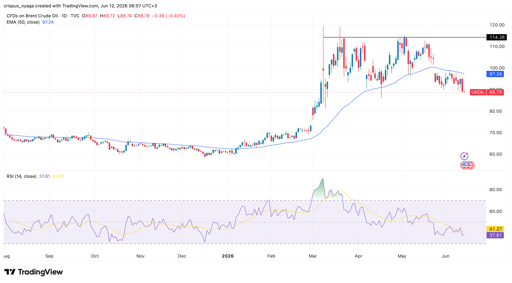
Brent crude oil chart | Source: TradingView
The daily chart shows that Brent plunged to a low of $88.93, its lowest level since April 17. It formed a large down-gap on May 22nd and moved below the 50-day Exponential Moving Average (EMA).
The Relative Strength Index (RSI) moved from a high of 90 in March to the current 37. It is pointing downwards and is hovering at its lowest point since January.
Therefore, the most likely scenario is where the price continues falling, potentially to the psychological of $80. However, a restart of the war, as we saw this week, will point to more gains.

Nio stock: Why Tesla rival dropped despite strong revenue growth

Nvidia stock analysis: top reasons why the shares may go parabolic soon

Broadcom stock falls to a key support: is it about to surge after earnings?

Oil jumps above $91, but the market’s biggest Hormuz fear has changed

Gold price sinks near two-week low: could US jobs data trigger the next crash?
No results found
Loading articles...
Failed to load articles. Please try again.