
Brent crude oil price crash to accelerate, but two key risks remain

AI Sentiment: 12/100 Bearish
This score is generated through AI-driven analysis of the article's content.

powered by

Sell Brent crude exposure via a short position in Brent futures (or an inverse oil ETF like USO/DBO-style inverse products if available). The article points to a supply surge (tankers waiting to cross Hormuz, Iran selling after sanctions lift, elevated US/Canada/Venezuela output) while demand is weakening (demand destruction from high prices). Technicals confirm: below the $86.23 neckline after a double-top, targeting ~$60.
Key Risk: A Middle East escalation that shuts Hormuz or triggers a US/Iran/Israel war, instantly removing the supply glut and forcing a sharp Brent rebound.
Short Russian oil-linked equities/ETFs (e.g., Lukoil (LUKOY) ADR or Russia-exposed energy baskets) or use crude differentials via a Russia crude proxy. Ukraine refinery strikes threaten Russia’s export ability (article cites near-record ~3.83m bpd shipping). If exports get disrupted, Russian barrels tighten relative to global benchmarks, but the broader oil complex can still fall—so Russia-specific supply risk should hurt Russian producers’ cash flows and valuations.
Key Risk: A rapid workaround that restores Russian refinery throughput and export routes (or a political deal that pauses strikes), letting Russia maintain shipments.
- Brent crude oil price has slumped in the past few months.
- The US-Iran deal will lead to a supply surge in the oil market.
- This surge will happen amid a period of prolonged demand destruction.
Brent crude oil price continued its strong downward trend today, June 23, reaching its lowest level since March 2nd as investors focused on the ongoing US-Iran talks. It has now slumped by over 35% from its highest point this year, and this trend may continue as supply jumps.
Crude oil supply to surge as demand destruction remains
Brent and the West Texas Intermediate (WTI) benchmarks have continued their recent downtrend as investors focused on the ongoing US-Iran talks in Switzerland and the fact that the Strait of Hormuz has been opened.
The hope is that the world oil supplies will surge in the coming months as there are hundreds of fully-loaded tankers waiting to cross the Strait. At the same time, iran is swimming in oil that it can now sell at market prices after the Trump administration lifted its sanctions.
On top of this, oil production remains at an elevated level in other countries. For example, US oil production has jumped to nearly 14 million barrels per day, while Canada is selling over 5.3 million barrels. Venezuela has come to the market after the arrest of Nicolas Maduro earlier this year.
At the same time, the announced supply increaes by OPEC+ cartel will now take effect as the Strait of Hormuz opening continues.
All this will happen at a time when there is an ongoing demand destruction in the oil market. This is happening because of the elevated oil prices in key countries and the supply chain issues.
Potential risks facing the oil market
There are two main risks that face the oil market today. The first one is the fact that Israel has opposed the current deal between the US and Iran, and will do everything in its power to destroy it. Its best option, in this case, is its attacks in Lebanon, which is a major red flag for Iran.
Intensified attacks against Lebanon will likely lead Iran to end the ongoing talks and start a bombing campaign against Israel. Such a move would push the US to intervene and restart the war.
The other key risk is the fact that Ukraine has intensified its attacks against Russian refineries this year. This trend will continue as the country seeks to bring pain to Russia’s government.
Such a move will disrupt the ongoing exports from the country. Recent data showed that Russia was shipping over 3.83 million barrels of crude oil per day, a near record.
READ MORE: What is in the new US-Iran peace deal? Here’s what we know
Brent crude oil price technical analysis
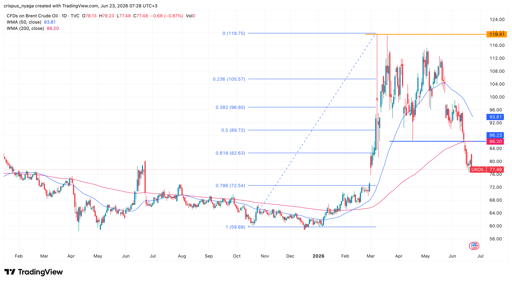
Brent oil prices chart | Source: TradingView
Technicals suggest that Brent crude oil price has been in a strong downward trend in the past few months. It slumped from $120 in March to the current $77.50.
Oil formed a double-top pattern and has moved below the neckline of $86.23, its lowest level in April. By measuring the double-pattern’s height and then the same distance from the neckline, we see that the price may crash further to $60 later this year.
The alternative scenario is where Brent rebounds and retests the neckline at $86.20. Such a move will be a break-and-retest pattern, which is also a bearish sign in technical analysis.

How will private credit and equity stocks react to Fed rate hikes?

WTI crude oil price forecast as Middle East risks remain elevated: can it hit $120?

Top crypto price predictions today: Pi Network, Pepe Coin, Zcash

Here’s why the Enbridge stock is in a strong downward trend

Here’s why the TripAdvisor stock has crashed to a record low
No results found
Loading articles...
Failed to load articles. Please try again.