
Gold’s $4,000 break exposes cracks in the year’s hottest haven trade

AI Sentiment: 18/100 Bearish
This score is generated through AI-driven analysis of the article's content.

powered by

Buy DXY. The same forces pressuring gold—stronger rate expectations and a resilient US labor market—are supportive for the dollar. The article explicitly links gold weakness to dollar strength and “harder” rate expectations. If jobs data stays firm, the dollar should keep leading and cap any gold stabilization.
Key Risk: US data disappoints (especially nonfarm payrolls) and rate expectations roll over, causing a fast dollar reversal.
Sell XAU/USD on rallies. The article flags a repricing: firmer Treasury yields + a resilient jobs market are reviving the “higher-for-longer” Fed trade, which is bearish for non-yielding gold. Technicals back it: gold is below the 100-period moving average and momentum looks capped; resistance sits near $4,161.80, with $3,985.60 as the first downside pivot. If $3,985.60 breaks cleanly, push for a deeper support test.
Key Risk: A sharp jobs slowdown or dovish Fed signals that quickly cuts rate-hike odds, sending the dollar/yields down and gold back above $4,161.
- Gold slips below $4,000 as dollar and Fed hike bets bite again this week.
- US jobs data and Warsh speech now set the tone for bullion traders.
- Fundmentals stay bearish while $3,985 support comes under pressure.
Gold’s slide below $4,000 is less a flight from safety than a repricing of the trade that carried bullion through the first half of the year.
The metal is still close to record territory by historical standards, but the market’s mood has changed. Traders are no longer paying up for war risk alone.
They are asking whether sticky inflation, firmer Treasury yields and a resilient US labour market give the Federal Reserve cover to keep policy tight, or even raise rates again.
Dollar strength takes control
Spot gold fell for a third session in Asia on Wednesday, slipping back below the $4,000 an ounce mark and staying close to Tuesday’s seven-month low.
US gold futures also weakened, extending a selloff that has already delivered gold’s steepest quarterly drop since 2013 and a fourth straight monthly decline.
The pressure is coming from the same forces that have lifted the dollar.
Uncertainty over US-Iran talks has kept a geopolitical premium alive, but it has also revived concerns about energy costs and inflation.
That mix has been more helpful for the greenback than for bullion.
For gold, the problem is simple: when the dollar rises and rate expectations harden, the metal’s lack of yield becomes harder to ignore.
Jobs data keeps the Fed trade alive
Tuesday’s US data gave hawks more to work with. Job openings rose to 7.594 million in May, the highest in two years, while consumer confidence edged up to 91.2 in June.
The details were not uniformly strong, but they were firm enough to suggest the labour market has not cracked.
Cleveland Fed President Beth Hammack has also kept the rate-risk story alive, saying higher borrowing costs may still be needed if inflation pressures do not ease.
Futures markets are assigning a strong probability to at least one Fed hike by September, making this week’s labour data central for gold traders.
The ADP private payrolls report and ISM manufacturing survey are due later on Wednesday, followed by the nonfarm payrolls report on Thursday.
A strong jobs number would probably deepen the pressure on bullion. A weaker print could slow the dollar’s advance and give gold room to stabilise.
Technicals favour selling into rallies
Fed Chair Kevin Warsh’s appearance at the ECB Forum in Sintra will be watched closely, though investors may be disappointed if he avoids firm forward guidance.
That would leave the data, rather than central-bank messaging, in control.
The fundamentals still lean bearish. Gold remains below the 100-period simple moving average on the four-hour chart, with momentum indicators pointing to limited upside.
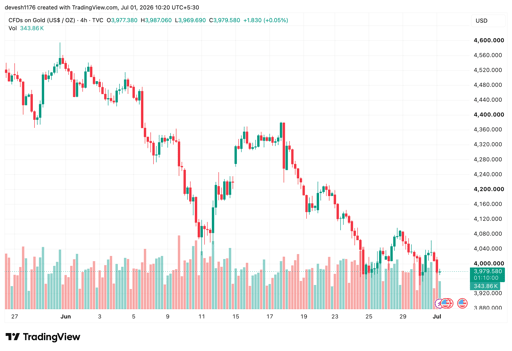
Source: TradingView
Resistance sits near $4,161.80, while $3,985.60 is the first downside pivot. A clean break below that zone would leave sellers looking for a deeper test of support.
For now, any rebound looks vulnerable unless the dollar or rate expectations soften.

Crude oil prices retreat: Brent, WTI slip even as rebound risks persist

Gold slips below $4,600: could Warsh turn this pullback into something bigger?

Is Brent setting a trap below $90 as Russia quietly tightens fuel supply?

USDT gold and silver options expand crypto’s push into commodity markets

Brent price forecast: could oil fall below $85 as Hormuz fears ease?
No results found
Loading articles...
Failed to load articles. Please try again.