
WTI and Brent oil prices tick up on Hyperliquid as Iran closes the Strait of Hormuz

AI Sentiment: 72/100 Bullish
This score is generated through AI-driven analysis of the article's content.

powered by

Buy WTI crude futures (or WTI ETF USO). Strait of Hormuz closure + renewed US strikes = immediate supply-risk premium; inventories are already falling, so any disruption delays the “oil glut.” Momentum is turning up (price + volume/open interest rising), and a break toward $80 is the near-term path if escalation continues.
Key Risk: A rapid de-escalation where Iran reopens the Strait and strikes pause, collapsing the supply-risk premium.
Buy Brent crude futures (or BNO). Brent is pressing resistance near $79.5 and is likely to test/clear it if the US-Iran cycle keeps heating up; Ukraine attacks on Russian refineries/tankers add a second, non-Iran shock to supply. This combination keeps the “glut delay” narrative intact.
Key Risk: A clear, sustained reduction in Middle East shipping risk plus stabilization of Russian exports (refineries/tankers stop being hit), pushing Brent back below $79.5.
- Brent and WTI crude oil prices rose on Hyperliquid.
- The US launched the third wave of attacks against Iranian targets.
- Iran announced that it had closed the Strait of Hormuz.
West Texas Intermediate (WTI) and Brent crude oil benchmarks rose slightly on Hyperliquid as tensions between the US and Iran escalated. WTI rose to $73, with its 24-hour volume and open interest rising to $113 million and $222 million, respectively. Brent rose to $78, with a trading volume of $63 million.
Iran closes Strait of Hormuz, triggering US strikes
WTI and Brent benchmarks rose slightly as tensions between the US and Iran escalated. In a statement on Saturday, Iranian officials said that they had closed the Strait of Hormuz, blaming the US for violating the ceasefire agreement. In a statement in Turkey, Trump said that the ceasefire was “over.”
The US military, through CENTCOM, said that it had launched more strikes against Iranian targets overnight, with Iranian officials vowing to respond. In the last attacks, Iran launched retaliatory attacks on US military sites in Kuwait and Bahrain.
At 7:15 p.m. ET today, U.S. Central Command forces began launching the third round of strikes this week against Iran after Islamic Revolutionary Guard Corps forces blatantly attacked M/V GFS Galaxy, a Cyprus-flagged container ship transiting the Strait of Hormuz. A civilian crew…
— U.S. Central Command (@CENTCOM) July 11, 2026
Recent data shows that traffic through the Strait of Hormuz has faded in the past few days. Tankers are afraid of being attacked, which would lead to losses worth millions of dollars. Also, insurers are afraid of offering services to ships crossing the Strait.
These developments are happening a day after Trump warned Iran against assassinating him. In a Truth Social post, Trump said that Iran would be destroyed if it did that. This statement came after the US received intelligence that Iran was considering ways to assassinate him.
In a statement on Saturday, Iran’s Mojtaba Khamenei said that Iran would retaliate against the killing of his father and other Iranians, including the school girls in Minab.
Therefore, there is a risk that the kinetic activity between the US and Iran will resume, affecting oil supplies at a time when inventories are still falling.
Russia and Ukraine war
Meanwhile, crude oil prices are reacting to the ongoing developments in Russia, where Ukraine has continued to attack oil and gas infrastructure in the country. It has already attacked some of the biggest Russian refineries, leading to shortages across the country. Ukraine has also attacked Russian oil tankers at sea.
Therefore, there is a risk that Russian oil supplies to the global market will be disrupted in the near future. All these events mean that the oil glut that some analysts were expecting will be delayed.
Brent crude oil price technical analysis
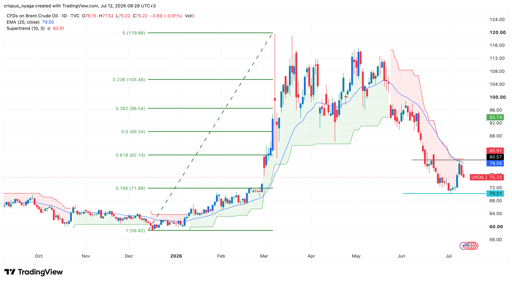
Brent crude oil prices chart | Source: TradingView
The daily chart shows that Brent crude oil price bottomed at $70.20 earlier this month as investors reflected on the situation between the US and Iran. It then bounced back to $79.5 as the two sides restarted their strikes, and then pulled back to $75.22.
Brent then rose to $78 on Hyperliquid on Sunday as the two sides launched strikes. It is attempting to rise above the key resistance level of $79.5, which it reached last week.
It remains slightly below the 61.8% Fibonacci Retracement level and the 50-day Exponential Moving Average (EMA). Also, the Supertrend indicator is still red, a sign that bears remain in control.
Therefore, the price will likely be highly volatile depending on how the Iranian situation evolves. An escalation, which is happening, may push oil prices to $80 and above in the near term.

Pinterest stock crashes below key price: Is it a bargain or a value trap?

Cloudflare stock analysis: bullish outlook, but key valuation risk remains

AeroVironment stock forecast as its revenue and backlog jumps

US 10-year Treasury yield jumps as Trump floats $5,000 dividend checks

XRP price prediction amid RLUSD stablecoin and ETF tailwinds
No results found
Loading articles...
Failed to load articles. Please try again.