
Oracle stock drops below crucial support as its bond yields jump: now what?

AI Sentiment: 18/100 Bearish
This score is generated through AI-driven analysis of the article's content.

powered by

Buy ORCL. The news is bad on debt/FCF, but the stock is already pricing a lot of that: it broke key support (~$134.95), is below all moving averages, and is oversold. Meanwhile, fundamentals are still accelerating (Q4 revenue +21%, cloud infra +93%, RPO +$85B to $638B). That mix sets up a sharp mean-reversion bounce toward prior support/analyst targets ($160–$180) once the market stops extrapolating near-term cash burn.
Key Risk: Oracle’s free cash flow stays deeply negative and debt/capex keep rising fast enough that lenders/credit spreads force a real equity dilution or downgrade.
Buy ORCL 2034 (e.g., ORCL 6.5% 2034 area). Yields jumped to ~6.52% from ~5.34% YTD, which is a classic “panic repricing.” If the backlog/RPO growth holds and capex stabilizes, the bonds should re-rate tighter even if the stock remains volatile. This is a cleaner way to play “debt fear overdone” than buying equity outright.
Key Risk: A credit event: refinancing gets worse than expected or the company can’t fund capex/interest without materially worsening terms, pushing yields higher again.
- Oracle stock continued its strong retreat this week.
- Its corporate bond yields have continued rising.
- Technicals suggest the stock has more downside to go.
Oracle stock continued its strong freefall this week, reaching its lowest level since April last year. ORCL has slumped by over 62% from its all-time high, with Larry Ellison’s net worth plunging by $60 billion this year to $187 billion. It has become one of the top laggards in the AI space.
Oracle stock has plunged despite strong revenue and backlog growth
ORCL stock has been in a steep decline despite being one of the top beneficiaries of the artificial intelligence boom. Its most recent financial results showed that its revenue and backlog continued rising.
Its revenue jumped by 21% to $19.2 billion in the fiscal fourth quarter, with its cloud infrastructure figure rising by 93% to $5.8 billion. Its cloud apps revenue jumped by 10% to $4.1 billion.
For the year, its revenue jumped by 17% to $67 billion, with its operating cash flow rising by 54% to $32 billion.
Most importantly, the company’s RPO or backlog, jumped by $85 billion in Q4 to $638 billion, with its top clients including companies like Applied Intuition, SoundHound (SOUN), Admiral, and Kobalt.
Wall Street analysts are bullish on the company, with the revenue estimate for the first fiscal quarter being $19.12 billion, up by 28% YoY. Its annual revenue is expected to jump 32% this year to $90 billion, followed by $130 billion next year.
Soaring debt and OpenAI deal are key risks
Despite this growth, analysts are still concerned about Oracle’s huge debt load and its overreliance on OpenAI. Of its huge RPO, $300 billion of it comes from OpenAI, a company whose growth has started slowing amid rising competition from Anthropic. The contract will start in 2027, with OpenAI buying massive amounts of AI compute.
Most importantly, there are concerns about its massive debt load and soaring capital expenditure. Its capex jumped by 162% in the last fiscal year, with its free cash flow coming in at negative $24 billion.
The company’s debt has also jumped, and this trend will continue. It ended the last year with $130 billion in debt, with the company planning to raise $40 billion through debt and equity. It raised $43 billion in debt sales and $5 billion in equity.
Investors are concerned about its soaring debt, which has pushed its yields higher. TradingView data shows that the yield of its 2034 bonds jumped to 6.518% from the year-to-date low of 5.34%. Its 2038 bonds are yielding 6.70%, while its 2027 ones are yielding 4.56%.
Still, on the positive side, the ongoing Oracle stock crash has made it a bargain, with most analysts having a favorable rating. Keycorp recently reiterated its overweight rating, while Wedbush’s Dan Ives placed a target of $240.
Bernstein has a target of $325, while Wolfe Research placed a target of $225. MarketBeat data shows that the average target for the stock is $268.
ORCL stock technical analysis
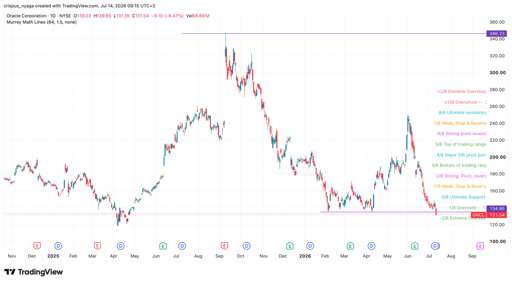
Oracle stock chart | Source: TradingView
The daily chart shows that the ORCL stock has slumped in the past few months, moving from a high of $346.23 on September 10 last year to the current $131.5.
It recently crossed the crucial support level of $134.95, its lowest level in February and April this year.
The stock has dropped below all moving averages and the oversold level of the Murrey Math Lines tool. It also remains below the Supertrend indicator.
Therefore, the waning sentiment will likely push it lower, potentially to $120 or even $100. However, in the long term, the stock will bounce back as investors rotate from semiconductor names to hyperscalers.

Micron, Nvidia, AMD stocks at risk as Anthropic, OpenAI leads push to slow AI growth

How will private credit and equity stocks react to Fed rate hikes?

WTI crude oil price forecast as Middle East risks remain elevated: can it hit $120?

Top crypto price predictions today: Pi Network, Pepe Coin, Zcash

Why SpaceX stock is up around 1% on Friday
No results found
Loading articles...
Failed to load articles. Please try again.