
$10,000 in each of QQQ, TQQQ, and SQQQ 5 years ago: Here's the result

AI Sentiment: 78/100 Bullish
This score is generated through AI-driven analysis of the article's content.

powered by

Buy QQQ. The article shows Nasdaq 100 leadership over 5 years (QQQ up ~99%, total return ~105%) with mega-cap tech compounding. QQQ gives tech upside without the daily-reset drag that crushed SQQQ and limited TQQQ’s “3x” outcome over longer windows. Key risk: a sustained Nasdaq 100 drawdown (rates spike or tech earnings collapse) that turns multi-year compounding into multi-year losses.
Key Risk: A long, deep Nasdaq 100 bear market that keeps QQQ down for years.
Buy TQQQ only as a tactical position for a continued grind higher in Nasdaq 100. The article’s 5-year result (~131% price, ~142% total return) proves leverage can pay when volatility is contained and the trend persists. This is the “right tool” if you expect upside momentum, not a choppy range. Key risk: volatility spikes and whipsaws that cause daily-reset losses even if the index ends flat.
Key Risk: Choppy, high-volatility trading that makes TQQQ lose money even without a big net drop in the Nasdaq 100.
- The Nasdaq 100 Index has jumped in the last five years amid the tech boom.
- This surge has benefited the QQQ and TQQQ ETFs.
- SQQQ, on the other hand, has plunged by over 95%.
The technology sector has done well in the past decade, with the Nasdaq 100 Index beating its top peers like the S&P 500 and the Dow Jones. This article explores the outcome if one had invested $10,000 in the Invesco QQQ ETF (QQQ), ProShares UltraPro QQQ (TQQQ), and ProShares UltraPro Short QQQ (SQQQ) five years ago.
What are QQQ, TQQQ, and SQQQ
QQQ is one of the largest technology-focused exchange-traded funds (ETF) in the United States with over $476 billion in assets under management (AUM). It has an expense ratio of 0.18%.
The fund tracks the Nasdaq 100 Index, which tracks the biggest technology names in the US. Its top names are companies like Nvidia, Apple, Micron, Microsoft, Amazon, and AMD. It is rebalanced quarterly and reconstituted annually.
The UltraPro QQQ ETF, on the other hand, uses a different approach. It is a leveraged fund that seeks a daily investment return that corresponds to three times the daily performance of the Nasdaq 100 Index. It has over $35 billion in assets and has a net expense ratio of 0.82%.
The UltraPro Short QQQ ETF takes the opposite of the TQQQ by allowing investors to profit when the daily price of the Nasdaq 100 Index drops. If the index drops by 1% in a session, the fund gains 3x. For example, the index dropped by 0.28% on Wednesday, while the SQQQ gained 0.80%.
In most cases, risk-averse investors who are bullish on tech stocks buy the QQQ ETF or QQQM, its cheaper sibling. Investors who expect it to jump over time buying the TQQQ, while those who see it falling buy the SQQQ fund.
Five-year returns compared
The past five years have seen technology stocks soar, with several names attaining a $1 trillion valuation. The QQQ ETF has jumped by 99% in this period, while the TQQQ has jumped by 131%. On the other hand, the SQQQ ETF has dropped by 96% in the same period.
Note that the TQQQ ETF did not jump by 300% in this period (3x that of the QQQ). The reason for this is that its performance is based on the daily gains or losses of the Nasdaq 100 Index.
The best way to assess an asset’s performance is not to just look at the price return. Instead, one should look at the total return, which includes the dividends paid.
In this case, the QQQ ETF has returned 105%, while the TQQQ has jumped by 142%. The SQQQ fund has dropped by 96% in the same period.
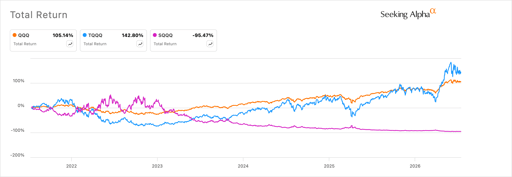
QQQ vs TQQQ vs SQQQ five-year performance | Source: Seeking Alpha
Therefore, a $10,000 investment in QQQ five years ago would now be worth about $20,500. A similar investment in the TQQQ ETF would be worth $24,200 today, while the same in SQQQ would be worth just $500.
To be clear, past performance does not always guarantee what will happen in the future, meaning that the situation may reverse. For example, the SQQQ ETF jumped by nearly 90% in 2022 as the stock market plunged. Also, these figures are gross and don't include taxes.

TLT ETF slumps, inflows jump as US Treasury yields soar

AI development slowdown: what it means for Nvidia, Micron and other chip stocks

FTSE 100 tumbles as oil shock sends UK borrowing costs back to 1998

Dow futures plunge 250 points: 5 things to know before Wall Street opens

US yields just hit a 19-year high: these 5 stocks could take the biggest hit
No results found
Loading articles...
Failed to load articles. Please try again.