
Hang Seng Index jumps on China stimulus hopes as Alibaba stock soars
AI Sentiment: 78/100 Bullish
This score is generated through AI-driven analysis of the article's content.

powered by

Buy Hang Seng Index exposure (e.g., iShares Hang Seng Index ETF, 2800.HK). The catalyst is clear: investors are pricing imminent China stimulus via faster bond issuance, and the index just broke above 25,000 with momentum toward 26,000. This is a “policy hope” trade that tends to run when bond/credit expectations improve.
Key Risk: China disappoints—no meaningful stimulus/bond-issuance acceleration at the Politburo, and the index gives back the 25,000 breakout.
Buy Alibaba (BABA) for AI-led upside. The stock is already leading on Qwen 3.8 Max momentum and the Apple-phone model deal, and it should keep benefiting if China’s AI investment theme broadens alongside stimulus. In a stimulus-driven tape, the market often rewards the most visible growth platform winners.
Key Risk: AI execution or monetization stalls—regulators, competition, or weak demand causes AI progress to fail to translate into earnings growth, crushing the multiple.
- The Hang Seng Index jumped by over 2% on Monday.
- There are hopes that China will offer a new stimulus package.
- Alibaba stock jumped after launching a new AI upgrade.
The Hang Seng Index jumped more than 2% on Monday, making it the best-performing major benchmark in Asia as investors bet on fresh Chinese stimulus following a string of weak economic data. The index climbed to 25,103, its highest level since June 5.
Hang Seng Index jumps on stimulus hopes
Hong Kong stocks continued rising, even as other Asian benchmarks like Kospi and Nikkei 225 dived. The surge is driven by the rising hope that Beijing officials will provide stimulus after last week’s weak macro data.
According to the FT, officials are expected to focus on speeding bond issuance at the next Politburo meeting. The urgency of this stimulus jumped after a report showed that the economy expanded by just 4.3% in the second quarter because of the impact of the US-Iran war.
Earlier this year, Chinese officials placed an annual growth target of between 4.5% and 5%, the lowest in decades. As such, by the second quarter growth coming in at 4.3%, it means that the economy may not hit that subdued target. In a note, a Goldman Sachs analyst said:
“For policymakers, the worry is that if the deceleration continues, then your target for the full year is at risk.”
While Chinese exports are booming, weak household confidence has undermined domestic demand. Indeed, data showed that retail sales and house prices were highly subdued.
It is common for the Hang Seng and the Shanghai Composite to do well whenever there is hope that Beijing will implement a large stimulus package.
Alibaba stock jumps amid China AI growth
One area where Beijing is investing substantial resources is in the artificial intelligence (AI) industry. In a speech last week, Xi Jinping said that China would continue to invest in the industry. He also launched a new AI Alliance made up of 29 nations.
The country has made some major progress in the recent past, with Moonshot’s Kimi K3 model beating those made by American companies like Anthropic and OpenAI. Moonshot is now aiming to launch its IPO in Hong Kong soon.
Other Chinese companies like MiniMax and DeepSeek have continued to thrive in the past few months. Alibaba stock was the best gainer in the Hang Seng today because of its AI progress in the AI sector. It soared after the launch of Qwen 3.8 Max and after inking a deal to add this model to Apple phones.
The other top gainers in the Hang Seng Index today were CNOOC, Semiconductor Manufacturing International (SMIC), Alunium Corporation, and Laopu Gold.
HSI Index technical analysis
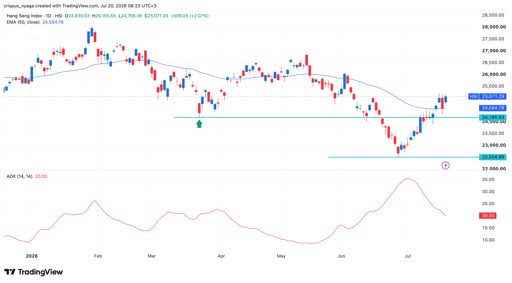
Hang Seng Index chart | Source: TradingView
The daily chart shows that the Hang Seng Index has rebounded in the past few weeks. It has soared from a low of 22,504 in June to the current 25,098.
The index has recently soared above key resistance levels, including 24,185 (March low) and the psychological level of 25,000. After underperforming key indices like the Kospi and Nikkei earlier this year, there is a likelihood that it will continue rising in the near term. If this happens, the index may soar to 26,000.
Crude oil prices retreat: Brent, WTI slip even as rebound risks persist
Kospi Index at a crossroads as Samsung, SK Hynix leverage bets reverse

How Meta’s $18B teen safety settlement could reshape social media regulation
Nvidia is using its balance sheet to fuel the AI boom. Is it a double-edged sword?
Dow holds weekly gain as Warsh inflation warning lifts rate hike bets
No results found
Loading articles...
Failed to load articles. Please try again.