
USD/JPY forecast: what next for the falling Japanese yen?

AI Sentiment: 78/100 Bullish
This score is generated through AI-driven analysis of the article's content.

powered by

Buy USD/JPY. The rate gap is still widening (BoJ ~1% vs Fed 3.50–3.75% with >67% odds of more Fed hikes), and the chart is already in a bullish regime (above 162.82 breakout; supported by 50-day EMA and Supertrend). Add on dips toward 162.8–163.0 targeting 164 then 165.
Key Risk: The BoJ delivers a surprise, faster tightening path that meaningfully narrows the US–Japan rate gap and forces USD/JPY to reverse below 162.8.
Sell JPY via a carry proxy: short JPY against a broad risk basket using USD/JPY or buy USD/JPY call spreads. The yen sell-off is being reinforced by carry traders, and Middle East risk is pushing investors into USD safety while oil lifts inflation expectations. This trade benefits if carry keeps unwinding slowly and USD stays bid.
Key Risk: A sharp risk-off move that specifically strengthens JPY (e.g., global funding stress that triggers yen repatriation) or a sudden BOJ intervention that actually sticks.
- The USD/JPY pair has remained in an uptrend in the past few months.
- The Japanese yen retreat continued amid the crisis in the Middle East.
- Technicals suggest that the pair has more upside to go in the near term.
The Japanese yen remained under intense pressure today, July 23, as traders rushed to the US dollar amid the rising tensions in the Middle East. The USD/JPY pair was trading at 163.07, a few pips below this week’s high of 163.2.
Japanese yen crash is continuing
The Japanese yen has continued falling this month, even as the country’s central bank has launched several defensive measures.
The Bank of Japan has hiked interest rates to the highest level since 1995, and hinted that it may deliver more increases.
At the same time, the bank has spent more than $73 billion on foreign exchange market interventions. While these interventions typically trigger a stronger yen, the gains have historically been short-lived.
The Japanese yen has mostly dropped because of the significant gap that exists between the US and Japanese interest rates.
Japanese rates have jumped to 1%, while in the United States, the Fed has left them unchanged between 3.50% and 3.75%. Economists and traders now expect the Fed to hike rates further this year as inflation concerns remain. Odds of a Fed hike have jumped to over 67% on Polymarket.
Higher interest rates in the United States have made the US dollar more attractive than the Japanese yen. They have also fueled the popularity of the USD/JPY pair among carry traders, who borrow in low-interest-rate currencies to invest in higher-yielding ones.
The ongoing crisis in the Middle East has contributed to the ongoing Japanese yen sell-off because the country depends substantially on oil coming from the region. In a statement, an Iranian official said that the crisis would escalate. He said:
“If the Americans target a bridge or a power plant in Iran, Iran will, in turn, strike infrastructure and bridges in the region, including energy facilities where the United States has interests.”
Data shows that Brent and the West Texas Intermediate (WTI) continued rising overnight as the crisis continued. Also, Houthis hit an oil tanker attempting to cross the Bab El-Mandab Strait. Brent jumped to $96, while the West Texas Intermediate (WTI) approached the key resistance at $90. These events have fueled the US dollar gains as investors rush to its safety.
USD/JPY technical analysis
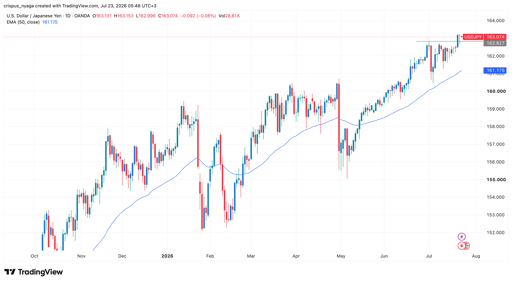
USD/JPY chart | Source: TradingView
The daily chart shows that the USD/JPY pair has continued rising in the past few months. These gains have been supported by the 50-day Exponential Moving Average (EMA).
The pair has recently crossed the important resistance level of 162.82, its highest level on July 1. It also remains above the Supertrend indicator.
Therefore, the path of the least resistance for the pair is bullish, with the next key level to watch being at 164. A move above that price may see it hit the resistance at 165 over time.

Duolingo stock jumps as charts flash warning amid transition from growth to value

CoreWeave stock flashes a warning sign despite strong revenue growth

SCHD nears title of biggest dividend ETF, but technical risks loom

Nio stock: Why Tesla rival dropped despite strong revenue growth

Nvidia stock analysis: top reasons why the shares may go parabolic soon
No results found
Loading articles...
Failed to load articles. Please try again.