
JEPI vs GPIX: Which covered call ETF actually wins on returns?

AI Sentiment: 78/100 Bullish
This score is generated through AI-driven analysis of the article's content.

powered by

Buy GPIX. The article shows GPIX has outperformed JEPI across 1Y, YTD, and since launch, with higher yield (8.12% vs 8.05%) and lower fees (0.29% vs 0.35%). That combination—more income plus better total returns—fits a covered-call ETF that’s currently capturing more upside than JEPI.
Key Risk: Sustained sideways-to-bear markets where call premiums don’t offset equity losses, causing GPIX’s higher “beta” to hurt more than JEPI.
Sell or avoid JEPI. Despite similar covered-call mechanics, the article’s performance gap is large: 1Y (+6.80% vs +18%), YTD (+2.68% vs +8.9%), and since launch (+28% vs +75%). With higher expense (0.35% vs 0.29%) and slightly lower yield, JEPI looks like the inferior product right now.
Key Risk: JEPI’s ELN structure proves more defensive in the next downturn, narrowing or reversing the performance gap.
- JEPI has gained billions of dollars this year and is slowly approaching the $50 billion AUM mark.
- GPIX, which Goldman Sachs launched three years ago, is nearing $5 billion.
- Historical data suggests that GPIX does better than JEPI by far.
JPMorgan’s Equity Premium ETF JEPI has done well in the past few years, with its assets soaring to $45 billion. Its inflows have jumped by over $4.1 billion as investors rushed to buy it for its 8% yield.
Still, another little-known fund by Goldman Sachs is making waves. Goldman Sachs S&P 500 Premium Income ETF (GPIX) has gone from nowhere to $4.1 billion in assets, with the year-to-date inflows hitting $2 billion. So, which covered call ETF should one buy?
What is the JEPI ETF?
JEPI, while not the first covered call ETF, has become the biggest in the industry. It has become a popular fund among investors seeking monthly payouts that are higher than those offered by passive funds like SCHD and VYM.
The fund uses a fairly simple approach. It uses the covered call strategy, where it invests in about 115 companies in the S&P 500 Index through equity-linked notes (ELNs). It then writes call options on the S&P 500 Index.
This investment generates returns by making money as the stocks it invests in rise and make their dividend payments. At the same time, the fund receives a monthly premium from its call options. JEPI has an expense ratio of 0.35%, which is quite affordable for an active fund.
What is the GPIX ETF?
Goldman Sachs created the GPIX ETF after observing JEPI’s success. While the two funds have a similar approach, they have some differences in how they are calculated.
For example, GPIX focuses on the whole S&P 500 Index and has stakes in all its companies. Instead of uses ELNs, the fund focuses on S&P 500 call options. It also has an expense ratio of 0.29%, making it more affordable than JEPI.
Also, the fund has a higher dividend yield than JEPI. It has a yield of 8.12%, while JEPI pays a 8.05% return.
GPIX is doing better than JEPI
Historical data shows that GPIX ETF is doing better than JEPI, possibly because it maintains a higher equity beta. In bull markets, it is designed to capture more returns than the more conservative JEPI.
Data shows that GPIX has had a better performance than JEPI ETF. Its total return this year has risen to 8.9% this year, while JEPI has jumped by just 2.68%.
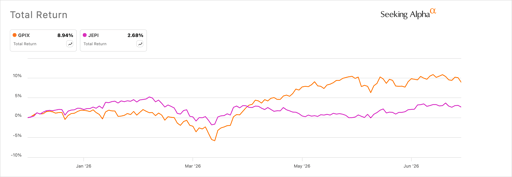
JEPI vs GPIX ETF | Source: TradingView
The same has happened in the last 12 months, with GPIX soaring by 18% and JEPI jumping by 6.80%. Since its launch in 2023, GPIX has jumped by 75%, while JEPI has jumped by 28%.
These numbers mean that GPIX is a better performer than JEPI by far. It also has a higher dividend yield and a smaller expense ratio than JEPI.
To be clear, past performance is never an indicator of what will happen in the future. But it can give a better indication of what will happen in the future, making GPIX a better buy than JEPI for now.

Evening digest: Trump pressures Fed as US jobs rise, gold falls

Apple stock falls 2% as foldable iPhone production faces supply hurdles

Tesla stock falls 6% as cybercab launch faces analyst, regulatory concerns

AMD stock forecast: why this Nvidia rival is on the cusp of a breakout

Adobe stock falls 7% as company announces new CEO amid leadership shakeup
No results found
Loading articles...
Failed to load articles. Please try again.