
Uniswap price jumps above $4: is a bigger UNI breakout about to explode?

AI Sentiment: 78/100 Bullish
This score is generated through AI-driven analysis of the article's content.

powered by

Buy UNI. Catalysts stack: Adams clarified v4 protocol fees won’t cut LP earnings; Uniswap submitted fee/burn proposals that route protocol revenue into the UNI burn mechanism; TokenJar buyback-and-burn activity is already linking trading fees to supply reduction. Price action supports it: higher highs/higher lows, ADX ~38, and bulls defending the $3.85–$3.71 support band after a failed hold above $4.
Key Risk: Governance rejects or delays the fee/burn proposals, breaking the revenue-to-burn link and turning the $4 breakout into a dead-cat bounce.
Buy UNI via a momentum add-on: buy on a daily close above $4.10 (break $4.05–$4.10 resistance). This forces the market to reprice the “fees → TokenJar → burn” story as real, not just proposed, and typically pulls in breakout buyers and trend funds after the first failed reclaim of $4.
Key Risk: UNI fails to sustain above $4.10 and falls back below $3.85, showing the breakout was only short-covering and the fee narrative isn’t moving enough flows.
- UNI briefly reclaimed $4 after a Uniswap v4 fee clarification.
- Governance proposals have strengthened the case for UNI burns.
- A close above $4 could strengthen the case for another leg higher.
Uniswap price has briefly reclaimed the $4 level after project-specific updates fueled buying interest, though the token has since surrendered part of its gains.
According to CoinGecko data, UNI climbed as high as $4.06 during intraday trading before easing to around $3.97, leaving the token up roughly 3.7% from its daily opening price and about 8.5% above its July 29 low of $3.74.
The move briefly pushed Uniswap back above the psychological $4 level for the first time in recent sessions, extending its recovery from the June low near $2.35 to more than 70%.
The latest advance has carried UNI back into a price zone last seen in May, with the token continuing to post higher highs and higher lows since bottoming in June.
Although sellers emerged around the $4 mark, buyers have so far managed to keep the price above important short-term support levels.
Interest in Uniswap strengthened after founder Hayden Adams addressed concerns surrounding the protocol's upcoming fee structure for Uniswap v4.
Adams explained that protocol fees would be added on top of the liquidity provider fee rather than deducted from it.
Under the proposed model, traders using a pool with a 30-basis-point liquidity provider fee would pay a total of 35 basis points, while liquidity providers would continue receiving the original 30 basis points and the remaining five basis points would be directed to the protocol.
His clarification eased concerns that enabling protocol fees would reduce liquidity provider earnings and encourage liquidity to migrate toward competing decentralized exchanges.
Governance activity has added another catalyst for UNI. Uniswap has submitted proposals covering protocol fees collected from v4 pools and deployments on Robinhood Chain.
If approved, protocol revenue would be routed into the existing UNI burn mechanism, creating a more direct connection between trading activity on the protocol and the token's circulating supply.
The proposal builds on momentum that has developed since Robinhood Chain launched on July 1.
DefiLlama data showed Uniswap generated approximately $5.2 million (approx. AED 19 million) in fees during a 24-hour period earlier this month, with Robinhood Chain contributing about $4.4 million (approx. AED 16.1 million) of that total.
Trading activity has also remained strong on the new network. Uniswap surpassed $1 billion (approx. AED 3.7 billion) in trading volume on Robinhood Chain within nine days of launch.
Future UNI buybacks and token burns, however, will still depend on governance approval, successful fee collection and continued trading volume across supported networks.
Fee switch and institutional products strengthen UNI outlook
Governance proposals are only one part of the bullish narrative supporting UNI.
Recent discussions around activating protocol fee switches across Uniswap v4 deployments have improved market sentiment as investors anticipate protocol revenue flowing into TokenJar smart contracts, which are designed to buy back and burn UNI from the open market.
Analysts have described the recent TokenJar transaction, worth approximately $2.2 million (approx. AED 7.9 million), as the largest UNI buyback-and-burn event since late 2025.
The development has renewed interest in UNI by linking protocol revenue more directly to token supply reduction.
At the same time, Uniswap Labs has continued expanding its institutional offering through v4.
The company recently introduced Permissioned Pools, allowing compliance-focused trading through automated market makers.
Following the audited release of its DualPool hook, Uniswap has also expanded its push into tokenized real-world assets alongside partners including Superstate and Securitize.
Those products extend Uniswap beyond traditional decentralized exchange trading and open new use cases for regulated tokenized assets.
Not all of UNI's recent price action has been driven by protocol developments.
After the Federal Reserve concluded its latest Federal Open Market Committee meeting, risk assets temporarily lost momentum as policymakers kept the federal funds rate unchanged at 3.50% to 3.75%.
Three committee members favored a 25-basis-point increase, reinforcing expectations that additional policy tightening remains possible if inflation stays elevated.
The decision lifted Treasury yields and strengthened the US dollar, prompting traders to reduce exposure to higher-risk assets across the cryptocurrency market.
UNI also gave back part of its earlier advance despite continuing protocol-specific optimism.
UNI price analysis: Bulls defend breakout as $4 remains the key hurdle
From a technical perspective, UNI continues to maintain a constructive daily trend despite failing to hold above $4.
The daily chart shows price trading above a rising trendline that has supported the recovery since June.
See below:
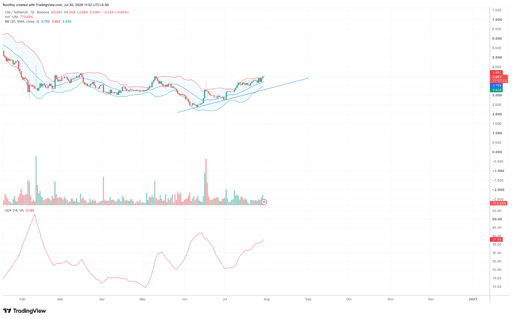
UNI/USDT 1-day price chart. Source: TradingView.
Every major pullback over the past several weeks has produced a higher low, keeping the broader uptrend intact.
Bollinger Bands indicate UNI is trading close to the upper band near $3.98 after repeatedly testing resistance around the $4 area.
While price touching the upper band often precedes short-term consolidation, it also confirms buyers remain in control during the current advance.
The middle Bollinger Band, which aligns near $3.71, now serves as the first important support level.
Holding above that area would keep the current bullish structure intact. A break below it could expose the ascending trendline around the mid-$3.50 region.
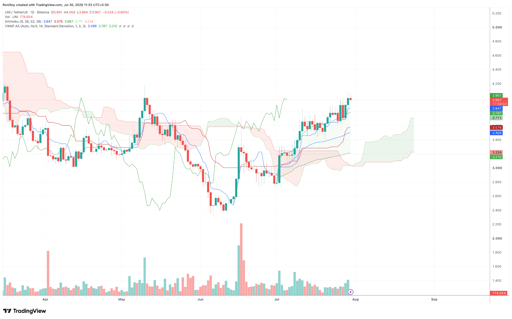
UNI/USDT 1-day price chart. Source: TradingView.
The Average Directional Index (ADX) has climbed to around 38, indicating the current trend has strengthened rather than weakened.
Readings above 25 typically point to a sustained directional move, suggesting the ongoing recovery still has momentum behind it.
UNI remains above both the Tenkan-sen and Kijun-sen while trading above the Ichimoku cloud, keeping the bullish structure intact.
The forward cloud also remains green, placing projected support below the current price.
The anchored VWAP remains below the current market price as well, showing buyers continue controlling the average traded price despite the latest intraday pullback.
Immediate resistance remains around $4.05 to $4.10, where UNI has already encountered profit-taking over the past 24 hours.
A decisive daily close above that region could open the path toward the May swing highs around $4.30, with the next upside objective near $4.60 if buying volume expands alongside continued governance progress.
On the downside, maintaining support above $3.85 would preserve the current sequence of higher lows.
If selling pressure increases following the macro-driven pullback, the $3.70 area around the Bollinger midpoint and the rising trendline could become the next zone where buyers attempt to regain control.
For now, whether bulls can establish a sustained move above $4 will likely depend on both continued progress on the protocol fee proposals and an improvement in sentiment across the broader cryptocurrency market.

Crypto stocks MARA, COIN, Strive, MSTR rally as a bull run starts, but risks remain

Ethereum gains 25% as ETF demand strengthens after record $3B short wipeout

Crypto rally today: Why are XRP, Dogecoin, Cardano, Pepe going up?

Bitcoin surges past $76K as buyers pile in: is real demand taking over now?

SOL surges past $90 as ETF flows turn stronger: is a run toward $100 underway?
No results found
Loading articles...
Failed to load articles. Please try again.