
Why FIFA wants to sell a stake in the World Cup — and why football is revolting
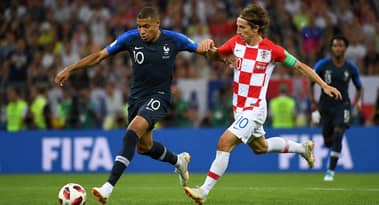
AI Sentiment: 18/100 Bearish
This score is generated through AI-driven analysis of the article's content.

powered by

Buy: JPMorgan (JPM) and JPMorgan-linked deal execution exposure. Rationale: the article says JPMorgan is valuing FFE (~$20B) and is working to bring investors; even if politics derail the structure, the bank is positioned for advisory/structuring fees and underwriting/placement activity. The market will focus on controversy, but deal-making volume usually rises when governance fights force renegotiations.
Key Risk: The consultation process collapses and FIFA cancels the transaction, cutting off advisory/placement fees.
Sell FIFA-linked exposure: short UEFA/FIFA-adjacent football media rights and sponsorship beneficiaries (e.g., short Liberty Media’s Formula 1/Live Nation-style sports media exposure via broad sports media ETFs like XLY?—instead use a clean proxy: short iShares Global Clean Energy? no). Use a direct proxy: short sports betting/football ad spend beneficiaries that rely on stable FIFA/UEFA calendars—betting operators like Flutter Entertainment (FLTR) and Entain (ENT). Rationale: a UEFA boycott and governance fight threatens tournament continuity, viewership, and sponsor budgets, hitting near-term cash flows.
Key Risk: A deal gets done fast and tournaments proceed normally, removing the boycott threat and restoring sponsor confidence.
- FIFA plans to sell up to 20% stake in a $20 bn subsidiary to outside investors.
- UEFA, others have condemned the plan, say it's a threat to football's governance
- Questions arise over the need for a sale with FIFA being not for profit body.
When FIFA on Tuesday announced plans to create a $20 billion subsidiary to manage the commercial rights of the World Cup and other major tournaments, the proposal immediately became one of the most controversial ideas in modern football governance.
What initially appeared to be a financial restructuring has quickly evolved into a debate over who should own football's biggest competition, how the game's wealth should be distributed, and whether the commercialisation of the sport has finally crossed a line.
The proposal has triggered fierce criticism from UEFA, several national football associations, and political leaders, while also exposing widening divisions between FIFA President Gianni Infantino's vision for global football and the traditional European power structure.
A senior adviser to FIFA president Gianni Infantino resigned on Friday in protest against plans to sell a stake in the commercial rights linked to the World Cup.
On Thursday, UEFA's 55 member associations unanimously voted to boycott all FIFA tournaments, less than two weeks after Spain lifted the World Cup trophy.
Even as criticism mounted from across the football world, FIFA defended the proposal, insisting that "nobody is selling football" despite objections to its decision to begin consultations on bringing private investors into a new commercial entity tied to the World Cup and other tournaments.
What is the proposal?
At the heart of the controversy is FIFA's proposal to establish FIFA Forward Enterprise (FFE), a commercial subsidiary that would oversee the governing body's event and commercial operations.
FIFA would retain majority control of the company but plans to offer minority stakes of up to 20% to outside investors, raising about $4.2 billion.
According to the governing body, valuation forecasts prepared by JPMorgan place FFE's value at roughly $20 billion.
A vehicle founded by Joshua Kushner, brother of Jared Kushner, is expected to lead the proposed investor group.
FIFA is also working with JPMorgan to bring in additional investors, while former Liberty Media chief executive Greg Maffei has been advising on commercial strategy.
Despite widespread criticism, FIFA insists the proposal does not amount to selling football.
"Outside investors will have only a minority stake in FFE and will not play any operational role," FIFA said.
"Equally, they are investing in a subsidiary of FIFA, and not in FIFA itself. For FIFA, nothing changes."
FIFA says the money will transform football development
For FIFA, the proposal is about unlocking new capital rather than surrendering control.
The governing body argues that selling a minority stake in FFE would immediately allow it to expand funding for football development programmes across all 211 member associations.
Instead of focusing on the $4.2 billion capital raise itself, FIFA has framed the proposal around what that money would finance.
It has promised to increase development funding to $10 billion over the 2027-2030 cycle, a dramatic increase from the $3.86 billion budgeted during the current four-year cycle.
Under the proposal, each of FIFA's 211 member associations would receive up to $40 million over four years.
That would include $20 million under the existing FIFA Forward programme and another optional $20 million through a newly created initiative called FIFA Fast-Forward.
According to FIFA, the additional programme would allow associations to invest in infrastructure, coaching, grassroots football, women's football, competitions, and national teams.
Those payments could increase further to $24 million during the 2035-2038 cycle.
"Football is the world's most popular sport and an extraordinary engine of human and social development," FIFA President Gianni Infantino said.
"Parts of the game have turned that popularity into remarkable commercial value – and we celebrate that success and want it to continue, because it lifts the whole game. Our job is to make sure the rest of football grows with it: FIFA exists to support sustainable, inclusive development in every corner of the world."
Infantino has repeatedly described the proposal as part of a broader effort to democratise football finances beyond Europe and South America.
"This is about the democratisation of football worldwide," he said.
UEFA leads growing resistance
That argument has found little support among Europe's football establishment.
Within hours of details emerging, criticism poured in from several confederations and national associations, many of whom complained they had not been consulted before FIFA began advancing the proposal.
The strongest response came from UEFA.
The European governing body accused FIFA of attempting to commercialise football's most important tournament in a manner incompatible with its responsibilities as the sport's global governing institution.
"The soul and governance of football are not assets to trade — especially with zero transparency as to who gains financially," UEFA said.
"None of us are the owners of football. It is not FIFA's to sell."
The organisation added that the proposal represented a dangerous precedent.
"UEFA takes it extremely seriously. So should every National Football Association. So should every stakeholder: leagues, clubs, players, supporters, governments, and everyone who cares about the future of the game."
The criticism reflects an increasingly strained relationship between FIFA and UEFA under Infantino's leadership.
Relations between the two organisations have steadily deteriorated over recent years over issues ranging from governance reforms to refereeing, disciplinary procedures, and tournament expansion.
The tensions became particularly visible during this summer's World Cup, when UEFA President Aleksander Ceferin declined to attend the final following disagreements with FIFA over several operational matters.
Political leaders have also entered the debate.
British Prime Minister Andy Burnham criticised the proposal, arguing that the World Cup should remain outside the influence of financial investors.
"The World Cup is not a product. It is the greatest competition in world sport, and it was never anyone's to sell," Burnham wrote on X.
"Dress the deal up however you like. Once you have sold a piece of it, you have sold out."
Why critics question the need for outside capital
The growing backlash has left FIFA defending not only the commercial merits of the proposal, but also its broader vision for how football should be governed in the future.
The central question raised by critics is not whether FIFA can raise billions of dollars from investors, but whether it actually needs to.
FIFA is already among the richest sporting organisations in the world, generating billions of dollars from broadcasting rights, sponsorship agreements, and commercial partnerships tied primarily to the men's World Cup.
Supporters of the proposal argue that creating FIFA Forward Enterprise would maximise those commercial revenues even further by giving the organisation a dedicated vehicle focused exclusively on commercial and event operations.
Critics, however, point out that FIFA itself has acknowledged FFE should generate higher revenues over the long term regardless of whether outside investors are brought in.
One source familiar with FIFA's thinking told The Athletic that establishing FFE had "separation and focus" in mind and that it was "eminently feasible" for the subsidiary to remain wholly owned by FIFA.
That observation has fuelled questions about why the governing body needs to dilute ownership at all.
The proceeds from selling a minority stake would largely fund a one-time increase in development payments to member associations.
Critics argue FIFA could instead retain full ownership of the commercial entity while gradually increasing those payments over time using higher commercial revenues.
That debate has become even sharper because FIFA approved a much smaller Forward budget less than a year ago, only to return with a proposal involving a dramatic increase in funding.
According to The Athletic, FIFA argues that the one-off Fast-Forward programme is necessary to "unlock and turbocharge long-term development projects that would otherwise be out of reach within a single FIFA Forward cycle."
For opponents, however, the sudden urgency raises more questions than answers.
Politics and private capital enter the picture
Another layer of controversy surrounds the identity of the prospective investors.
Joshua Kushner's investment vehicle is expected to lead the consortium interested in acquiring a minority stake in FIFA Forward Enterprise.
Almost immediately, attention shifted to Kushner's family connections.
Joshua is the brother of Jared Kushner, US President Donald Trump's son-in-law, prompting some observers to draw political connections between the proposed investment and Infantino's increasingly close relationship with Trump.
Sources close to Thrive Capital have sought to distance Joshua Kushner from those assumptions, The Athletic reported.
According to The Athletic, Joshua Kushner has donated to Democratic organisations, while his wife, Karlie Kloss, has also been a regular donor to Democratic candidates.
Even so, critics argue that Infantino's visible relationship with Trump has complicated public perceptions of the proposal.
The broader concern extends well beyond politics.
For many within football, the issue is whether private capital should have any ownership interest in the commercial engine that powers the World Cup.
Private equity firms ultimately seek financial returns for investors.
That objective, critics argue, sits uneasily alongside FIFA's stated mission as a not-for-profit governing body responsible for promoting football globally.
FIFA's statutes describe its mission as improving football and promoting it worldwide through its "unifying, educational, cultural and humanitarian values."
That language has been repeatedly cited by opponents, who argue that introducing external shareholders fundamentally alters the organisation's incentives.
Football has seen similar deals before
A defence of the proposal is the argument that outside investment is becoming increasingly common across professional sport.
Examples exist throughout the industry.
Formula One has long operated as a commercially driven business with private ownership.
Spain's La Liga sold future commercial rights to private equity group CVC in exchange for more than €2 billion in 2021.
UEFA itself jointly operates UC3, a commercial venture responsible for managing the business interests of its European competitions.
Supporters, therefore, could argue that FIFA is merely following an established trend.
Critics counter that those comparisons overlook an important distinction.
Unlike Formula One or many domestic leagues, FIFA exists as a not-for-profit governing body rather than a commercial entertainment company.
Its role extends beyond maximising revenue.
It oversees global football governance, distributes development funding, organises international competitions, and represents more than 200 member associations.
That broader responsibility, critics say, makes comparisons with purely commercial sports businesses misleading.
FIFA also benefits from that legal structure.
According to The Athletic, over the past decade, FIFA generated a pre-tax surplus of $1.241 billion while paying just $66 million in taxes, equivalent to an effective tax rate of roughly 5%.
Those advantages, critics argue, come with responsibilities that are difficult to reconcile with bringing in private investors seeking financial returns.
A vote that could reshape football
Despite the growing backlash, FIFA appears determined to continue with the consultation process.
The proposal will ultimately require approval from both the FIFA Council and the organisation's 211 member associations.
That vote is expected to become one of the most significant governance decisions in FIFA's modern history.
Football finance professor Kieran Maguire believes the politics surrounding the proposal cannot be ignored.
"FIFA under Infantino gives lots of money to small countries, who in turn vote for him to be re-elected as president," Maguire told CNBC last week.
Infantino is expected to seek another term as FIFA president next year.
Whether member associations view the proposal primarily as a financial opportunity or as a governance risk may ultimately determine both the future of FIFA Forward Enterprise and the direction of world football itself.

Nike stock lost $200B in value since its 2021 highs: what is ailing the sports giant?

Boehly, Walter in talks to sell Chelsea stake to Clearlake: report
Liverpool sells minority stake to Bezos-backed consortium in £1.65B deal

Why Josh Kushner and Bob Iger are paying a record $12.5B for the Lakers
FIFA World Cup 2026: Analysts see Robinhood, Adidas and Shake Shack as early winners
No results found
Loading articles...
Failed to load articles. Please try again.