
TLT ETF slumps as US debt nears $40 trillion, 30-year yield jumps

AI Sentiment: 18/100 Bearish
This score is generated through AI-driven analysis of the article's content.

powered by

Buy SPDR Bloomberg 1-3 Month T-Bill ETF (BIL). While long bonds get hit by deficit/debt fears, the article shows investors rotating into short-term Treasuries (BIL adding ~$4.1B YTD). Short duration limits damage if yields stay high.
Key Risk: The Fed pivots to rapid rate cuts and the front end rallies less than expected, making BIL’s yield advantage shrink versus longer bonds.
Sell iShares 20+ Year Treasury Bond ETF (TLT). The article flags rising 30-year yields (~5.20%) and heavy outflows, with debt near $40T likely keeping long-end yields pressured. Technicals confirm a downtrend: below moving averages and sitting in a descending channel, with $80 the next magnet.
Key Risk: A sharp risk-off rally (geopolitical shock or recession scare) that drives long-term yields down fast, forcing TLT to rebound.
- The TLT ETF has had over $4.4 billion in outflows this year.
- The US public debt is soaring and about to hit the $40 trillion mark.
- Technical analysis suggests that this ETF may drop further soon.
The popular iShares 20+ Year Treasury Bond ETF TLT has slumped into a correction as its outflows rose and as long-term US bond yields rose. It is also under pressure as the US public debt nears the $40 trillion milestone. It was trading at $82.7 on Friday, down by 10% from its highest point last year.
US public debt is nearing the $40 trillion mark
The TLT ETF is a top fund that invests in long-term US bonds. These bonds have come under intense pressure in the past few months as US deficit has jumped.
Data shows that the 30-year bond yield remains at 5.20%, a few points below the year-to-date high of 5.28%. It has jumped substantially from the year-to-date low of 4.60%.
The bond yield will be in the spotlight in the coming weeks as the US public debt continues rising and is now nearing the $40 trillion mark. Estimates are that this debt will cross this milestone in the next two weeks.
US government spending is getting out of hand during President Donald Trump’s era. For example, the US-Iran war that was started a few months ago, has consumed over $40 billion so far. The Trump administration is requesting Congress for over $90 billion in funding for the war.
At the same time, the administration is requesting a defense spending of over $1.5 trillion, a big increase from the previous year’s $1 trillion. This defense spending is more than what most countries spend in a year, combined.
Trump is also spending on unnecessary projects, including the new battleground ships. Media reports suggests that these ships will cost over $275 billion.
The rising bond yields is having an impact on the US government priorities. For example, the Trump administration decided to intervene in saving the Japanese yen recently. The administration fears that Japan will continue selling its US treasury holdings, lifting the borrowing costs.
These fears explain why investors have started dumping their TLT holdings. Data shows that the fund had over $282 million in outflows on Friday. Before that, its outflows stood at $438 million and $230 million, respectively. In total, these funds have shed over $4.4 billion in assets this year.
US bond yields are also rising as Trump restarts his attempts to remove Lisa Cook from the Federal Reserve, a move that the Supreme Court halted. Dan Scavino, a Trump administration official, sent Cook a letter, saying that the administration intended to remove her from the Fed. She now has 21 days to provide a written response to the administration’s concerns.
In contrast, ETFs tracking short-term government bonds are adding substantial sums of money. The State Street SPDR Bloomberg 1-3 Month T-Bill ETF (BIL) has added over $4.10 billion in assets this year.
TLT ETF technical analysis
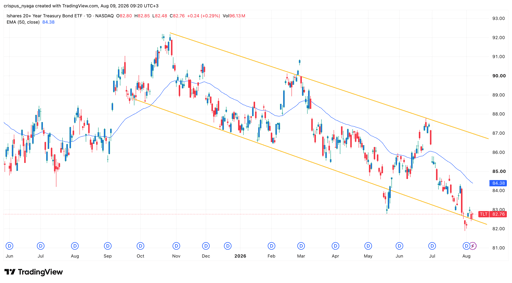
TLT ETF chart | Source: TradingView
The daily chart shows that the TLT ETF has been in a downward trend in the past few months. As a result, it formed a descending channel and is along its lower side. It remains below all moving averages, a sign that bears remain in control. Therefore, the fund will likely continue falling, potentially to the psychological level of $80.

How Meta’s $18B teen safety settlement could reshape social media regulation

Nvidia is using its balance sheet to fuel the AI boom. Is it a double-edged sword?

Invezz Explains: why you should closely watch payrolls, claims, ADP and JOLTS data

Dow holds weekly gain as Warsh inflation warning lifts rate hike bets

Workday stock jumps 5% after earnings beat, but analysts split on AI growth outlook
No results found
Loading articles...
Failed to load articles. Please try again.