
SCHD ETF just hit a record high: Here’s why DIVB is a better buy
AI Sentiment: 78/100 Bullish
This score is generated through AI-driven analysis of the article's content.

powered by

Buy iShares Core Dividend ETF (DIVB) vs Schwab US Dividend Equity ETF (SCHD). DIVB has higher total returns (30% this year; 90% over 5 years) and slightly lower fees (0.05% vs 0.06%). It also adds buybacks, which can lift earnings per share even when dividend growth is slower. SCHD is strong, but the article’s data says DIVB has been the better compounding vehicle.
Key Risk: DIVB’s outperformance reverses because buyback-heavy and tech-tilted holdings (largest weight in IT) underperform in the next cycle, dragging total returns below SCHD.
Sell Schwab US Dividend Equity ETF (SCHD) and rotate into DIVB. SCHD is at an all-time high and the article shows DIVB has beaten it on both price and total return over 5 years and this year. With SCHD’s “anti-AI” positioning, any rebound in AI/tech leadership can leave SCHD lagging.
Key Risk: Dividend/quality leadership stays with SCHD’s factor mix (healthcare/consumer staples tilt) and SCHD continues to compound faster despite being at a record high.
- The SCHD ETF has jumped to a record high this year.
- It has beaten the S&P 500 and Nasdaq 100 despite its low AI exposure.
- The DIVB ETF is beating the SCHD this year.
The Schwab US Dividend Equity ETF SCHD has done well this year and is now sitting at its all-time high. It has jumped by 25% this year, beating the Nasdaq 100 and S&P 500 indices despite the fact that it has limited exposure to the artificial intelligence (AI) industry.
It has become the second-biggest dividend ETF in the world after the Vanguard Dividend Appreciation ETF (VIG). While the SCHD is a good dividend fund, data shows that the iShares Core Dividend ETF (DIVB) is a better buy.
What is the SCHD ETF?
The SCHD ETF is a top fund that tracks the Dow Jones US Dividend 100 Index, which is made up of 100 companies that have a long track record of growing their dividends in a long time. It has a tiny expense ratio of 0.06%, making it an extremely cheap fund to own.
The fund owns 100 companies across multiple sectors, with the biggest ones being the constituents being Abbott Laboratories, Amgen, and Merck. Its other top names are firms like Coca-Cola, Home Depot, UnitedHealth, and Chevron.
Healthcare and consumer staples account for about 40% of the fund, with the other top sectors being in industries like energy, industrials, financials, and technology. It has little exposure in the booming AI industry, which explains why it is often seen as an anti-AI fund.
What is the DIVB ETF?
The DIVB ETF, on the other hand, is a fund that tracks the Morningstar US Dividend and Buyback Index. This fund is made up of over $300 companies that have a long record of paying dividends and buybacks. Buybacks help to boost stocks by increasing their earnings-per-share (EPS).
The information technology sector makes the largest portion of the fund with a 18.8% share. It is followed by industries like financials, industrials, healthcare, consumer staples, and energy.
The biggest companies in the fund are firms like ADP, Accenture, IBM, JPMorgan, HP, Paychex, Cognizant, ExxonMobil, and Johnson & Johnson. It has an expense ratio of 0.05%, making it cheaper than SCHD. However, its 2.8% dividend yield is slightly lower than SCHD’s 3%.
DIVB is beating the SCHD ETF
Historical data shows that the DIVB ETF is a better fund than the SCHD in terms of total returns. A total return is one that includes the stock performance and the dividends it pays.
DIVB’s price return in the last five years stood at 67.6%, double what the SCHD returned. The same trend has happened this year as the DIVB has risen by 28% compared to SCHD’s 25%.
When looking at the total return, DIVB has had a total return of 30% this year, higher than SCHD’s 27%. In the past five years, its total return was 90%, higher than SCHD’s 58%. Notably, the fund has beaten the S&P 500 Index, which has jumped by 87% in the same period.
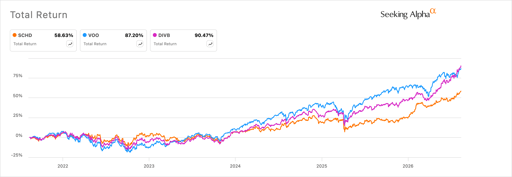
VOO vs SCHD vs DIVB ETFs performance | Source: SeekingAlpha
As such, while the long-term performance is not an indicator of what to expect, it is often safer to invest in a fund that has a long history of performing well.

Dow closes 600 pts higher as Fed Rate hike bets ease and stocks rally

Evening digest: Volkswagen announces job cuts, Nvidia acquires Hugging Face
Strategy, Coinbase stocks rally as Bitcoin reclaims $80,000

Oracle stock surges 5% as analysts see major upside ahead

Broadcom stock falls: why analysts are divided on the stock
No results found
Loading articles...
Failed to load articles. Please try again.