
Kospi Index rebound gains momentum: What’s driving it and what happens next
AI Sentiment: 68/100 Bullish
This score is generated through AI-driven analysis of the article's content.

powered by

Buy. The article points to a sharp rebound in Samsung (+45% from July lows) driven by strong earnings/forward guidance and long-term customer commitments with price floors/ceilings—less “boom-bust” than past memory cycles. Foreign investors are also net buyers of Kospi exposure, supporting follow-through. Target the next leg toward the Kospi’s ~8,000 resistance as memory leadership persists.
Key Risk: Memory demand or pricing breaks the “floor/ceiling” commitments, sending Samsung back into a cyclical revenue drop.
Buy. SK Hynix is rebounding alongside Samsung and is a major Kospi weight (>50% combined with Samsung). The thesis is that sustained data-center spending by hyperscalers (Google/Meta/Amazon/Microsoft) keeps DRAM/NAND demand firm, and the long-term commitments reduce the odds of a quick reversal. Ride momentum while the Kospi is above the descending channel.
Key Risk: Hyperscalers pause or cut data-center memory orders, causing SK Hynix guidance to roll over fast.
- The Kospi Index has rebounded in the past few weeks.
- Top stocks like Samsung Electronics and SK Hynix have all rebounded.
- Technicals suggest that the stock may rebound further soon.
The Kospi Index has rebounded in the past few weeks as investors have moved back to memory companies like Samsung Electronics and SK Hynix and as the US and Iran has war has paused. It jumped to 6,977, up by 31% from its lowest level this month.
Samsung Electronics and SK Hynix stocks have rebounded
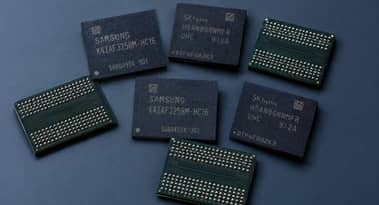
The Kospi Composite Index has held steady, helped by the ongoing recovery of memory stocks after the recent earnings. Samsung Electronics has jumped by 45% from its lowest level in July and is hovering at its highest level in over a month. Similarly, SK Hynix shares has jumped by double digits in this period, a notable thing since these two companies account for over 50% of the fund.
Memory stocks, including their US peers like Micron, SanDisk, and Western Digital have all jumped after the recent earnings. Most of these companies published strong earnings and forward guidance. Unlike in the past, many of these companies announced long-term commitments from the biggest companies in the world, with price floors and ceilings.
These long-term commitments helps to prevent the cyclical nature the memory industry has gone through. A good example of this is what happened in 2023 when all of them announced a big drop in revenues.
Most notably, their biggest clients announced plans to continue spending in the data center boom. This includes companies like Google, Meta Platforms, Amazon, and Microsoft, which cumulatively plans to spend over $750 billion this year.
Still, there is a risk that the ongoing memory stocks and Kospi Index rebound is a dead-cat bounce. This is a situation where an asset in a freefall bounces back modestly and then resumes the downward trend.
Societe Generale, the giant French bank, has maintained that the Kospi Index may continue rising, citing the sustained demand for memory chips. Also, foreign investors have bought $4.7 billion worth of Kospi Index stocks.
US and Iran war has paused
Further, the Kospi Index has rebounded because of the ongoing developments in the Middle East where the US-Iran war has paused. The two sides have not launched any attacks in the past two weeks, with media reports citing the falling US weapon stockpiles.
As a result, crude oil prices have pulled back in the past few weeks, with Brent and the West Texas Intermediate moving below $90. This retreat normally benefits South Korea, which imports most of its oil from the Middle East.
Still, the war is not yet over as the two sides have not inked a ceasefire, and the US is leaning towards sanctions.
Separately, President Donald Trump has asked Pete Hegseth to scale back the military exercises with South Korea, citing his good relationship with Kim Jong Un. He also cited the fact that South Korea refused to join his war against Iran.
Kospi Index forecast
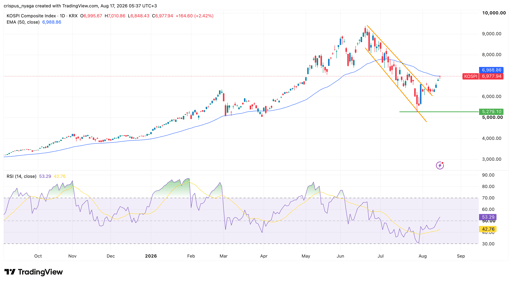
Kospi Composite Index chart | Source: TradingView
The daily chart shows that the Kospi Index has rebounded, reaching its highest level since July 24 this year. It has already moved above the upper side of the descending channel, confirming the bullish outlook. Also, the Relative Strength Index has jumped above the neutral level of 50.
Therefore, the index will likely continue rising, potentially to the key resistance level of 8,000. In the future, however, there is a risk that it will resume the downtrend as memory stocks retreat.

Jensen Huang sees AGI arriving with OpenAI's Astra: 3 stocks investors should watch
Top FTSE 100 shares to watch: Barclays, Scottish Mortgage, Rolls-Royce

Here’s why Bittensor (TAO), Near Protocol, and Venice Token rising

Nike to lose S&P 100 place as stock sinks to 12-year low: what’s ailing NKE?

DAX Index outlook: Top 3 news to move German stocks this week
No results found
Loading articles...
Failed to load articles. Please try again.