
Brent tops $100 as Iran war disrupts supply despite record IEA release
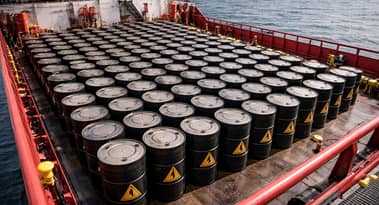

- Brent tops $100 as Iran war disrupts global oil supply routes.
- IEA announces record 400 million-barrel oil reserve release to calm markets.
- Hormuz closure and tanker attacks fuel fears of deeper supply shock.
Oil prices surged sharply on Thursday as escalating tensions linked to the war involving Iran triggered major disruptions to global energy flows, pushing benchmark Brent crude back above $100 a barrel despite a record release of emergency reserves.
Brent crude jumped as much as 9.46% to $100.68 per barrel, while West Texas Intermediate (WTI) climbed close to $96.
The surge came even after the International Energy Agency announced its largest coordinated release of strategic oil reserves in history in an effort to calm markets.
Traders remain concerned that disruptions to shipping routes and production across the Middle East could create a significant supply shortfall in the coming months.
Brent climbs above $100 as supply disruptions intensify
The latest rally in oil prices has been driven by mounting supply concerns tied to the conflict in the Middle East.
Oman evacuated all vessels from its Mina Al Fahal export terminal outside the Strait of Hormuz, said a Bloomberg report.
The precautionary measure followed rising security risks in the region.
At the same time, two oil tankers were attacked in Iraqi waters, prompting Iraq to halt operations at its oil terminals, the director of the General Company for Ports Iraq told state media.
These disruptions have compounded fears of a wider supply shock as the crucial Strait of Hormuz remains effectively closed.
The waterway typically carries about one fifth of global oil supply.
Several Gulf producers have begun cutting output in response. Iraq was among the first to reduce production, followed by Kuwait and Saudi Arabia.
As a result, roughly 6% of global crude supply has already been affected, with the possibility of further reductions if the conflict continues.
Prices have been highly volatile throughout the week, with Brent and WTI briefly spiking toward $120 per barrel before pulling back.
IEA launches record reserve release to stabilize markets
In response to the worsening supply outlook, the International Energy Agency announced that its 32 member nations would release 400 million barrels of oil from emergency reserves.
The coordinated action represents the largest release in the agency’s history, exceeding the 182 million barrels deployed after Russia’s invasion of Ukraine in 2022.
The United States alone plans to release 172 million barrels from its Strategic Petroleum Reserve, with shipments expected to begin next week and continue for roughly 120 days.
Despite the historic intervention, markets have remained skeptical about whether the reserves can offset the supply shock.
“Prices right now are still in panic mode. There is a lot of emotion, fear, uncertainty built into the price that we see,” said Pavel Molchanov, senior investment strategist at Raymond James in a CNBC report.
MST Marquee's Energy analyst Saul Kavonic said the emergency stock release may only partially bridge the gap created by disrupted shipments through Hormuz.
“But the IEA decision also signals how acute the oil shortage risk is, suggesting the IEA does not believe the war is [likely] to end soon, and stock draws now will need to be replaced later, portending higher prices even after the war ends,” he said.
China export curbs and market uncertainty add pressure
Additional pressure on energy markets has emerged from Asia, where Chinese refiners have begun canceling previously agreed export cargoes of refined fuels such as gasoline and diesel.
China’s largest refining companies were instructed last week to stop signing new export contracts, with the latest directive tightening those restrictions further.
The move suggests Beijing is attempting to preserve domestic fuel supplies amid uncertainty over global energy flows.
Analysts warn that the disruption to shipments through the Strait of Hormuz remains the most significant driver of market volatility.
“The only thing that’s really going to bring oil prices back down is if we really see the Strait of Hormuz reopen,” Neil Beveridge, director of research at Sanford C. Bernstein & Co., said in an interview on Bloomberg Television.
Strategic reserve releases may provide temporary relief, but the scale of the disruption could overwhelm those measures.
Beveridge noted that flows from reserves are “nothing compared with the 20 million barrels” per day potentially disrupted by the closure of Hormuz.
As geopolitical tensions continue to escalate, energy markets remain highly sensitive to developments that could determine whether global oil flows stabilize or face further disruption.

Why is gold back above $4,400 and could payrolls send it even higher?
Crude oil price forecast as Iran ramps up attacks on Kuwait
Oil pushes toward $100 as US-Iran strikes flare: what could drive it higher?

Why gold is sliding despite fresh US-Iran strikes: is $4,000 next?

Oil jumps above $91, but the market’s biggest Hormuz fear has changed
No results found
Loading articles...
Failed to load articles. Please try again.