
LayerZero price forecast as bearish pressure holds despite ZRO gains

AI Sentiment: 28/100 Bearish
This score is generated through AI-driven analysis of the article's content.

powered by

Buy AAVE. LayerZero’s 5,000 ETH direct donation plus 5,000 ETH to bolster Aave liquidity and plans to deepen GHO liquidity are second-order positive for Aave’s lending depth and stablecoin ecosystem. If DeFi United attracts more bridge/DeFi capital, Aave should capture incremental deposits and usage even if ZRO remains weak.
Key Risk: DeFi United funds don’t translate into real Aave deposits/borrowing (capital stays idle or flows to competitors).
Sell ZRO. The news is supportive (10,000 ETH to DeFi United/Aave), but price action is still bearish: ZRO is below all five daily moving averages, a daily bearish flag is forming, and MACD stays bearish. The bounce to ~$1.50 looks like a relief rally that can fade back toward the next support zone near $1.22 if $1.55–$1.90 fails.
Key Risk: ZRO breaks above and holds $1.90–$2.00, turning the bearish flag into a sustained uptrend.
- LayerZero (ZRO) price is up 5% in the past 24 hours.
- Gains come amid 10,000 ETH pledge to Aave-led DeFi United effort.
- ZRO currently faces significant overhead resistance and could retest $1.22.
LayerZero (ZRO) has gained about 5% over the past 24 hours, rebounding from lows near $1.40 to trade around $1.50.
The move snaps a two-day decline and comes as the broader crypto market attempts to push higher, with several DeFi tokens posting gains as investors look past recent security-related concerns.
While the recovery suggests improving short-term sentiment, the broader setup remains mixed.
Analysts point to the possibility that renewed institutional interest and a shift toward risk-on positioning could support further upside.
However, traders continue to weigh these gains against a prevailing bearish structure, keeping positioning cautious.
LayerZero price gains
The ZRO token’s uptick in the past two days mirrors ecosystem movements across the DeFi market.
Consensys, Mantle, Avalanche Foundation and others have deposited or pledged support after the Kelp DAO exploit.
Notably, LayerZero Labs has formally pledged over 10,000 ETH to the Aave-led "DeFi United" recovery initiative.
This strategic commitment arrives as part of a wider industry-wide response to the recent rsETH incident, which saw attackers siphon $290 million from the Kelp DAO project.
A concerted effort has seen major industry players back a recovery effort, including LayerZero, whose allocation is structured to provide both immediate support and long-term liquidity depth.
LayerZero Labs said it’s donating 5,000 ETH directly to the DeFi United recovery effort, while depositing an additional 5,000 ETH to bolster Aave market liquidity.
Furthermore, the company has announced plans to strategically deepen liquidity for GHO, the native stablecoin of the Aave ecosystem.
“We will continue working with Aave and others across DeFi on how OFTs should be set up when integrated into lending markets and beyond,” LayerZero noted.
Confidence in the cross-chain bridge platform shows in the daily price move.
ZRO price bearish despite gains
Despite the positive sentiment generated by the DeFi United initiative, ZRO price action remains constrained by technical challenges.
While oscillators hover neutral, moving averages indicate a strong sell signal.
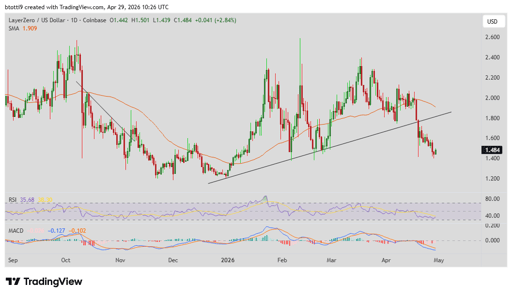
LayerZero ZRO remains under technical pressure, with the price trading below all five major daily moving averages, indicating persistent overhead resistance.
Market observers also point to a bearish flag formation on the daily chart, a pattern typically associated with continuation to the downside.
This outlook aligns with the recent rejection near $1.55 and the subsequent retest of lower support levels.
Momentum indicators reinforce the cautious stance. The Relative Strength Index (RSI) sits near 36, close to oversold territory and signalling weak buying interest.
At the same time, the MACD remains in bearish territory, suggesting that selling pressure continues to dominate.
Unless ZRO can reclaim key levels, particularly the $1.90–$2.00 range, downside risks remain elevated. In that scenario, analysts see the next potential target for bears around $1.22.

ADA shorts are piling in: could $0.20 trigger a violent Cardano rebound?

Solana slips as Fed hike bets rise: could $90 become the next battleground?

XRP falls despite ETF inflows: why are buyers still failing to defend $1.40?

Bitcoin, Ethereum and XRP are falling: is this just a reset before the next leg?

Is Zcash price at risk of falling below $1,000?
No results found
Loading articles...
Failed to load articles. Please try again.