
USD/INR forecast: Here’s why the Indian rupee is soaring today
AI Sentiment: 62/100 Bullish
This score is generated through AI-driven analysis of the article's content.

powered by

Buy USD/INR (long USD vs INR). The RBI is pressured to defend the rupee, but the article flags rising inflation and higher bond yields (5Y ~6.9%, 10Y ~7%), which keeps the rate-hike debate alive and limits rupee upside. Meanwhile the Fed tone is hawkish, supporting the dollar. Technicals also show the pair holding above key EMAs and likely bouncing from the lower channel toward 100.
Key Risk: RBI actually turns decisively hawkish and aggressively defends the rupee (bigger rate hikes + sustained intervention), breaking the uptrend in USD/INR.
Sell INR government bonds (short 5Y and/or 10Y). The setup is straightforward: inflation is rising (CPI up, WPI up), yields are already climbing, and the market is pricing more hawkish RBI action. Even if growth slows, the near-term driver is higher inflation and yield pressure, which keeps bond prices capped.
Key Risk: RBI hikes less than markets expect and growth fears dominate, causing yields to fall and bond prices to rally.
- The Indian rupee jumped today as the recent crash paused.
- The RBI is considering all options to prevent its collapse.
- The bank may decide to hike interest rates soon.
The Indian rupee rose slightly on Thursday after reports that the country’s central bank was considering all options, including hiking interest rates amid the slump. The USD/INR pair retreated to 96.4050, a few points below the record high of 96.97.
RBI considers rate hikes and interventions
The Reserve Bank of India has come under intense pressure this year as it fights numerous challenges. A key issue is that the Indian rupee has been in a strong sell-off this year and its trading at a record low. It has become one of the worst-performing currencies in the emerging markets.
The rupee has slumped because of India’s exposure to the Middle East, where it buys most of its oil and gas. The closure of the Strait of Hormuz has pushed it to look for alternative sources of energy, including Russia, where it had stopped buying amid US pressure.
Russia, which used to sell its oil to India at a discount, is now selling at full price. As a result, data shows that India’s inflation has started going upwards this year.
The recent numbers showed that its inflation rose to 3.6% in April, with wholesale prices jumping to a 42-month high of 8.3%. In most cases, companies normally hike prices when their cost of doing business jump, meaning that the CPI will continue rising this year.
The RBI has been forced to intervene by buying rupees this year. Now, there are signs that the bank is considering hiking interest rates to make it more attractive.
Data shows that India’s government bond yields have risen, with the five-year hitting 6.90% and the ten-year rising to 7%. Government bond yields jump when investors are anticipating rate hikes.
The challenge, however, is that higher rate hikes will slow the economy. In a recent statement, the RBI hinted that the economy will grow by 6.9% this year, down substantially from last year’s expansion of 7.6%.
Hawkish Fed minutes
The USD/INR exchange rate is also reacting to the relatively hawkish minutes by the Federal Reserve. These minutes revealed that most officials expressed concern about the rising US inflation.
As a result, many of them were supportive of future rate hikes in the country. A rate hike will be a big disappointment to President Donald Trump, who has campaigned aggressively for the Fed to cut interest rates.
Looking ahead, the next main catalyst for the US dollar will be the upcoming Kevin Warsh swearing in, which happens tomorrow. Market participants will watch his statement closely for signs on whether the bank should hike interest rates.
USD/INR technical analysis
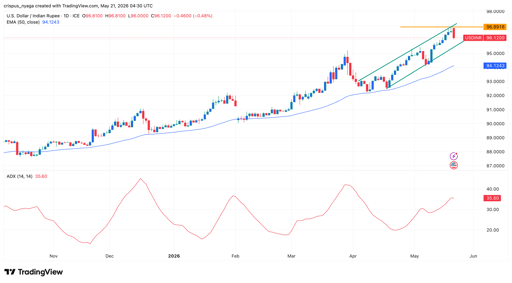
USDINR chart | Source: TradingView
The daily chart shows that the USD to INR exchange rate has been in a strong rally this year and is now hovering near its all-time high. It pulled back after revelations that the RBI was considering interventions in the near term.
This report comes as the pair has constantly remained above the 50-day and 100-day Exponential Moving Averages (EMA). It has also formed an ascending channel and is now moving towards its lower side.
Therefore, the most likely scenario is where the USD/INR pair softened a bit and then resumes the uptrend. If this happens, the pair may drop to 96.50 and then surges towards 100 by the end of the year.

SCHD nears title of biggest dividend ETF, but technical risks loom

Nio stock: Why Tesla rival dropped despite strong revenue growth

Nvidia stock analysis: top reasons why the shares may go parabolic soon

Broadcom stock falls to a key support: is it about to surge after earnings?

Platinum price analysis: Cautious trading and FOMO at play ahead of US CPI data
No results found
Loading articles...
Failed to load articles. Please try again.