
Figma stock price is stuck in a bear market: will it crash further or rebound?

AI Sentiment: 35/100 Bearish
This score is generated through AI-driven analysis of the article's content.

powered by

Buy ADBE. The article flags FIG weakness after “latest Adobe earnings,” implying the market is rotating within software on AI execution. Adobe has the strongest AI distribution and monetization path in creative software; if FIG’s fear trade fades, investors will pay up for the incumbents that can bundle AI into existing workflows. This is a relative-value play: when “AI kills software” fears soften, ADBE typically rebounds faster than smaller, loss-making peers.
Key Risk: Adobe’s AI features fail to translate into higher growth/margins, and the market keeps compressing software multiples.
Sell FIG. The stock is at an all-time low, below all moving averages, and forming a descending triangle—classic bearish continuation. Even with strong revenue growth (46%) and retention (139%), the quarter’s $142M net loss and big opex jump (R&D/S&M/G&A) keep sentiment fragile. If the market treats AI “SaaSpocalypse” fears as a growth multiple reset, FIG can revisit $15 support and overshoot on risk-off.
Key Risk: FIG proves the opex surge was temporary and guides to sustained profit expansion, forcing a valuation re-rate.
- Figma stock price has retreated sharply in the past few months.
- The company’s growth has accelerated despite the SaaSpocalypse fears.
- Technicals suggest more pain before an eventual rebound.
Figma stock price has come under intense pressure this year and is now hovering at its all-time low amid the rising concerns about its revenue growth in this artificial intelligence (AI) era. After peaking at $143 following its IPO last year, the stock has plunged to $19 today, with its market cap falling from $60 billion to $10.2 billion.
Figma stock has crashed amid growth concerns
Figma, a top player in the design industry, has become one of the top laggards in the stock market. This retreat has mirrored the performance of other companies in the software industry, like Salesforce, Adobe, and ServiceNow.
The stock has plunged amid concerns of SaaSpocalypse, a situation where software companies will be disrupted by AI tools. Besides, it is easy to make some quality graphics using AI tools like ChatGPT and DeepSeek.
Still, financial results shows that the company is doing relatively well in terms of revenue growth. The most recent numbers showed that its revenue grew by 46% in the first quarter to $334 million.
Most notably, the company is not losing customers to AI tools. Its net dollar retention rate rose to 139%. Its paid customers with an ARR of $10,000 and above jumped to 15,218 from 9,000 in the second quarter of 2024. Those with an ARR of $100,000 and above rose to 1,525 from 1,000 in the same period last year.
Still, the results showed that the company suffered a $142 million net loss during the quarter. This was a big reversal since it made a $44 million profit a year earlier. This loss jumped as the company boosted its operating expenses, with R&D rising to $172 million, S&G soaring to $125 million, and G&A hitting $103 million.
On the positive side, the company made an adjusted free cash flow of $89 million and an operating profit of $52 million.
There are signs that the company is not all that overvalued, especially using the rule-of-40 multiple. The company has a forward revenue growth of 35% and an operating profit margin of 16%. This gives it a rule-of-40 multiple of 51%.
Analysts have a bullish outlook for the Figma stock price. JPMorgan have a target of $42, much higher than the current $19. RBC, Piper Sandler, Morgan Stanley, and BTIG have targets of over $35.
Figma stock price technical analysis
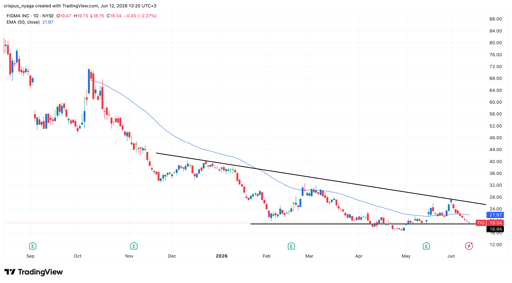
FIG stock price chart | Source: TradingView
The daily chart shows that the Figma share price has come under pressure in the past few months since going public. It has remained below the descending trendline that links the highest point since December last year.
The stock has also moved below all moving averages, a sign that bears remain in control. There are also signs that it has formed a descending triangle pattern, a common bearish continuation signal.
Therefore, the most likely scenario is where the stock remains under pressure in the near term, especially after the latest Adobe earnings. If this happens, it may drop to the key support of $15, and then stage a strong comeback in the long-term as the SaaSPocalypse fears end.

Why Oracle stock is down around 5% on Tuesday

CoreWeave stock flashes a warning sign despite strong revenue growth

Why are Intel and AMD stocks falling today

Dell stock falls before earnings: strong AI demand will not alone sustain 250% rally

SCHD nears title of biggest dividend ETF, but technical risks loom
No results found
Loading articles...
Failed to load articles. Please try again.