
Micron stock jumps 7% as AI memory demand fuels supercycle optimism
AI Sentiment: 82/100 Bullish
This score is generated through AI-driven analysis of the article's content.

powered by

Buy MU. AI-driven memory demand plus evidence of supply tightness (DRAM/HBM conversion, constrained clean-room capacity, and “can’t reprice” fixed BOM devices like consoles) supports a longer supercycle. The valuation discount (MU ~9.7x forward vs Nasdaq ~25.5x) gives upside if the market stops treating memory as pure boom-bust. Technicals are still in a long-term uptrend, with resistance near ~$1,089 to watch.
Key Risk: AI memory demand cools faster than supply tightness eases, causing prices to fall and the “supercycle” narrative to break.
Buy NVDA. Second-order effect: if memory supply is the constraint, AI server build-outs slow less when the platform leader (NVDA) keeps winning share in AI accelerators and systems that pull the most memory per rack. MU strength signals the AI infrastructure spend is real; NVDA is the demand engine that keeps driving those systems even when memory is tight.
Key Risk: AI capex shifts away from NVDA platforms (or customers redesign systems to use less memory per compute), reducing NVDA’s ability to translate the memory supercycle into earnings.
- Micron jumps 7% as AI memory demand fuels supercycle hopes.
- RBC lifts Micron target to $1,200 on prolonged DRAM upcycle.
- Memory shortages support Micron as shares near record highs.
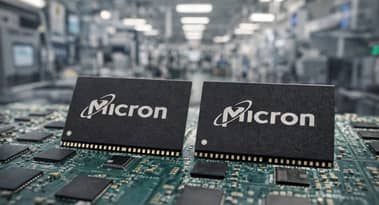
Micron Technology MU shares surged more than 7% on Monday as investors continued to embrace the artificial intelligence-driven semiconductor rally, while fresh signs of memory chip shortages reinforced expectations of a prolonged industry upcycle.
The stock rose to $1,076.79 in trading, extending recent gains as broader markets reacted positively to the prospect of a potential peace agreement between the United States and Iran.
Micron has become one of the key beneficiaries of the AI infrastructure boom, with growing demand for memory chips used in data centers, AI servers, and advanced computing applications driving investor enthusiasm.
The company’s shares have also attracted attention because of their relatively low valuation compared with broader technology stocks.
Investors reassess Micron's valuation
Despite its recent rally, Micron continues to trade at a discount to many technology peers.
According to FactSet data, the company was trading at 9.74 times forward earnings as of Friday's close, compared with 25.5 times for the Nasdaq Composite.
The discount reflects the memory industry's long history of boom-and-bust cycles, which have traditionally led investors to assign lower valuation multiples to memory-chip manufacturers.
However, the emergence of artificial intelligence as a major demand driver has prompted some investors to reconsider that view.
Market participants increasingly believe the industry may be entering a prolonged "supercycle" as AI systems require significantly larger amounts of memory capacity.
Recent developments have added to concerns about tight memory supply conditions.
Last week, Microsoft's Xbox division highlighted challenges related to component availability, offering another indication that demand continues to outpace supply.
Wedbush analyst Matt Bryson said in a research note, “That a platform holder is publicly weighing a new hardware model and flagging constrained console output shows the pass through has moved from PCs and phones into fixed BOM [bill of materials] devices that can’t easily reprice, reinforcing our structural shortage through 2027+ thesis”.
RBC sees longer-lasting memory upcycle
Analysts at RBC Capital also turned more optimistic on Micron's prospects, raising their price target on the stock to $1,200 from $525 while maintaining an Outperform rating.
The firm increased its estimates based on stronger pricing assumptions and expectations for higher memory-chip volumes.
According to RBC, the current DRAM upcycle has already lasted 12 quarters, exceeding the eight- to nine-quarter cycles experienced in 2014 and 2018.
The firm believes the cycle could continue for another five to six quarters as supply growth remains constrained.
RBC cited limited clean-room capacity, ongoing conversion toward high-bandwidth memory (HBM) production, robust capital expenditure trends, and growing demand from generative AI applications as factors supporting the outlook.
The brokerage also noted that the expansion of inference workloads and agentic AI applications is creating a structural increase in memory demand, while few near-term developments appear capable of easing supply tightness.
Technical outlook remains constructive
From a technical perspective, Micron continues to trade in a strong long-term uptrend.
The stock currently sits 18.1% above its 20-day simple moving average, 55.7% above its 50-day moving average, and 176.4% above its 200-day moving average.
The broader bullish structure remains intact, with the 20-day moving average positioned above the 50-day average and the 50-day average above the 200-day average.
This pattern has supported the stock's advance since a golden cross formed in June 2025.
However, momentum indicators suggest the pace of gains may be moderating.
The MACD remains below its signal line and the histogram remains negative, indicating slower upside momentum compared with earlier stages of the rally.
Investors are now closely watching resistance near $1,089.50, close to Micron's 52-week high of $1,089.29, as the stock continues to test the upper end of its recent trading range.

Software stocks are back from the dead as AI fuels growth: can the rally continue?

GoPro stock soars 200% after Markiplier stake, $285M Starman deal

SpaceX stock rally meets another lockup expiry test on September 9: what to expect

Dow closes 270 pts lower as strong jobs report lifts September Fed rate-hike bets

Evening digest: Trump pressures Fed as US jobs rise, gold falls
No results found
Loading articles...
Failed to load articles. Please try again.