
Crude oil price tumbles on Hyperliquid as Trump TACOs on planned Iran attacks

AI Sentiment: 25/100 Bearish
This score is generated through AI-driven analysis of the article's content.

powered by

Buy USO (or WTI futures exposure) after the Iran-attack pause. Oil sold off hard (WTI ~$81) on “TACO” de-escalation, and the market is likely to overshoot lower before any new escalation headline. Technicals also point to a near-term base around $80 as traders cover risk after the immediate threat is delayed.
Key Risk: A sudden Iran retaliation or renewed US strike plan that reignites supply-shock fears and pushes WTI back above $90 fast.
Buy BNO (or Brent futures exposure) for the same reason, but with a slightly longer horizon: Brent fell from ~$100 peak to ~$83, and the “attack canceled” narrative can keep risk premia compressing for weeks until a new trigger. Cup-and-handle breakdown plus below 50/100 EMAs can still mean a tradable bounce from oversold levels.
Key Risk: Escalation that targets Gulf energy infrastructure (especially desalination/power) and forces Brent to reprice toward the prior war highs.
- Crude oil price dropped sharply on Hyperliquid.
- Trump decided to pause his planned attacks against Iran.
- He is under pressure from Middle East countries against escalating.
Brent and WTI crude oil prices slipped sharply on Hyperliquid after President Donald Trump halted the planned attacks against Iran, citing requests from Iran and other Middle East countries. WTI dropped to $81, with its 24-hour volume hitting $181 million.
Brent, the global benchmark, dropped to $83, down sharply from last month’s high of $100. The two benchmarks remain substantially lower than where they were at the peak of the war.
Trump chickens out on planned attack against Iran
Brent and WTI oil prices tumbled after President Donald Trump decided against hitting Iran as most media organizations had predicted. CBS and the Wall Street Journal said that Trump had finally decided to bomb Iranian energy and other infrastructure projects. The attack was to start on Saturday and go on for a few weeks, with the goal being to pressure Iranians to reach a deal with the US.
Despite the threats, Trump decided to pause the attacks, citing requests from Iran and other Middle East countries. In reality, however, Axios reported that he paused the attacks after a call from Saudi Arabia’s Crown Prince Mohammed bin Salman. Other Gulf allies like Qatar, UAE, Turkey, and Pakistan are also pushing Trump to de-escalate. This situation is known as TACO (Trump Always Chickens Out).
An attack on Iran's critical infrastructure would mark a dangerous new phase of the conflict, with far-reaching consequences for global energy markets. Iran has repeatedly warned that it would retaliate by targeting critical infrastructure across the Gulf, including oil and gas facilities, bridges, power plants, and desalination plants.
Strikes on desalination facilities would be particularly devastating, as Gulf countries rely on them for the vast majority of their freshwater supply, potentially triggering a severe humanitarian crisis alongside widespread economic disruption.
Iran has proven to be a formidable opponent during this war. The country has launched major attacks against US bases in the Middle East, destroying equipment worth billions of dollars.
Iran has dismissed President Trump's claims that negotiations are underway and making progress, insisting that no direct talks are taking place between Washington and Tehran. Iranian officials pointed to the latest U.S. strikes as evidence that diplomatic efforts have effectively broken down.
Those attacks ended the Memorandum of Understanding (MoU) reached earlier, and they also marked the third time the Trump administration has launched military action against Iran during periods when negotiations were reportedly ongoing.
Meanwhile, there are concerns about the US military readiness. Just recently, the head of European Command warned the Pentagon that he lacked sufficient naval forces to continue protecting Israel from incoming ballistic missiles.
Crude oil price technical analysis
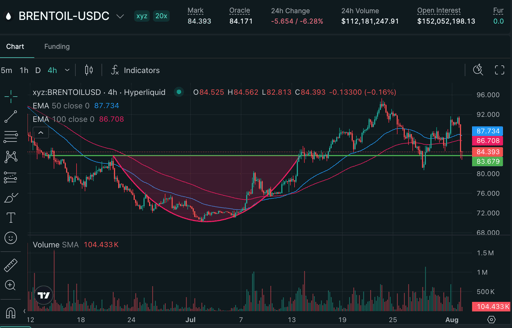
Brent crude oil price chart | Source: TradingView
The four-hour chart shows that Brent dropped to $83 on Hyperliquid. It has dropped from Friday’s high of $91 and retested the upper side of the cup-and-handle pattern. It has moved below the 50-period and 100-period Exponential Moving Averages (EMA), a sign that bears are prevailing.
Therefore, prices are likely to remain under pressure and could fall toward the $80 level or even lower. The key risk to this outlook is that the conflict remains highly fluid, leaving markets vulnerable to sharp swings in either direction. Any further military escalation between the United States and Iran could quickly reverse sentiment and trigger heightened volatility in the days ahead.

Venice Token is rising: top reasons VVV has more room to go

XRP price prediction as RLUSD crosses key milestone, ETF inflows jump

Nvidia stock in focus as earnings loom and GPU price hikes approach

Here’s why the Bloom Energy stock is losing momentum despite its growth

Marvell stock forecast: valuation concerns persist ahead of earnings
No results found
Loading articles...
Failed to load articles. Please try again.