
Nikkei 225 Index on edge ahead of Softbank earnings as Japanese yen dips

AI Sentiment: 35/100 Bearish
This score is generated through AI-driven analysis of the article's content.

powered by

Buy SoftBank into the earnings-driven selloff. The stock is down ~6% today and >30% from its YTD high, but the broader Nikkei setup still points upward (bullish flag/above 100-day). If SoftBank’s earnings confirm stability in Arm and cash generation, the market can quickly re-rate the “volatility” discount back down.
Key Risk: Arm/AI portfolio weakness shows up again in guidance (or a further valuation hit), making the selloff structural, not just pre-earnings noise.
Buy Kioxia as a memory-cycle mean reversion. It’s down >8% today and >55% from its all-time high despite revenue/profit growth with rising memory prices—classic “good fundamentals, bad tape.” If memory pricing holds, the next move is a sharp rebound as investors stop treating it like a broken story.
Key Risk: Memory prices roll over faster than expected, wiping out the profitability growth that’s supposed to support the rebound.
- Nikkei 225 Index retreated as most technology stocks tumbled.
- Softbank dropped sharply ahead of its earnings.
- The Japanese yen resumed its downward trend, with the USD/JPY hitting 157.7.
The Nikkei 225 Index retreated by over 1.25% today, August 6, as technology companies like Softbank, Kioxia Holdings, Tokyo Electron, and Advantest pulled back. It also dropped as the Japanese yen resumed its downtrend despite the Bank of Japan (BoJ) and US government rescue. It retreated to 65,455 points, down from the year-to-date high of 72,845.
Softbank, Kioxia, and Tokyo Electron retreated
Technology companies, which fueled the Nikkei 225 index’s jump to a record high, have taken another path recently, with their volatility rising.
Softbank stock dropped by 6% and is down by over 30% from the year-to-date high. This retreat happened as traders waited for its earnings report, which will provide more color about its business.
The company has come under pressure in the past few weeks. For one, Arm Holdings, one of its biggest holdings, has dropped from $450 to the current $274. OpenAI, another large firms in its portfolio, is facing substantial competition pressure from companies like Anthropic and Moonshot. These pressures are risin and have pushed it to cut prices and postpone its planned IPO.
Kioxia Holdings, another top company in the Nikkei 225 Index, retreated by over 8% as memory firms dropped. It has now dropped by over 55% from its all-time high, mirroring the performance of other memory firms like Samsung, SK Hynix, and SanDisk. This retreat is happening despite its demonstrated revenue and profitability growth amid the rising memory prices.
Other companies in the tech industry have also pulled back even after big-tech companies like Microsoft, Meta Platforms, and Alphabet committed to keep spending this year.
Japanese yen resumes its downtrend
The Nikkei 225 Index is also reacting to the ongoing performance of the Japanese yen. The USD/JPY exchange rate dropped from the year-to-date high of 163.97 to 155.20 after the BoJ and the US government intervened.
Media reports suggest that the BoJ spent over $50 billion defending the yen last week. At the same time, the US government swapped some of its euro holdings to yen, with officials committing further help ahead.
Recently, however, the Japanese yen has softened, with the USD/JPY pair rising to 157.72. This performance is similar to what happened in April when the BoJ intervened. At the time, the pair dropped to 155.60 and then resumed the uptrend, reaching a multi-decade high of 163.97.
Therefore, there is a risk that the BoJ will now start hiking interest rates to bridge the gap with the United States. Such a move would have some impact on Japanese stocks.
Nikkei 225 Index technical analysis
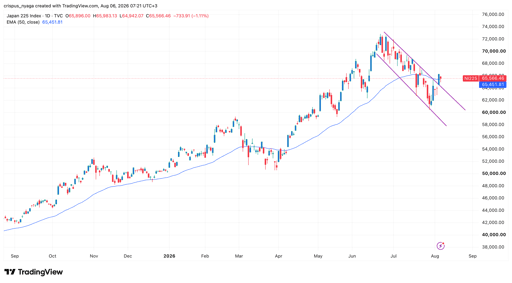
Nikkei 225 chart | Source: TradingView
The daily chart suggests that the index will have a bullish breakout in the coming days or weeks. That’s because it has slowly formed a descending channel, which is part of the bullish flag pattern. It has retested the upper side of this channel, completing the break-and-retest pattern.
The index has also remained above the 100-day moving average, which has provided it with the most support. Therefore, the path of the least resistance is upward, with the next key target being the psychological level of 70,000.

Dow closes 270 pts lower as strong jobs report lifts September Fed rate-hike bets

Evening digest: Trump pressures Fed as US jobs rise, gold falls

Apple stock falls 2% as foldable iPhone production faces supply hurdles

Tesla stock falls 6% as cybercab launch faces analyst, regulatory concerns

AMD stock forecast: why this Nvidia rival is on the cusp of a breakout
No results found
Loading articles...
Failed to load articles. Please try again.