
Why are Intel and AMD stocks up today?
AI Sentiment: 78/100 Bullish
This score is generated through AI-driven analysis of the article's content.

powered by

AMD. The upgrade is specific (datacenter + market-share gains) and lines up with the macro tailwind (falling 10Y yields lifting growth/semis). If Nvidia’s earnings confirm AI infrastructure demand, AMD’s CPU leverage and datacenter positioning should re-rate further. Key upside catalyst: CPU share gains by 2027 plus “agentic AI” driving incremental processor demand.
Key Risk: Nvidia’s earnings disappoint on AI server demand, forcing AMD multiple compression and delaying datacenter/CPU share gains.
Intel. Pelosi’s disclosed call buying is a sentiment signal that coincides with renewed investor interest in Intel’s manufacturing and AI push. With yields falling, the market is more willing to pay for turnaround stories; Intel’s rebound can extend if semis keep catching a bid into Nvidia’s report.
Key Risk: Intel’s execution slips (manufacturing/AI roadmap misses or guidance weak), and the stock falls back despite the macro bounce.
- Intel shares rose about 2%, while AMD gained roughly 4% in Tuesday trading.
- Falling 10-year Treasury yields helped support a broader recovery in US stocks.
- Intel also got a boost from Pelosi's disclosure while AMD got a fresh bullish call.
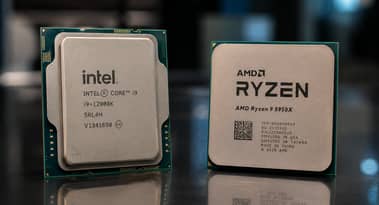
Intel and AMD shares moved higher on Tuesday as semiconductor stocks rebounded alongside a broader recovery in US equities, with falling Treasury yields helping ease pressure on growth and technology stocks.
Investors were also looking ahead to Nvidia's upcoming earnings report, which could provide fresh signals on demand for artificial intelligence infrastructure and the broader health of the chip industry.
Intel gained about 2%, while AMD rose roughly 4%.
The Philadelphia Semiconductor Index climbed 1.4%, while the S&P 500 added about 0.3%.
The Nasdaq Composite rose around 0.5%, and the Dow Jones Industrial Average gained 0.13%.
The benchmark 10-year Treasury note yield fell to 4.658%, extending its decline from Monday.
Treasury yields had moved lower after reports that the US Treasury Department could use its $1 trillion General Account to fund bond repurchases.
Lower yields can support technology and semiconductor stocks by reducing the relative pressure on higher-growth companies and improving investor appetite for riskier assets.
Pelosi disclosure adds to Intel momentum
Intel also appeared to benefit from a congressional filing showing that the household of former House Speaker Nancy Pelosi purchased a sizable position in the chipmaker.
The disclosure showed purchases on July 24 of 10,000 Intel shares valued between $500,001 and $1 million.
The filing also listed 50 call contracts with a $50 strike price expiring June 17, 2027, valued between $250,001 and $500,000.
The transactions were identified as spouse-owned, indicating that they were made by Paul Pelosi.
The filing comes as Intel has attracted renewed investor interest around its manufacturing ambitions and efforts to establish a stronger position in artificial intelligence.
Bloom Energy, another company in which Pelosi's household disclosed a new position, also jumped on Tuesday.
The latest purchases represent the third set of transactions disclosed by Pelosi and come as both Intel and Bloom Energy have posted substantial gains in 2026.
Bloom Energy was up 136.6% through Monday, while Intel had gained 124% year to date.
However, congressional disclosures do not necessarily indicate future stock performance, particularly because the trades may have occurred weeks before they become public.
AMD gets bullish analyst call
AMD received an additional boost after Raymond James upgraded the stock to Strong Buy from Outperform and raised its price target to $641 from $565.
AMD currently trades at $471.54.
The new target implies about 40% upside from AMD's Monday closing price.
Raymond James analyst Simon Leopold on Tuesday said, “AMD offers the strongest combination of direct earnings leverage, datacenter positioning and market-share gains.”
Leopold expects AMD's growth trajectory to allow the company to overtake Intel in the CPU market by 2027.
Raymond James expects the overall CPU market to reach approximately $201 billion by 2030, including conventional data center CPUs, AI head-end CPUs and agentic CPUs.
The firm expects the growing adoption of autonomous AI agents to become the “principal new growth engine for the CPU market,” potentially creating another major source of demand for processors.

Kioxia share price on edge as it plans a $10 billion ADR US listing

Why calls to slow AI may actually be good news for ServiceNow stock

Samsung and SK Hynix defy a 6% US chip rout: what is Korea seeing differently

HPE stock declines 8% on Monday: here's why

Netflix stock rises as Evercore raises price target to $110
No results found
Loading articles...
Failed to load articles. Please try again.