
Apple stock falls as Tim Cook signs off, Ternus faces AI and post-iPhone tests
AI Sentiment: 28/100 Bearish
This score is generated through AI-driven analysis of the article's content.

powered by

Buy AAPL. The article flags valuation risk, but it also shows Apple still has multiple near-term levers: iPhone 17 Pro upgrades, a likely foldable iPhone launch, and Mac demand from on-device AI (Apple-designed chips running LLMs locally). If Siri’s backend improvements translate into better task completion, Apple’s “experience layer” position can monetize without needing a brand-new device immediately. Key risk: AI investment costs and supply-chain constraints (memory/storage/logic-chip) keep rising faster than Apple can pass through, compressing margins and forcing the premium multiple to collapse.
Key Risk: Margins get crushed by AI-related component cost inflation and Apple can’t pass it through, forcing the valuation premium to unwind.
Sell GOOGL. The piece implies Apple is using Google tech to improve Siri, but the bigger point is Apple is trying to own the next computing platform after the smartphone. If Apple’s AI assistant and on-device AI deepen, it reduces Google’s leverage in the consumer AI interface and shifts more usage to Apple’s ecosystem (where Apple captures the experience and distribution). Key risk: Google’s AI stack keeps winning the interface layer (search/assistant) and Apple’s Siri improvements don’t materially change user behavior.
Key Risk: Apple’s AI efforts fail to shift the interface layer, and Google retains/expands its consumer AI distribution advantage.
- Apple stock falls as John Ternus takes over as CEO.
- Ternus faces pressure to strengthen Apple's AI strategy and Siri.
- Apple's next CEO must identify the company's post-iPhone growth engine.
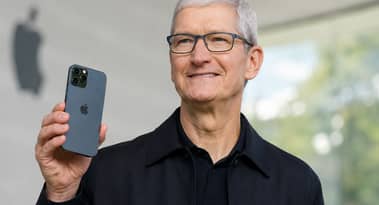
Apple shares AAPL fell 1.8% on Monday as John Ternus prepares to take over as chief executive, succeeding Tim Cook after more than a decade at the helm.
Ternus will assume control of a company valued at nearly $5 trillion, making sustaining Apple's growth from its current scale one of his biggest challenges.
The incoming CEO inherits a business that has expanded significantly under Cook.
Apple sold about 72 million iPhones in the year Cook became CEO, while Counterpoint Research estimates the company will sell 255 million this year.
Cook's tenure has also been defined by disciplined capital allocation, regular product launches and a substantial expansion of Apple's services business. T
he company has returned more than $1 trillion to shareholders through dividends and buybacks.
However, investors are now looking for Apple's next major growth driver, particularly as artificial intelligence reshapes the technology industry.
Ternus faces Apple's AI challenge
One of Ternus's immediate priorities will be Apple's artificial intelligence strategy, particularly the development of Siri.
Futurum Group CEO Daniel Newman said Apple needs to identify the next major computing platform after the smartphone. "Apple needs to own this," Newman said in a CNBC interview, adding that he believes this is Ternus's "big job."
Newman argued that Apple currently occupies an important position as the "experience layer" for AI because consumers increasingly use services such as ChatGPT and Claude through Apple devices.
However, he said the company has yet to fully capitalize on that position.
Apple has announced software improvements designed to make Siri capable of completing more tasks.
Early tests of the Siri AI beta by the Wall Street Journal found that it could take longer than competing assistants, although Apple's use of Google technology on the backend has significantly improved its capabilities.
Newman said Apple's bigger challenge goes beyond Siri and concerns whether the iPhone itself will remain the central device for computing.
"Is the handset going to be the device of the future?" Newman asked.
He pointed to efforts by OpenAI and Meta to develop new devices that could change how consumers interact with technology.
Valuation and supply chain risks
Apple's valuation presents another challenge for Ternus.
The stock trades at 33 times next year's earnings, compared with about 20 times for the S&P 500, even though Apple's earnings are growing at roughly half the market's rate.
Craig Moffett of Moffett Nathanson said investors have been willing to pay a premium for Apple because it appears relatively safe amid uncertainty over returns from massive AI investments.
However, he cautioned, "when valuation gets stretched, safety isn't safe anymore."
Apple is also dealing with pressure across its supply chain.
AI companies are competing for memory, storage and logic-chip capacity, potentially increasing Apple's costs and contributing to shortages. The company has passed some higher costs on to consumers.
Apple's continued dependence on China is another issue facing Ternus.
While Cook has largely managed tariff-related risks through political engagement, much of Apple's supply chain remains concentrated in China amid an ongoing US-China trade conflict.
The company's services business is facing pressure as well. A California judge's rulings have reduced Apple's ability to collect fees from some in-app purchases. Appfigures estimates that Apple's US App Store commission revenue fell 6% in the June quarter.
New products offer opportunities
Despite these challenges, Apple enters the transition with several strengths.
The iPhone remains highly popular, with the iPhone 17 Pro benefiting from improvements including a better camera and stronger battery.
The Mac is also seeing renewed demand as Apple-designed chips prove capable of running large language models locally, contributing to product shortages.
A foldable iPhone is also expected to feature in Ternus's first iPhone launch event.
IDC estimates the device could capture 40% of the foldable smartphone market by the end of 2027.
Newman said Ternus also faces a high bar following Cook's tenure. He credited Cook with building Apple's global supply chain and strong unit economics, while noting that Ternus's background in hardware and engineering gives him a different skill set.
"We've seen the headsets kind of flop. Cars didn't work out. Apple's smart home never really became a thing," Newman said, highlighting Apple's difficulty in creating successful new product categories.
Apple's stock has gained more than 2,200% during Cook's tenure, although Newman said it has lagged several Magnificent Seven peers. He also estimated that Apple spent about $877 billion on share buybacks during that period.
For Ternus, the task is therefore not simply to maintain Apple's existing businesses, but to establish where the company's next phase of growth will come from as AI changes the technology landscape.

SpaceX stock gains as Bernstein maintains bullish outlook

Strategy (MSTR) stock gains after resuming Bitcoin purchases after 10 weeks

Dell stock flags bearish divergence pattern as earnings loom: will it rise or fall?

Nvidia stock rises as company announces $3.5B investment in MediaTek

Credo Technology stock: Insider selling meets options market jitters before earnings
No results found
Loading articles...
Failed to load articles. Please try again.