
AUD/USD signal: forecast as RBA and Fed rate hike odds rise

AI Sentiment: 35/100 Bearish
This score is generated through AI-driven analysis of the article's content.

powered by

Sell AUD/USD. Higher odds of both RBA and Fed hikes push the market toward tighter USD policy and less room for AUD to rally; strong Aussie data is already “priced,” while the article flags elevated inflation and renewed oil/energy pressure that can keep both central banks hawkish. Technicals also point to a bearish reversal (rising wedge convergence, PPO bearish crossover, RSI rolling over). Target 0.700 support.
Key Risk: A sharp risk-off move that weakens the USD (or a surprise dovish Fed/RBA shift) that drives AUD/USD back above 0.7207.
Sell AUD exposure via AUD/JPY (or AUD futures). The news ties the hawkish rate repricing to higher oil after US-Iran activity; that supports global growth but also keeps inflation sticky, which tends to keep JPY relatively supported versus high-beta AUD when rates are uncertain. With AUD/USD set up to break lower, AUD/JPY should follow on the same rate-and-risk repricing.
Key Risk: Oil spikes further and triggers a broad commodity/risk rally that lifts AUD/JPY despite the wedge/oscillator bearish setup.
- The AUD/USD pair has formed a bearish reversal pattern.
- Traders are betting that the Fed and RBA will hike interest rates.
- Technicals suggest that the pair may drop in the near term.
The Australian dollar held firm today, September 3rd, as investors adjusted their RBA and Federal Reserve expectations for the year. The AUD/USD pair was trading at 0.7165, a few points below the August high of 0.7207.
RBA rate hike expectations rise
Traders are bracing for interest rate hikes from the Federal Reserve and the Reserve Bank of Australia (RBA) happening as soon as this month.
Polymarket gives the odds of RBA’s rate hike happening in September rose to 67%. These odds jumped after the US and Iran resumed their kinetic activity, which led to higher oil prices.
Australia has also published strong macro numbers this week. An S&P Global report showed that the services PMI came in at 53.2 in August, higher than the expected 52.9. A PMI reading of 50 and above is usually a sign that a sector is growing. The composite PMI came in at 52.7, also higher than the expected 52.50.
Another report released on Wednesday showed that the Australian economy expanded by 2.1% in the second quarter, higher than the expected 1.8%. It grew by 0.4% in Q2 after growing by 0.3% in Q1 on a QoQ basis.
This growth happened even as the Reserve Bank of Australia (RBA) became the most hawkish central banks this year. It has already delivered three rate hikes this year, with officials leaving the door open for more hikes.
A key concern is that Australia’s inflation has remained at an elevated level in the past few months. This trend will likely continue now that the US and Iran have restarted their kinetic activity, leading to higher energy prices. Brent, the global benchmark, rose to $95.68, while the West Texas Intermediate (WTI) rose to $91.
Odds of Fed rate hikes rising
The same situation is happening in the US, where odds that the Fed will hike rates this month have jumped to 55% on Polymarket. These odds soared after Kevin Warsh delivered a highly hawkish statement at the Jackson Hole Symposium.
In it, he hinted that the bank was concerned about the state of inflation, which has remained above the 2% target in the past five years.
Focus now shifts to the upcoming US nonfarm payrolls (NFP) report that will provide color on the labor market. Economists expect the data to show that the economy created over 80k jobs in August this year.
AUD/USD technical analysis
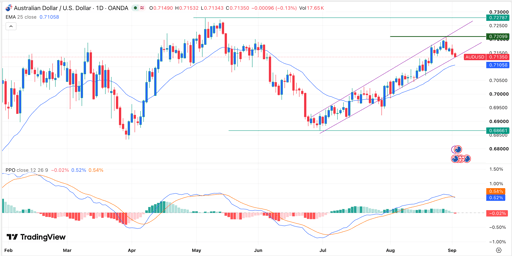
AUDUSD chart | Source: TradingView
The daily chart shows that the AUD/USD pair may be on the verge of a bearish reversal in the coming days. For one, it has formed a rising wedge pattern whose two lines are about to converge.
Also, the two lines of the Percentage Price Oscillator (PPO) have made a bearish crossover, while the Relative Strength Index is pointing downwards.
Therefore, the most likely scenario is where the AUD/USD pair falls, potentially to the key support of 0.700.

Credo Technology stock has slipped after earnings: how low can it get?
Snowflake stock forms bearish divergence as earnings loom: will it rise or crash?

HPE stock forms rare cup-and-handle pattern as Dell earnings set up key catalyst

Here’s why Rolls-Royce share price is falling and what may happen next

NZD/USD signal: forecast as RBNZ hikes rates as New Zealand bond yields jump
No results found
Loading articles...
Failed to load articles. Please try again.